You may not control all the events that happen to you, but you can decide not to be reduced by them.” — Maya Angelou
Everywhere you turn, there seems to be possible sources of anxiety. Recent clients have brought up anxiety related to politics, weather events, family conflict, job-related stressors, acts of public violence, and so on. If you are looking for a reason to be anxious, you don’t need to look far.
It can be incredibly easy to get sucked into an anxiety spiral when our focus is on all the things we worry about. And once we’re in that spiral, it can be incredibly difficult to get out of it. I have added and will continue adding ideas for avoiding the anxiety spiral, and getting out of it (see here). One idea is to focus on what you CAN control.
First, let’s look at just a small sample of things that are outside of our control:
I cannot who is president. I cannot control what difficult task my manager assigns to me. I cannot control the never-ending heat or tornados. I cannot control my spouse’s words when we are arguing. I cannot control if my neighbor gives me a dirty look when she sees me outside.
I could go on and on and on, but you get the idea: there is SO much in our lives that we are unable to control, no matter how hard we might try.
When we focus on those things, it’s easy to feel anxious, stressed, worried, frustrated, and hopeless. However, if we can switch our focus to what we CAN control, it’s likely that we’ll begin to feel less dysregulated, more positive, and more like ourselves.
So what CAN we control? I’ll be honest, when you make a list of what you CAN control and a list of what you CANNOT control, sometimes the latter feels very overwhelming. BUT there ARE things we can control.
I can control who I spend time with.
I can control how I speak to others and about others.
I can control how I speak to myself and about myself.
I can control what I spend my time doing.
I can control my thoughts (though this may be difficult sometimes).
I can control the amount of water I drink.
I can control what foods I choose to eat to fuel my body.
I can control the amount of sleep I get.
I can control the amount of time I look at a screen.
I can control the amount of exposure I get to the news.
I can control what coping skills I use.
I can control the amount of time I spend on social media.
I can control who I follow on social media.
I can control how much physical activity I get each day.
I can control what boundaries I set with other people.
Back in 2020, I saw the below image making the rounds on social media (source is at the bottom of the image). What a time to be alive, right? COVID hit, and so many things that were outside of our control changed.
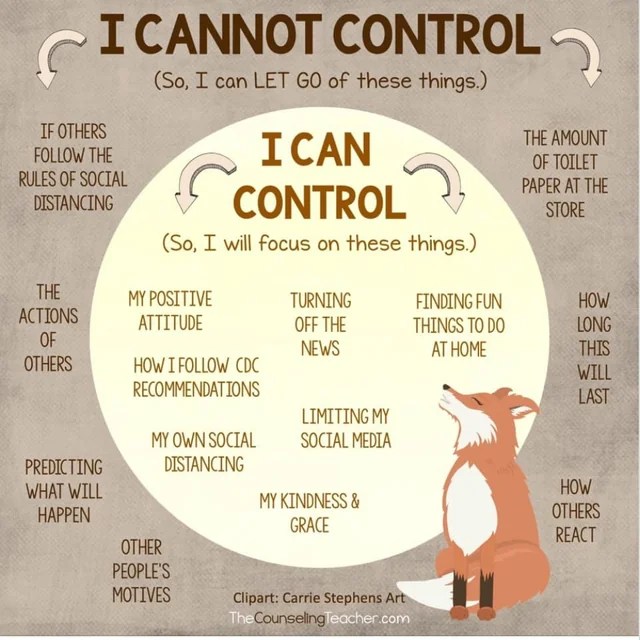
Those things outside of our control could feel SO big, SO heavy, SO overwhelming. Many people, though, found comfort in focusing on what they COULD control. It’s a tactic that can work well in lots of different situation. And see at the top where it says “So, I can LET GO of these things” in parentheses? First of all, easier said than done, right? BUT TRUE.
I believe self-talk is one of the greatest tools we have to tackle negative thinking and anxiety. It can be monumentally helpful to have a script to help you focus on what you can control. Maybe it will sound like this:
“Self, you cannot control ______. That’s a fact. So Iet’s choose to focus on _____ instead, because that is something you can control.”
Make it your own, and use it as a script to pull your focus back to what is within your control. If you’re struggling, reaching out to a family member or a friend who may help you identify what is within your control can help. Of course, a mental health provider can also help with this strategy.
Drop a comment with your script, or something within your control that you’re choosing to focus on!
Disclaimer: I am a licensed independent mental health practitioner and certified professional counselor, but I am not your therapist. The information in this article is for general informational purposes only. This article does not create a therapist-client relationship. If you need specific recommendations based on your individual circumstances, please consult with a mental health practitioner near you.
 Krista H Counseling