Does anyone else struggle with decisions? I often joke that I have “decision fatigue.” As is typical with anxiety, it’s the “what if” questions that get to me. What if I make the wrong choice and regret it? What if there’s something I’m not considering? What if someone judges me for making this choice?
Sometimes it seems less uncomfortable to consult a magic 8 ball or flip a coin! Let something or someone else make the decision! You know why, right? Because then the responsibility is off our shoulders and we have someone else to blame if it all goes wrong.
As someone who is resistant to making decisions, I love a good pros and cons list. I love hand writing out advantages and disadvantages to something, and being able to look at which list is longer and seems more meaningful/impactful.
I recently took a Dialectical Behavior Therapy certification class and learned how to level up my pros and cons list. Instead of just one row of two columns, one for “PROS” and one for “CONS,” the DBT pros and cons list has two columns AND two rows. It’s a two by two grid. So you’re able to put the pros and cons of two actions (completing the urge and not completing the urge).
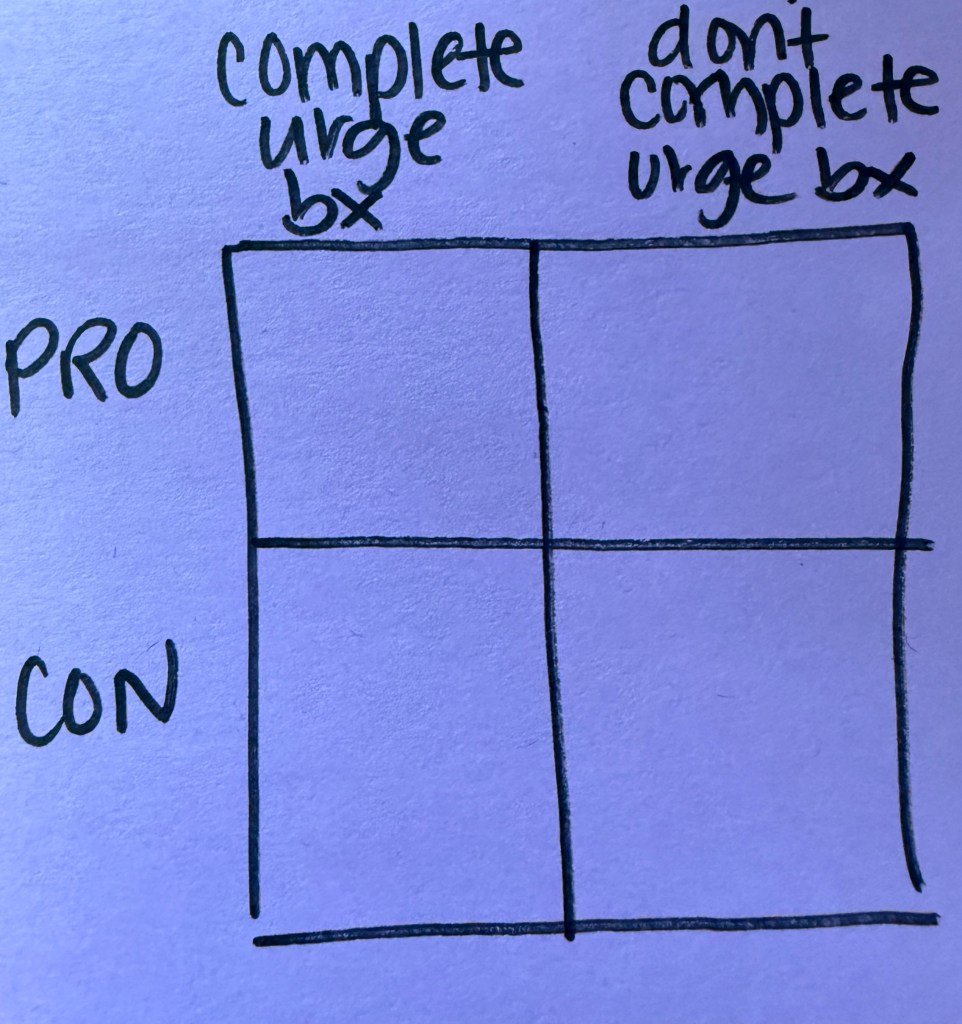
The DBT pros and cons list was designed to challenge urges (specifically unhealthy urges such as self-harm behavior and substance use). So you’ll see “complete urge bx” (“bx” = behavior in clinical writing) above the left column and “don’t complete urge bx” above the right column. Then top row is for PROs and bottom row is for CONs.
For example, someone with a history of addiction and substance use who is feeling the urge to drink alcohol, would use this grid to look at both the pros and cons of drinking, and the pros and cons of not drinking. Take a couple of minutes to think about what the pros and cons would be for both behaviors.
Using the pros and cons list for these behaviors can be less about determining what the “best” course of action is, and more about prompting your brain to remember the WHY. When considering self-harm behavior or engaging in substances, the short-term pros of the urges may not be worth the long-term consequences, but it can be hard to remember that sometimes! Making this pros and cons grid helps someone look at the big picture and can increase motivation to resist urges and impulses that you may regret later.
I think this form of a pros and cons list can be generalized to other things as well to help make informative decisions.
Do I confront a friend about something hurtful they said? What are the pros and cons or confronting them and the pros and cons of not confronting them.
Do I begin anxiety medication? Obviously talk to a prescribing physician about this, but if you’re on the fence maybe looking at the pros and cons of starting meds and the pros and cons of not starting meds will help.
Do I pick ________ or ________? Maybe you’re deciding between two jobs, two colleges, two cities to move to. You could look at the pros and cons of options you’re considering.
- Some questions to help you fill out the pros and cons grid:
- What are some of the immediate benefits of this choice?
- What are some of the long-term benefits of this choice?
- What are some immediate negatives of this choice?
- What are some of the long-term negatives of this choice?
- What will these choices cost me?
- What about each of these choices will feel good (or not good)?
I absolutely do not mean to detract from using the DBT pros and cons list as a way to assess urges for self-harm or substance abuse. This is obviously a very helpful tool for that.
However, I think it can be helpful for other choices as well. I walked a client through a pros and cons list about confronting his mother about a comment she made that he found hurtful. We looked at the short term and negative terms benefits and downsides of confronting her, and he was able to come to a decision that he felt good about.
If you find yourself struggling with an urge or decision, consider using the DBT pros and cons grid to help you consider all aspects of the decision. It might help!
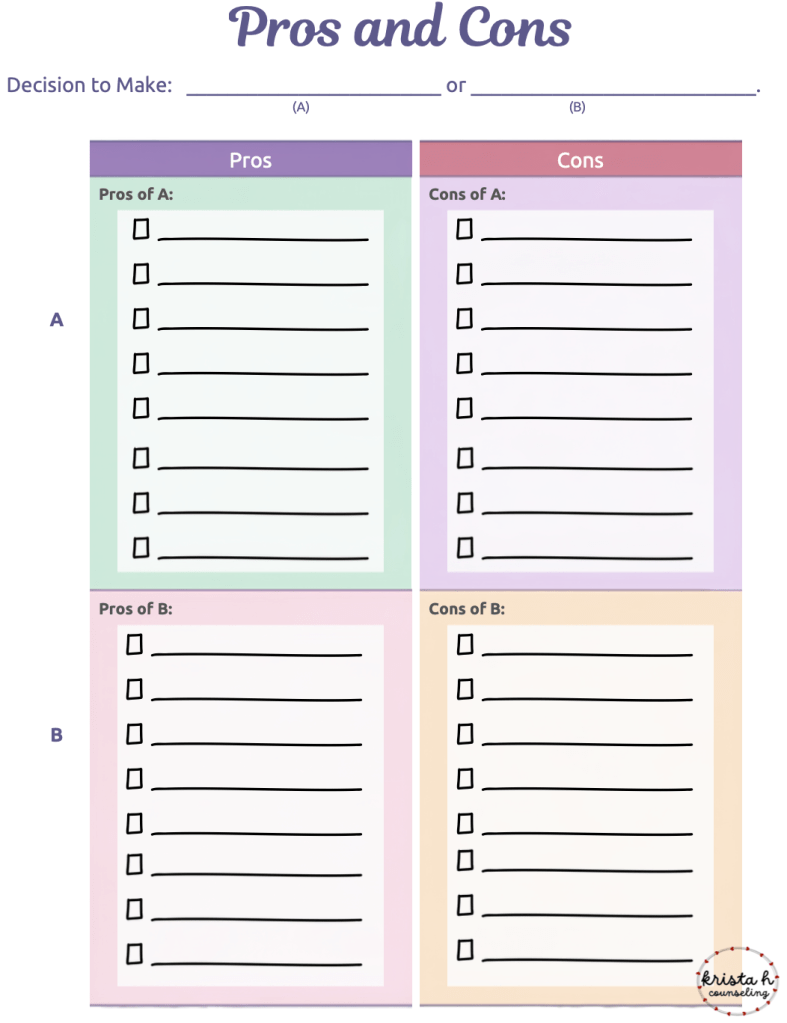
Below is a free printable pros and cons grid for your use. Note that, unlike the grid example above, the choices are rows, with the pros being on the right column and the cons being on the left column.
Thanks for reading!
Disclaimer: I am a licensed independent mental health practitioner and certified professional counselor, but I am not your therapist. The information in this article is for general informational purposes only. This article does not create a therapist-client relationship. If you need specific recommendations based on your individual circumstances, please consult with a mental health practitioner near you.