The last post published was Coping Skills Reminder Signs, and towards the end, I realized that I did not have an extensive list published of coping skills… and I cannot believe I’ve gone this long without making one. It’s really hit-or-miss online finding a list of coping skills for kids. Don’t get me wrong, there are some good ones out there, but I’ve had a hard time finding free, printable lists of more than 15-20 coping skills. So if you’re looking… voila, here it is.
You may call these “calming strategies,” “calming skills,” “calming techniques,” “coping strategies,” or something else. What you call them isn’t important… what IS important is that they help your child (or you!) calm down. As a therapist, I always tell clients, both children and adult, that coping skills don’t work the same for everybody. What works for me may not work for you. What works for you may not work for your kiddo. What works for one of your kiddos may not work for your other kiddo. Sometimes it’s a little bit of trial and error to figure out what works.
So here are 75 coping skills for kids to try. Usually, I recommend picking a few to try, then keeping track of what works and what doesn’t.
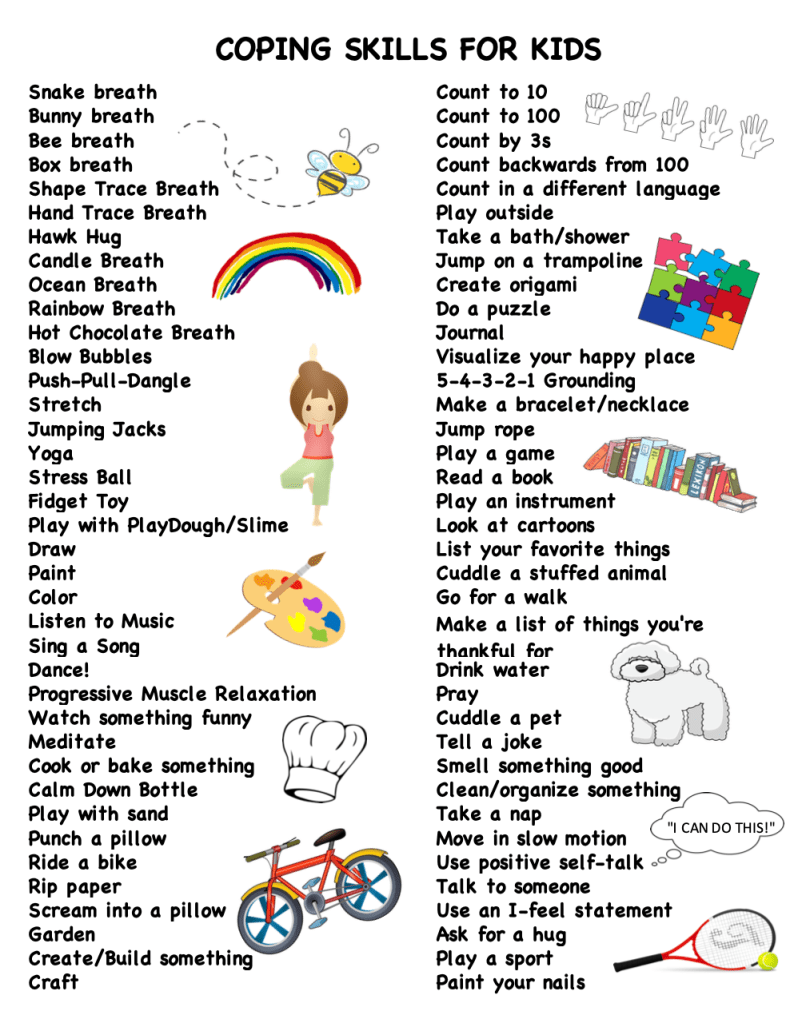
You can download this (with logo) to print by clicking here.
Not all of these may look familiar to you, so here is a list of them with explanations or links:
- Snake breath – take a big, deep breath, then release it while make a “ssssssss” sound, like a snake
- Bunny breath – take a breath by taking 3-4 little “sniffs” through your nose, then let the breath out through your nose
- Bee breath – plug your ears, take a big, deep breath, then release your breath while making a “mmmm” sound
- Box breath – breathe in for four seconds, hold for four seconds, then breathe out for four seconds
- Shape Trace Breath – trace a shape (i.e., star, triangle, hexagon) while take deep breaths
- Hand Trace Breath – trace your hand/fingers while taking deep breaths; breathe in while traveling up a finger and breathe out while traveling down the length of your finger
- Hawk Hug – hug yourself like you love yourself! Hug yourself by placing your right hand on your left shoulder and your left hand on your right shoulder. Take a few deep breaths, then gently and slowly pat your shoulders with your hands, alternating sides.
- Candle Breath – hold your hand in front of you like you’re holding a candle, then imagine blowing on the candle slowly and softly, so as not to blow it out
- Ocean Breath – hold your hands over your ears, then breathe in and out of your nose (this will create sounds like ocean waves)
- Rainbow Breath – hold your arms at your sides, arch them around and up over your head as your breathe in, then move them back down to your sides as you breathe out
- Hot Chocolate Breath
- Blow Bubbles
- Push-Pull-Dangle
- Stretch
- Jumping Jacks
- Yoga
- Stress Ball
- Fidget Toy
- Play with PlayDough/Slime
- Draw
- Paint
- Color
- Listen to Music
- Sing a Song
- Dance!
- Progressive Muscle Relaxation – tensing and release muscle groups. I usually recommend Angry Octopus (for young kids) or this YouTube video.
- Watch something funny
- Meditate (there are many guided meditations for kids on YouTube)
- Cook or bake something
- Calm Down Bottle
- Play with sand
- Punch a pillow
- Ride a bike
- Rip paper
- Scream into a pillow
- Garden
- Create/Build something
- Craft
- Count to 10
- Count to 100
- Count by 3s
- Count backwards from 100
- Count in a different language
- Play outside
- Take a bath/shower
- Jump on a trampoline
- Origami
- Do a puzzle
- Journal
- Visualize your happy place – have your child pick a place that makes them happy, then close their eyes and imagine they are there
- 5-4-3-2-1 Grounding
- Make a bracelet/necklace
- Jump rope
- Play a game
- Read a book
- Play an instrument
- Look at cartoons
- List your favorite things
- Cuddle a stuffed animal
- Go for a walk
- Make a list of things you’re thankful for
- Drink water
- Pray
- Cuddle a pet
- Tell a joke
- Smell something good
- Clean/organize something
- Take a nap
- Move in slow motion
- Use positive self-talk
- Talk to someone
- Use an I-feel statement
- Ask for a hug
- Play a sport
- Paint your nails
Some tips for getting your child to use coping skills:
- Practice when they’re happy/in a good mood!
- Model these for your children – they’re more likely to do something if they see you do it.
- Praise your child for using coping skills!
- Prompt your child to use a coping skill when you see them getting upset.
- Consider making a Coping Skills Reminder Sign.
I hope this is a helpful list! I’d love for you to leave me a comment with the coping skill that works best for your child!
Disclaimer: I am a licensed mental health therapist, but I am not your therapist. The information in this article is for general informational purposes only. This article does not create a therapist-client relationship. If you need specific recommendations based on your individual circumstances, please consult with a mental health practitioner near you.


Thank you for this resource that is simply worded in terms any parent can comprehend and follow. I plan to share this with parents I work with in Head Start Child Development Centers.
LikeLiked by 1 person
Thank you so much for this comment! I appreciate it, and am happy to provide these resources!
LikeLike
hal yang akan saya hentikan mungkin untuk tidak menegur atau memarahi di tempat umum dan akan memberikan waktu untuk ananda mengungkapkan apa hal yang telah terjadi
LikeLike
(Saya menggunakan Google Translate, jadi saya minta maaf atas kesalahan dalam tanggapan saya): Terima kasih atas komentar Anda! Saya sangat setuju dengan Anda. Mempermalukan orang di depan umum bisa sangat merugikan, dan saya sarankan, seperti yang Anda nyatakan, untuk menyimpan percakapan sulit tersebut dalam suasana pribadi.
Original comment in English: The thing I would stop doing is probably not to reprimand or scold in public and would give your child time to express what has happened.
My response in English: (I used Google Translate, so I apologize for any errors in my response): Thanks for your comment! I totally agree with you. Publicly shaming people can be very damaging, and I suggest, as you stated, to keep those difficult conversations private.
LikeLike