I love using Inside Out when working with kids on emotion identification and emotion regulation. It’s a fun movie and kids generally have a positive response when they see any of the characters from Inside Out, which mean the activity usually goes rather well.
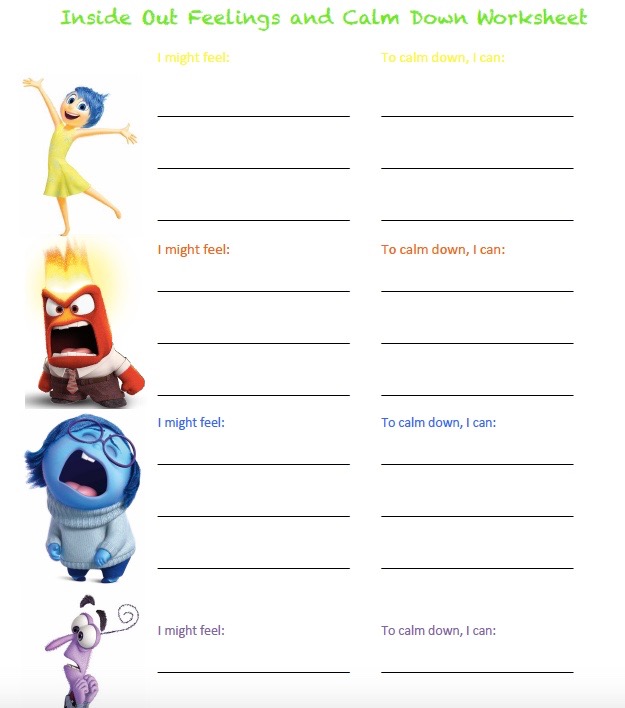
I have created this worksheet to help kids identify how they’re feeling, how their body might be feeling, and some calming strategies they can use to help calm down. This is similar to the Inside Out Feelings Book that I posted, but this worksheet is all on one piece of paper… and the reason for that is that I thought it would be nice to print this worksheet out and put it somewhere in the home (on the fridge, maybe?) as a visual prompt from kiddos.
Download it here: Inside Out Feelings and Calming Strategies Worksheet
What I would do is sit down and help your kiddo fill in the blanks on the worksheet – for each of the four emotions (joy, anger, fear, sadness) there are 3 lines to write in body signals (how their body feels when they feel that emotion) and 3 lines to write an appropriate calming strategy. Some of the body signals and calming strategies might overlap, but it would probably be beneficial to make sure there’s some variety!
Once it’s all filled out, put it somewhere your kiddo can see it. Then, when you notice your child getting upset, prompt them to go find their Inside Out Feelings Worksheet, identify how they feel (help them, if needed due to age or development), then identify a calming strategy to use to calm down.
 Krista H Counseling
Wow that was odd. I just wrote an incredibly long comment but after I clicked submit my comment didn’t show up. Grrrr… well I’m not writing all that over again. Anyways, just wanted to say great blog!
LikeLike
joyful- to calm down, I can?
LikeLike
Sometimes, especially with kids, that joyfulness/happiness can get a bit too BIG (and usually the consequence is not being able to pay attention or some other “undesirable” behavior). It’s GREAT to be happy and joyful, but if kids get too antsy/excited, some deep breaths or a different coping skill can help them get to a place where they can be happy, but still function in whatever setting they are in. We don’t need to use coping skills every time we feel happy/joyful! Thanks for asking about this!
LikeLike