Anxiety: Symptoms in Children/PreTeens/Teens

All it takes is a quick Google search to find several articles indicating that anxiety is on the rise in children and teenagers.

An article from the American Psychological Association states:

“Even before the COVID-19 pandemic, growing numbers of young people were experiencing high rates of clinical-level anxiety. About 11.6% of kids had anxiety in 2012, up 20% from 2007. But during the pandemic, those numbers nearly doubled, such that 20.5% of youth worldwide now struggle with anxiety symptoms…”

Children across the nation are experiencing symptoms of anxiety at an increasing, and alarming, rate. Here are some examples of triggers from some of my preteen/teen clients:

  • Anxiety due to bullying at school
  • Anxiety due to parent’s financial troubles
  • Anxiety due to school performance/expections
  • Anxiety due to conflict within their friend group
  • Anxiety due to business/feeling overwhelmed with school, work, extracurriculars
  • Anxiety due to watching news coverage of traumatic events
  • Anxiety due to conflict between their parents
  • Anxiety due to not feeling like they “fit in”
  • Anxiety about body image/weight/clothing size

Because of this increase in anxiety researchers are seeing in children, I thought it prudent to write a series on anxiety in children, pre-teens, and teenagers. Warning: it is always best to consult a medical/mental health provider if you believe your child has anxiety. Leave the diagnosing to the professionals (doctors, psychiatrists, psychologists, therapists, counselors, social workers). I include a post about symptoms not so that you can diagnose your child, but so that you can be aware of what to look for and reach out for help if needed.

To start, here is a list of symptoms for Generalized Anxiety Disorder (GAD) from the Diagnostic and Statistical Manual of Mental Disorders Fifth Edition Text Revision (DSM-5-TR):

  • Excessive anxiety and worry occurring more days than not for at least 6 months
  • Restlessness or feeling keyed up or on edge
  • Being easily fatigured
  • Difficulty concentrating or mind going blank
  • Irritability
  • Muscle tension
  • Sleep disturbance

To meet diagnostic criteria according to the DSM-5, individuals must be experiencing the first symptom, plus at least three of the six other symptoms. The symptoms must be causing them distress or impairment in social, occupational, or other important areas of function. Lastly, the symptoms must not be explained by substances or another mental disorder.

If you seek help from a professional, they will use the DSM-5-TR to make a formal anxiety diagnosis. However, there are many other symptoms kids can report that can indicate an anxiety concern. Symptoms I’ve had reported to me by anxious preteens/teens include:

  • Headaches (often caused by muscle tension)
  • Stomachaches
  • Feeling self-conscious or very sensitive to criticism
  • Avoiding situations/places/people
  • Clingy behavior/reassurance seeking
  • Change in appetite
  • Emotional outbursts
  • Hyper-focused on “perfection”/being perfect
  • Anxiety/panic attacks (these can feel different for different people)
  • Racing thoughts
  • Fidgeting

Other symptoms can be experienced, but these are the ones commonly reported to me by my clients.

I’d like to point out that just because your child/preteen/teenager experiences some or a lot of these symptoms doesn’t mean that they have anxiety or could meet diagnostic criteria for an anxiety disorder. I personally experience several of these symptoms, sometimes on a daily basis, but do not meet criteria for an anxiety disorder. This can make diagnosis hard.

The other thing that can make diagnosing tricky is that many of these symptoms overlap with symptoms of other disorders. This is why diagnosing is best left to the professionals. For example, change in appetite, difficulty concentrating, and sleep disturbance are also symptoms of depression (I’m hoping to do a similar series on depression when we’ve wrapped up anxiety, so keep checking back for that!).

So why is this important to know? My personal opinion is that awareness is important because knowing the symptoms means that you can recognize them and get help faster than if you aren’t aware. Generally with anxiety, the sooner you get help for mental health concerns, the faster you progress in treatment. This isn’t always the case, but it’s much easier to treat anxiety in its early stages than it is if someone has been dealing with anxiety for 2-3 years and it’s reached a higher severity.

A point I want to make is that EVERYONE has anxiety. Some anxiety is healthy. If you didn’t have any anxiety, you might cross the road without looking for cars. Anxiety helps us prepare for the future and prevent harm on a daily basis. The catch is that a “normal” level of anxiety does not cause distress. Remember that piece of diagnostic criteria from the DSM-5-TR… the anxiety must be causing distress or impairment in social, academic, work, or other settings.

So if you notice these symptoms, talk to your child and perhaps a coparent. Decide if the symptoms are causing distress or if they are a barrier to your child being successful at home, school, work, or socially. If the answer is yes, I’d recommend reaching out to a mental health professional for an evaluation and to discuss treatment options.

Stay tuned for posts about treatment options for anxiety, how to support your child with anxiety, and coping skills specifically for anxiety.

Disclaimer: I am a licensed mental health therapist, but I am not your therapist. The information in this article is for general informational purposes only. This article does not create a therapist-client relationship. If you need specific recommendations based on your individual circumstances, please consult with a mental health practitioner near you.
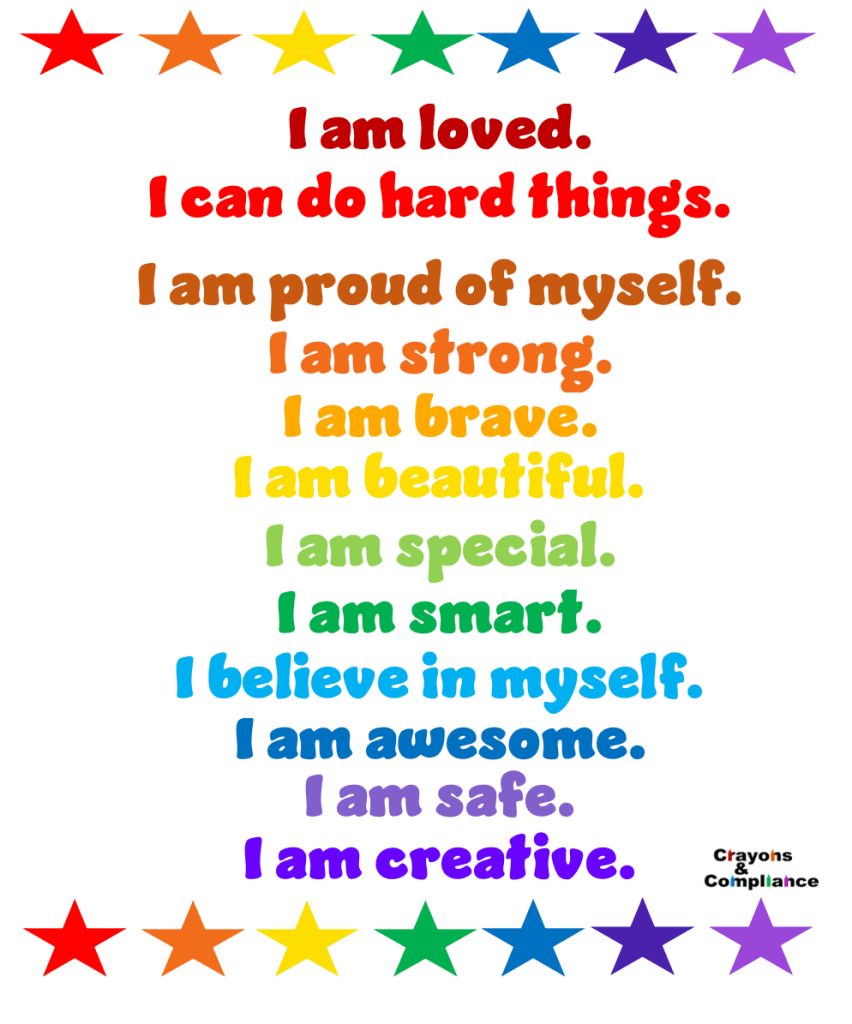
Affirmations for Kids (FREE FUN Printable)

As a CBT therapist, I recommend affirmations to many of my clients, and also use them myself. We have the ability to think negatively, and this affects the way we feel about ourselves. Our children receive direct and indirect messages daily that may lead them to feel badly about themselves. It happens and there’s not much we can do to control it.

But what we can control is making sure that we balance out the negative with positive self-talk. One form of self-talk is affirmations. Affirmations are positive statements that we think or say about ourselves, others, or the world around us. Typically when I recommend affirmations, they are specifically targeted to increase positive thoughts about that individual (not typically about others or the world).

Affirmations can be incredibly helpful for children, even if they don’t realize it. When you fill your brain with positive thoughts, not only is that a period of time when you’re NOT thinking negatively, but it also makes it more like that you will think more positively about yourself in the future. It doesn’t happen over night, but consistently saying/thinking positive affirmations can make a huge impact in increasing self-esteem.

How do you know what to say? Affirmations can be a little tricky, especially for adults, because what resonates with one person may not resonate with another. The good news with kids is that we get to keep them simple, especially for younger kids. Keep it simple so it’s not confusing and so they can remember it. You can find some simple affirmations below (and a free printable!). If you are interested in other affirmations, a quick google search will yield hundreds of other options. Or… you can engage your kid in writing their own, with your help if needed.

Here are some simple affirmations:

I am loved.

I am special.

I am strong.

I am brave.

I am accepted.

I am important.

I am smart.

I am kind.

I am special.

I can do hard things.

I am safe.

I am creative.

I am beautiful/handsome.

I am proud of myself.

I believe in myself. I am awesome.

I’ve also created a printout with (most of) these affirmations. It’s colorful and fun:

You can click here to download/print this. You can click here for the same printout, but with “handsome” instead of “beautiful.”

When to say these? I usually recommend making them part of a daily routine. I find that for my family, bedtime is the easiest time to add affirmations. Our mornings are rushed, and it’s difficult for us to remember during other parts of the day. Bedtime works for us. I have this printed and on the wall in my daughter’s bedroom and we say these each night before bed. You can also have your child say these on an add-needed basis, like if they are feeling sad or had a bad interaction with someone that left them doubting themselves.

Lastly, kiddos aren’t always great about remembering to do things, so prompt your children. It may also help to actually say the affirmations WITH them. Your children are more likely to do things if they see you do it as well. Also, if your child is resistant, you can try to make it fun. Whisper affirmations, yell affirmations, sing them, say them in a silly voice. It will still have the same benefits.

Good luck! Drop a comment with YOUR favorite affirmation, either for you or a young one in your life.

Disclaimer: I am a licensed mental health therapist, but I am not your therapist. The information in this article is for general informational purposes only. This article does not create a therapist-client relationship. If you need specific recommendations based on your individual circumstances, please consult with a mental health practitioner near you.

Self Esteem Daily Worksheet (FREE printable)

From my experience in working with children, especially those in middle school and high school, issues with self-esteem are fairly common. The culprit? Well, to be honest, the majority of the time it’s their own unhealthy thinking patterns. Once those negative thoughts start, if you don’t stop them, they snowball and will have a negative impact on the way you feel and on your overall self-esteem.

From my work with school-aged clients, it’s mostly interactions with peers at school that trigger these negative thoughts. It doesn’t have to be bullying incidents – even hearing a friend compliment another friend’s hair, but NOT complimenting yours can send out a rush of negative thoughts. Or seeing another classmate get attention for their new, fancy, expensive phone, while you are stuck without one or stuck with last year’s model. Yes, bullying and snide comments from other students hurt tremendously and have a devastating affect on self-esteem, but they aren’t necessary for self-esteem to suffer.

It’s not just interactions with classmates though. Self-esteem can be impacted by all sorts of things, including school performance, interactions with siblings, and interactions with parents. As if that wasn’t enough, another big culprit is social media. Most people walk away from periods of social media scrolling feeling worse about themselves than they did before they logged in. The comparison game is to blame. We compare the whole of our lives to someone’s highlight reel – and sometimes the people we compare ourselves to have tools at their fingertips that we don’t, like hairstylists, personal trainers, makeup artists, personal chefs, and photoshopping tools.

Because it’s actually the negative thoughts about these interactions that affect self-esteem, it’s important to try to balance those negative thoughts with positive ones. How? By prompting your brain to do so. You cannot think 2 thoughts at the same time, so if you’re “forcing” your brain to think about something positive, you cannot be thinking negatively at the exact same time. But try telling your 13 year old to think of something positive…. it’s hard! At any age! Even adults struggle with what to think about, even if they know it would help to think of something more positively.

That’s where this worksheet comes in. Instead of struggling to think about something, this worksheet gives them something to think about – and it’s positive things about themselves. Double win. As you can see below, there are 4 “boxes,” each with a prompt to list 4-5 things about themselves. Five of their favorite things about themselves, 4 things about themselves they are proud of, 5 things they are good at, and 4 reasons they are special.

You can click here for the free printable!

This is something that can be done all at once, or one box at a time over the course of 4 days… or, really, however you and your child want to do it. Once completed, it can be helpful to hold onto the worksheet and keep it around, so that your child can look at it when they’re having negative thoughts about themselves. This completed worksheet can be a great reminder about why they’re so awesome, and looking at it may help get rid of those negative thoughts.

As always, if you believe your child needs some professional help and/or expresses a desire to talk to a therapist/counselor, please seek help. You can read the post on my counseling blog site called How to Find a Therapist if you need/want guidance with finding a provider.

Disclaimer: I am a licensed mental health therapist, but I am not your therapist. The information in this article is for general informational purposes only. This article does not create a therapist-client relationship. If you need specific recommendations based on your individual circumstances, please consult with a mental health practitioner near you.
Social Skills Series: Greeting Others

The next social skill in this Social Skills Series is Greeting Others. If you need a reminder on what social skills are and why they’re important, read Social Skills Series: Introduction.

Lately, I’ve seen many “jokes” about how the younger generations aren’t learning how to interact face-to-face, because they spend so much time on devices. I say “joke” in quotation marks, because it may be a little humorous, but it’s also really sad. Devices aren’t going away any time soon, but I truly believe that we can find balance – we can be on devices AND also know how to appropriately interact with others. One such interaction is Greeting Others.

There are many great rationales for why it’s important to greet others appropriately. For one, it’s a great way to make a first impression! If you can maintain eye contact, smile, and greet someone politely while speaking clearly, you’re likely to make a good impression on the person you’re greeting. It’s a good first step towards making a new friend, a new connection, or landing a new job. Greeting others helps us connect to those around us. It also shows that you care, and can brighten someone’s day.

With social skills, it can be helpful to break the skill down into steps. You can personalize these, but here’s an example of a set of steps for greeting others:

  • Look at the person
  • Smile
  • Say a greeting (e.g. “good morning” or “hello”)

It’s very common for kids to struggle with maintaining eye contact or a hard time speaking clearly. Or both! It doesn’t mean anything is “wrong,” it just means they need some practice.

Practicing the skill of greeting others typically involves role playing. The phrase “role playing” usually makes me roll my eyes and want to run away, but when doing this with kids, it can be so fun!

  • You can put on different shirts/hats/accessories and pretend to be other people to practice greeting each other.
  • You can use different voices/accents to practice greeting each other.
  • (or combine the first two for LOADS of fun)
  • You can also practice this with dolls or stuffed animals – pretend they are greeting each other.
  • It’s also a lot of fun (and super silly) to practice the WRONG way to greet each other – running away, closing your eyes, yelling, whispering, saying “bad morning,” etc. Kids get a kick out of this. Just make sure you follow up with practicing the “right” way.

Remember to praise and reward (optional) your child when they are successful! You want to praise every time they make it through the steps to greeting others. If they aren’t successful with all steps, praise them for the ones they got right, and give feedback on the one they didn’t (this would sound like, “Wow! You did a great job of making eye contact and smiling. Let’s try it again and can you speak a little louder this time?).

If you want to, you can use any reward – my recommendation would be to use a reward for a certain number of successes. Such as, five successful times of greeting earns a reward. You can even give a sticker for each success, then give a reward when they earn a certain number of stickers. Five stickers may equal ten extra minutes of tv time (or any other reward you want to use).

Some TIPS for practicing this social skill:

  • Practice when your child is calm/in a good mood. Practice will probably not go well if your child is grumpy or just got in trouble for something.
  • Make sure to praise you child!
  • Try to make it fun! If your child becomes uncooperative at any point, just end the practice and revisit it later.

Good luck! Drop a comment with any other fun ideas for practicing this important social skill!

Disclaimer: I am a licensed mental health therapist, but I am not your therapist. The information in this article is for general informational purposes only. This article does not create a therapist-client relationship. If you need specific recommendations based on your individual circumstances, please consult with a mental health practitioner near you.
Positive Consequences vs. Negative Consequences

Did you know that there are BOTH positive consequences AND negative consequences? I’m going to guess that you may not have known this. No shame – I had no idea until my extra training in behavior modification! This is similar to the concept of reinforcement, which can be both positive and negative (if you’re interested, you can read about that here).

Most people hear the word “consequence” and think “punishment.” This CAN be true, but consequence doesn’t always equal a form of punishment. A consequence (more specifically, a negative consequence) can be a punishment, but consequences can also be positive too!

It’s really no wonder that most people think consequences are always bad. How many times have you heard someone say, “there will be consequences” (or something similar) in a menacing way? Or how many times have you made a “Pros and Cons list”? Both of these use of the word “consequence” can depict consequences as being only bad things.

So what is a consequence? A consequence is what happens as a result of something else. Or, according to Dictionary.com, a consequence is the effect, result, or outcome of something occurring earlier. With this definition, consequence can be positive or negative. And to make matters even more complicated, whether it’s positive or negative can be subjective. A consequence of a thunderstorm is that the baseball game is cancelled. To the players, this may be a negative consequence. But to a tired mama who has to sit and watch her son play while also keeping track of his two younger siblings, this may more of a positive consequence.

For my own purposes as a therapist, and for the purposes of parenting, I think of “positive consequences” as praise and rewards, and negative consequences as any sort of “punishment.” This may not be technically correct, but for the purposes of parenting, it works. Again, if you want to get a little more technical, you can read Crash Course on Reinforcement (Positive and Negative).

Examples of negative consequences include loss of privileges, re-do, extra chores, time-out/ignoring/removing attention, or really any activity that your child doesn’t enjoy. Some parents make their children write out sentences about their behavior. Some parents make their children do jumping jacks or pushups. Or do something kind for a sibling. In my house, negative consequences include re-dos and loss of privileges. Different children respond differently to different negative consequences, so sometimes it’s a little trial-and-error to figure out what works best. Click here for tips on how to make negative consequences more effective.

Examples of positive consequences include praise, positive physical touch (high-gives, pats on the back) time-in/giving attention, and any sort of reward – whether it’s a special treat, extra tablet time, a special activity, etc. In my house, positive consequences frequently used include praise, positive physical touch, stickers, and small toys as rewards. Praise is such an under-estimated and under-used positive consequence. Click here for tips on making praise more effective.

To wrap up, remember that consequences can be both positive AND negative. While people tend to lean naturally towards using one or the other (I tend to lean towards using positive consequences more frequently, while my husband tends to lean more towards negative consequences), it’s usually good to have a nice balance of both. However, you’re the expert on your child; you know how they respond and can see for yourself what mix of consequences is motivating for them.

Disclaimer: I am a licensed mental health therapist, but I am not your therapist. The information in this article is for general informational purposes only. This article does not create a therapist-client relationship. If you need specific recommendations based on your individual circumstances, please consult with a mental health practitioner near you.
Crash Course on Reinforcement (Positive and Negative)

I’m taking a break from the Social Skills Series to write about Reinforcement. My post Crash Course on the Four Functions of Behavior is one of my most popular. What this tells me, is that people are actually interested in these terms/theories, and looking for more information. So if you are looking for more information on what Reinforcement is, this post is for you.

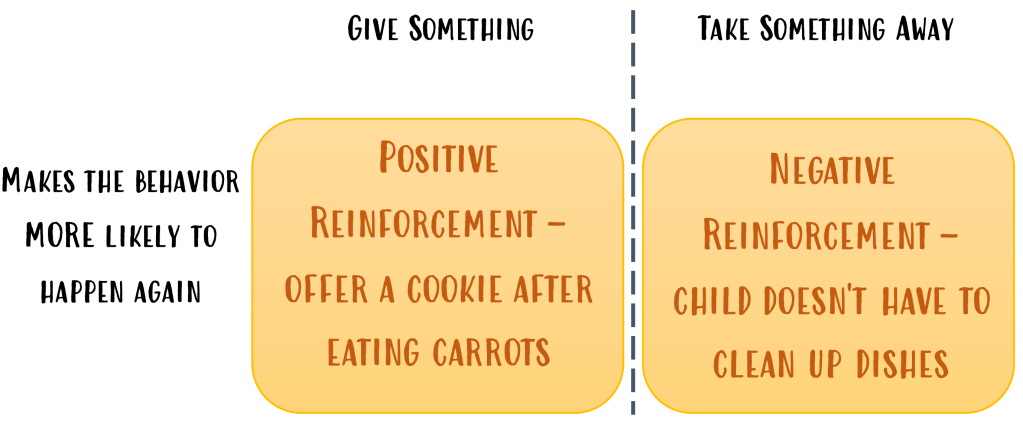
So what is Reinforcement? Reinforcement is anything that makes it MORE likely for a behavior to happen. Or, if you prefer dictionary definitions, Merriam-Webster says that Reinforcement is, “the action of strengthening or encouraging something.” In the behavior modification world, the “thing” you are trying to strengthen or encourage is positive behaviors. Check out the chart below (AND/OR download it here) – in this post we’re focusing on the top two boxes – positive and negative reinforcement. As you can see, you are either taking something (unpleasant) away or giving something pleasant in order to make the behavior more likely to happen.

There are a multitude of actions/things that can be used as Reinforcement. Reinforcement can be negative OR positive, and this is where it gets a little tricky. “Negative” in “negative reinforcement” doesn’t mean that it’s a punishment. Both negative and positive reinforcement are “good” things that make a behavior more likely to occur. They are both reinforcing. Let me say it again:

Both positive reinforcement AND negative reinforcement are “good” – BOTH make a behavior more likely to occur again.

Positive Reinforcement is usually easier to understand because it’s giving something good to make it likely the good behavior will reoccur. Think praise, rewards, and positive attention. My child does something “good” that I want them to do again (like cleaning up her socks off the floor, so I give her an extra cookie. Or she is kind to a friend, so I tell her what a great job she did. Or she says “okay” with no whining when I say it’s time to turn off the tv, so I give her 5 minutes of tablet time. Or she gets ready for bed without a fuss, so I read an extra book with her before bed. All of these are examples of positive reinforcement. You get something good for doing something good, which makes it more likely you’ll keep doing something good.

So what does the “negative” in Negative Reinforcement mean? It means you’re taking away something considered “bad” or unpleasant to make the positive behavior more likely to occur again. The most popular example of this is the alarm for seatbelts. In cars, it’s pretty common for an alarm to ding if you don’t put your seat belt on. That ding is pretty obnoxious. Once you put your seatbelt on, the dinging stops. This is negative reinforcement. You’re taking away something unpleasant (the dinging) to reinforce positive behavior (putting on the seatbelt). You get something unpleasant removed for doing something good, which makes it more likely you’ll keep doing something good.

Here’s an example of how both negative and positive reinforcement may be used to reinforce a good behavior. Let’s say your child doesn’t like carrots and typically whines about them, but today they ate all their carrots without any whining or fussing.

In this scenario, you have the option of giving something good (positive reinforcement) or taking away something “bad” (negative reinforcement) to make it more likely your child will eat their carrots without a fuss next time.

Unfortunately, I think negative reinforcement may be used to reinforce negative/bad/undesired behavior more often than it is to reinforce positive behavior. If you give your child a food they don’t like, then take it away when they whine/scream/complain/yell… that’s negative reinforcement. You are taking away something unpleasant (the yucky food), which reinforces the negative behavior (whining/screaming/complaining/yelling). If you tell your child it’s time to help with a chore, then change your mind when they throw themselves on the floor kicking and screaming… that’s negative reinforcement. You took away the unpleasant chore, which reinforced the “tantrum” behavior.

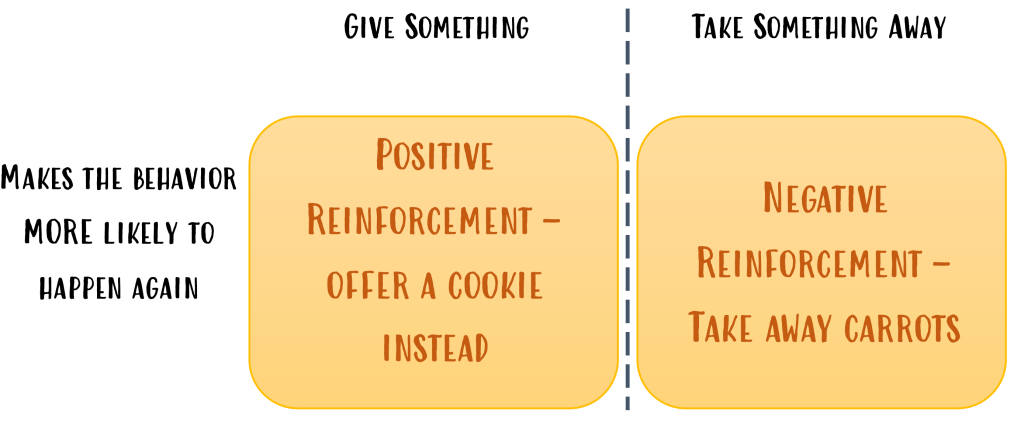
Let’s revisit our carrot scenario to see how positive and negative reinforcement would be used to actually make the negative behavior more likely. This time, let’s say your kiddo sees the carrots on their plate and yells “you know I don’t like carrots, mom! I’m NOT eating these.” Here’s how you might reinforce his yelling with positive and negative reinforcement:

Offer a cookie instead = give something good = positive reinforcement.

Take away carrots = taking away something unpleasant = negative reinforcement.

In this case, both positive reinforcement and negative reinforcement will make it more likely that your child yells at you again – and more likely that they won’t eat their carrots.

The two carrot examples above are also examples of how you can use positive reinforcement AND negative reinforcement at the same time. In the first example, giving a cookie as a reward will be reinforcing. Or letting your child off the hook for cleaning their dishes will be reinforcing. You can use one of these, or you can use both. Using them together will make the behavior even more likely – the reinforcement will be even stronger.

And that’s a wrap on positive and negative reinforcement. The most important thing to remember is this: Both positive reinforcement AND negative reinforcement are “good” – BOTH make a behavior more likely to occur again.

As always, I’d love to read your comments and questions – drop them below!

Disclaimer: I am a licensed mental health therapist, but I am not your therapist. The information in this article is for general informational purposes only. This article does not create a therapist-client relationship. If you need specific recommendations based on your individual circumstances, please consult with a mental health practitioner near you.

Social Skills Series: Saying “Please” and “Thank you”

Good morning/afternoon/evening/night! The next social skill in this Social Skills Series is Saying “Please” and “Thank you.” If you need a reminder on what social skills are and why they’re important, read Social Skills Series: Introduction.

Whether or not you’ve ever said the words “social skill” in relation to saying “please” and “thank you,” most people acknowledge that those words are very important in today’s society. Does that mean everyone uses them consistently? Not at all – even adults are not always great about it. But most people would agree that it’s kind and respectful to say “please” when they want something and “thank you” when they’ve received something.

One rationale for saying “please” is that it makes it more likely that the person will say “yes.” And a rationale for saying “thank you” is that it makes it more likely people will do kind things for you next time. These are pretty solid rationales, in my opinion. Can you think of examples of a time that you were inclined to say “no,” but because the person said “please,” you said “yes” instead? I can! Just a few days ago my daughter asked for “one more time” going down the water slide. I looked at her, considered her “please,” and told her that I was saying “yes” only because she had asked so nicely and said “please.” And how many times have you given something to someone, not gotten a “thank you,” and thought to yourself, “I guess I’m done doing nice things for them” or something similar? Please and Thank You are important!

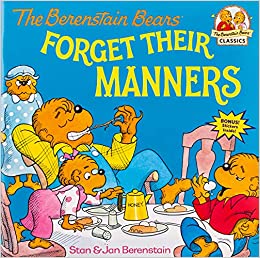
Books can be a great way to introduce skills to kids! There are two books in the Berenstain Bears series that can be read aloud to your child to introduce them to the concept of using “please” and “thank you.” One if The Berenstain Bears Forget Their Manners and the other is The Berenstain Bears Say Please and Thank You. I have not read the second one, but Forget Their Manners was a favorite of mine when I worked in a treatment facility with children.

So how to practice saying “please” and “thank you?” There are so many ways! One of the easiest ways I’ve practiced is to do a coloring activity with your child. You hold on to all of the crayons/markers/colored pencils, and when your child wants one, they must say “please” when asking and “thank you” once they’ve received. You could also practice with a small treat – carry a small baggie of m&ms or chocolate chips around, and in order to get one, your child must say “please” when asking and “thank you” once they’ve gotten one. Another idea is with a sticker book. My daughter still needs help peeling the stickers, so I can practice with her by making her ask “please” when she is ready for another sticker to put on, then saying “thank you” once I’ve given her one. Yet another option is to use building blocks of some kid – put all the blocks in a pile and before taking one, your child must ask “please,” then say “thank you” once you tell them it’s okay to take one.

Remember to praise and reward (optional) your child when they are successful! You want to praise every time they say “please” or “thank you.” Rewards are, again, optional. With each of these practice ideas, there is a positive consequence built in to the practice – they are getting a sticker for their book, getting a block to use, or getting a crayon to use. And obviously if you are having them practice saying “please” and “thank you” for a small treat, the small treat acts as a reward. If you want to, you can use another reward – my recommendation would be to use a reward for a certain number of successes. Such as, ten successful “please” and “thank you”s will earn something. You can even give a sticker for each success, then give a reward when they earn a certain number of stickers. Ten stickers may equal ten extra minutes of tv time (or any other reward you want to use).

Some TIPS for practicing this social skill:

  • Practice when your child is calm/in a good mood. Practice will probably not go well if your child is grumpy or just got in trouble for something.
  • Make sure to praise you child for saying “please” and “thank you.”
  • Kids LOVE IT when they can turn the tables – let them be in charge during the practice and praise YOU for saying “please” and “thank you.”
  • Try to make it fun! If your child becomes uncooperative at any point, just end the practice and revisit it later.

Good luck! Drop a comment with any other fun ideas for practicing this important social skill!

Disclaimer: I am a licensed mental health therapist, but I am not your therapist. The information in this article is for general informational purposes only. This article does not create a therapist-client relationship. If you need specific recommendations based on your individual circumstances, please consult with a mental health practitioner near you.

Tips for Making Praise Effective

There are some things you can keep in mind to make the most out of when you praise your children.  Praise is great and even a simple “good job” goes a long way, but read on to learn about some useful tips to make praise as effective as possible.

  • Immediacy – praise your child for their behavior as soon as you can!  If you wait until later in the day to praise them for something they did that morning, praise won’t be as effective.  One reason is your child, depending on age, may not even remember what they did that morning!
  • Consistency – to see the quickest and biggest changes, you must try to be consistent in praising your child.  If you’re working on improving your child’s listening, then praising them each time they listen the first time they’re told to do something will be more effective than just praising every once in a while.
  • Specific – label the behavior your kiddo did that made you want to praise them.  Instead of “good job,” say, “great job listening when I told you to _____.”
  • Size – make your praise BIG if your child did well on something they really struggle with.  Your praise probably won’t be so big on a behavior that your child normally does well at.
  • Contrast – make sure your child knows you’re pleased/proud/happy by using a positive voice tone and happy facial expressions.
  • Rationales – using rationales can be effective with older children.  Let them know why it’s so important or meaningful that they did whatever you’re praising them for.  For example, “thank you for listening to me the first time; when you listen right away you can get back to playing faster!”
  • Frequency – you want to be as frequent as possible with your praise, especially if you have a kiddo who is struggling in multiple areas.  The *ideal* ratio is 4:1 – four praise statements for every correction.  However, that can feel like an impossible goal sometimes, so just do the best you can.

I have created a fun handout that can be printed and put up somewhere to help parents, grandparents, teachers, etc. remember the components of praise.  You can find the printable version here.

Screen Shot 2017-12-19 at 10.24.40 AM

How to Make and Use a Chore Jar and Reward Jar

Sometimes it can be difficult to think of rewards and consequences when it’s time to use them. And sometimes using the same consequence or same reward can get really old… for you and your child.

Chore/Reward Jars fix this by letting you think of chores and rewards in advance, then letting/making your child pick one when it’s time. BONUS: they are super easy to make! Just follow these steps:

  1. Get two mason jars and a handful of popsicle sticks
  2. Use a permanent marker to write down your chores and rewards – one per popsicle stick.
  3. Place the chore sticks in one jar and the reward sticks in another.
  4. Wait until your kiddo earns a reward or consequence.
  5. When the time comes, tell your child to either pull out a chore stick (for negative behavior) or reward stick (for positive behavior).
  6. Follow through (or have your child follow through) with whatever is on the stick.

You can make these super fancy if you want… I’ve seen color-coded ones that are different levels of chores/rewards. And I’ve seen some decorated jars from some really creative parents. You can also use something other than jars and popsicle sticks. For example, you could use disposable cups and slips of paper. Or a bowl and pieces of paper.

A few things to keep in mind:

  • Be realistic with the chores – a chore that you have to help your child with might actually be reinforcing because your child gets one-on-one time with you. So include only chores your child can do on their own (or that they can attempt and you can “fix” it afterwards).
  • Ask your kid for input on (reasonable) rewards – you want to make sure they’re excited about picking something from the reward jar. They can even help you “make” the jars!
  • Explain the chore/reward jars to your kiddo so they aren’t confused the first time you use them.
  • Make sure the rewards are something you can follow through on, even if you’re in a hurry or if money is tight that week. The last thing you want is for your child to be excited about a reward then tell him/her that they have to pick a different one.
  • Add new chores/rewards to the jar occasionally so that there’s some variety.

Behavior is a Choice (and How Parents Can Use This Knowledge)

It may not feel like it, but every behavior is a choice. I went into our master bathroom today and, as usual, my husband has neglected to pick up the hangers from his clothes (and for some reason this drives me crazy). Before I sighed and rolled my eyes, I thought to myself… I can either get mad about it, or I can just do it myself and move on with my day. So I picked them up and moved on with my day.

Some behaviors don’t feel like choices. When I pay my mortgage, I don’t feel like I have a choice to do otherwise. But I do! I can choose to pay my mortgage, or I can choose not to and suffer the consequences of late fees, a hit on my credit, and potentially (eventually) foreclosure and homelessness. My husband may not feel like he has a choice about employment, but that’s only because to choose not to work would mean choosing to not be able to pay bills and provide for the family.

As adults, most of us are pretty good at using our well-developed brains to think through what the consequences of each of our behaviors are. I know that if I run a red light, I might get pulled over and get a ticket. I know that if I don’t do laundry, I won’t have clean clothes to wear. I know that if I eat a bunch of junk food I feel sluggish and my face breaks out.

Children’s brains aren’t as developed and they probably have a difficult time thinking about the consequences of their actions without a reminder or repetition. That’s why consistent consequences are so important. If you are consistent with putting your child in a timeout every time they hit their sibling, it won’t take long for them to catch on that hitting = timeout. Once you know that your child is aware of the consequences of a behavior, you know that they are making the choice to misbehave even though they know there will be a consequence. This, to me and many of the parents I’ve worked with, makes discipline a little easier. It makes you, as a parent, feel less like “the bad guy.” Your kiddo knew that they had a choice to make and chose something that would lead to consequences, so they take on that responsibility.

It’s also really helpful to frame it that way to a child by telling them the choice they made, followed by the consequence. Some examples:

  • “You chose not to eat your vegetables at dinner and the consequence is no bedtime snack.”
  • “You chose to argue when told it was time for bed, so now you won’t get a bedtime story.”
  • “You chose not to complete your worksheet at school, so now you won’t have any free time until it’s completed here at home.”
  • “You chose not to clean your room when I told you to, so now you owe me an extra chore after you clean your room.”

Speaking this way let’s your kiddo know that the consequence is a result of a behavior (choice) that they made, not because you’re a “mean” mom or dad. It can also be beneficial to remind your child of their choices and consequence if they are struggling to make the right choice. If you tell your child it’s time for bed and he begins arguing, reminding him that choosing to go to bed right away results in a bedtime story, while choosing to argue results in no bedtime story, you can help him make a better choice. Granted, he may choose to argue anyways, but at least you can be 100% sure that he knew what the consequence was before making his choice.