CBT Strategy: Ask “What Would I Tell a Friend?”

Did you ever watch Who Wants to Be a Millionaire? It might still be running, but I remember watching it years ago, and seeing how contestants were able to “phone a friend” when they needed help.

In CBT, there’s a common question that’s similar to “phone a friend.” (But no, you’re probably not going to be able to use this strategy to win a million dollars.) First, if you need a refresher on CBT, go find out more about it: Crash Course on CBT and the Cognitive Triangle.

When confronted with negative thoughts that are making you feel miserable (e.g., worried, sad, angry), it can be really helpful to ask, “what would I tell a friend in this situation.” Pretend your friend just pushed the “phone a friend” button and called to ask your advice for what to do in a given situation or with a negative thought. And pretend that situation or negative thought is what YOU’VE been going through.

For example, if I’m heading into an IEP meeting at my child’s school, I might be thinking a thought similar to, “the school isn’t going to listen to what I have to say or do what’s helpful for my child.” This thought is bound to make me feel hopeless, sad, or frustrated… and the meeting hasn’t even started!

So use the “what would I tell a friend?” strategy. Pretend a friend just called you, and said, “Krista, I’m really struggling. I’m headed to JJ’s IEP meeting and I’m worried the school isn’t going to listen to what I have to say, and that they aren’t going to do anything to help him.” Can you imagine your friend calling you to tell you all of that, and you respond, “yeah, you’re probably right. Maybe it’s best just not to go; just don’t even try.” Can you imagine?! Most people are not going to respond like that. Nobody I personally know would!

We are typically much, much kinder and encouraging to other people than we are to ourselves. It’s usually much easier to think of what advice/encouragement we would give to someone else who is in our situation. A few options:

  • “I’m so sorry you’re feeling worried about this. I’m sure it won’t be as bad as you’re thinking it will be.”
  • “I don’t think that’s going to happen! The teachers have been so great, I’m sure they’ll continue doing what’s best for JJ.”
  • “Even if they tried to do that, you’ve done so well for advocating for JJ! You can do it!”
  • “That’s stressful! Would it help to make some notes to take with you? Would it help to talk through your thoughts with me before you go to practice what you want to say?”

The great thing about this is that there is not just one right answer. If it’s true and helpful (meaning it causes positive emotions), then it’s “right.” When asked what you would tell a friend, a funny thing happens… typically we give encouragement/advice that we most need to hear. So if you use this strategy, you’ll like be able to say something that will be incredibly helpful for you.

Then what? Repeat it to yourself, often and with confidence! When the negative thought starts to creep in again, remember what you said earlier and replay it in your head.

This tactic is more helpful with some people than it is with others, but a great strategy to try if you’re struggling with negative thoughts that you’re having a hard time getting rid of!

So… in the above situation, what would YOU tell a friend?

Disclaimer: I am a licensed independent mental health practitioner and certified professional counselor, but I am not your therapist. The information in this article is for general informational purposes only. This article does not create a therapist-client relationship. If you need specific recommendations based on your individual circumstances, please consult with a mental health practitioner near you.
In Times of High Anxiety: Controlling What You Can Control

You may not control all the events that happen to you, but you can decide not to be reduced by them.” — Maya Angelou

Everywhere you turn, there seems to be possible sources of anxiety. Recent clients have brought up anxiety related to politics, weather events, family conflict, job-related stressors, acts of public violence, and so on. If you are looking for a reason to be anxious, you don’t need to look far.

It can be incredibly easy to get sucked into an anxiety spiral when our focus is on all the things we worry about. And once we’re in that spiral, it can be incredibly difficult to get out of it. I have added and will continue adding ideas for avoiding the anxiety spiral, and getting out of it (see here). One idea is to focus on what you CAN control.

First, let’s look at just a small sample of things that are outside of our control:

I cannot who is president. I cannot control what difficult task my manager assigns to me. I cannot control the never-ending heat or tornados. I cannot control my spouse’s words when we are arguing. I cannot control if my neighbor gives me a dirty look when she sees me outside.

I could go on and on and on, but you get the idea: there is SO much in our lives that we are unable to control, no matter how hard we might try.

When we focus on those things, it’s easy to feel anxious, stressed, worried, frustrated, and hopeless. However, if we can switch our focus to what we CAN control, it’s likely that we’ll begin to feel less dysregulated, more positive, and more like ourselves.

So what CAN we control? I’ll be honest, when you make a list of what you CAN control and a list of what you CANNOT control, sometimes the latter feels very overwhelming. BUT there ARE things we can control.

I can control who I spend time with.

I can control how I speak to others and about others.

I can control how I speak to myself and about myself.

I can control what I spend my time doing.

I can control my thoughts (though this may be difficult sometimes).

I can control the amount of water I drink.

I can control what foods I choose to eat to fuel my body.

I can control the amount of sleep I get.

I can control the amount of time I look at a screen.

I can control the amount of exposure I get to the news.

I can control what coping skills I use.

I can control the amount of time I spend on social media.

I can control who I follow on social media.

I can control how much physical activity I get each day.

I can control what boundaries I set with other people.

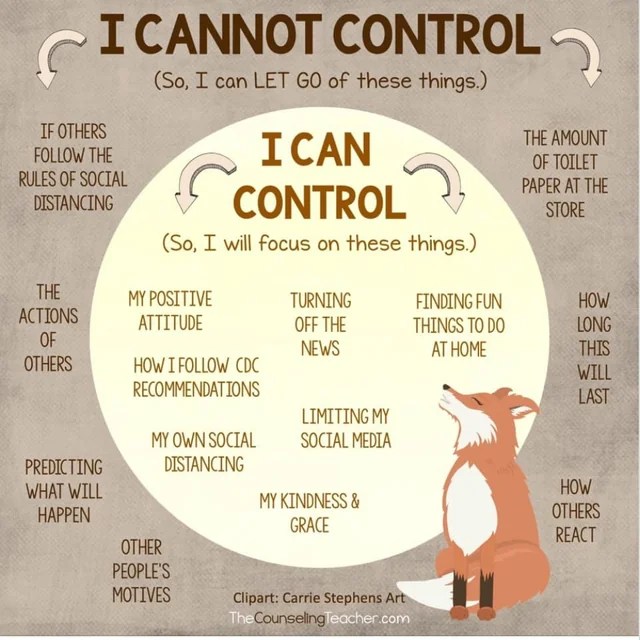
Back in 2020, I saw the below image making the rounds on social media (source is at the bottom of the image). What a time to be alive, right? COVID hit, and so many things that were outside of our control changed.

Those things outside of our control could feel SO big, SO heavy, SO overwhelming. Many people, though, found comfort in focusing on what they COULD control. It’s a tactic that can work well in lots of different situation. And see at the top where it says “So, I can LET GO of these things” in parentheses? First of all, easier said than done, right? BUT TRUE.

I believe self-talk is one of the greatest tools we have to tackle negative thinking and anxiety. It can be monumentally helpful to have a script to help you focus on what you can control. Maybe it will sound like this:

“Self, you cannot control ______. That’s a fact. So Iet’s choose to focus on _____ instead, because that is something you can control.”

Make it your own, and use it as a script to pull your focus back to what is within your control. If you’re struggling, reaching out to a family member or a friend who may help you identify what is within your control can help. Of course, a mental health provider can also help with this strategy.

Drop a comment with your script, or something within your control that you’re choosing to focus on!

Disclaimer: I am a licensed independent mental health practitioner and certified professional counselor, but I am not your therapist. The information in this article is for general informational purposes only. This article does not create a therapist-client relationship. If you need specific recommendations based on your individual circumstances, please consult with a mental health practitioner near you.

A Crash Course on Body Signals: What They Are and How to Use Them

When I have a kiddo struggling with emotion regulation, one of the first things I do is teach them about body signals.  This isn’t knowledge that people are born with and EVERYONE (yes, adults as well!) can benefit from understanding what body signals are, how to identify them, and how to use them to help with overwhelming emotions.


What are Body Signals?  

Body signals are the physiological symptoms that happen because someone is feeling a certain way.  Basically, it’s your body’s automatic response to emotions. People can differ on what body signals they experience – so my body signals for angry feelings might be different than someone else’s. Also, some people may experience the same body signal for different (and opposite!) feelings.


Identifying Body Signals

Most people aren’t really aware of their body signals until they start thinking about them.  Think back to the last time you were extremely happy/mad/sad/worried… do you remember feeling certain sensations in your body?  A lot of times just THINKING about something that makes you feel a certain way can elicit some of these body signals.  Common body signals for happy feelings include heart beating quickly, can’t sit still, and smiling.  Some others I’ve heard from kids include “ants in pants,” singing, crying, and “want to run!”  Common body signals for sad feelings include crying, slow movements, slumped shoulders, and talking in a quiet voice.  Common body signals for angry feelings include clenched fists, red or hot face, yelling and heart beating quickly.  Some others I have heard are “want to hit,” “want to kick,” sweating, growling/groaning, and stomping feet.  Common body signals for worried/scared feelings include butterflies in stomach, heart beating quickly and loudly, and shaking.


How Is This Information Useful?

Once you are aware of your body signals for certain emotions, you can have a better awareness of when you need to do something to calm down.  It’s called a Body SIGNAL for a reason – it’s a signal that you’re becoming overwhelmed with an emotion and need to use a calming/coping strategy to help you calm down and regulate those emotions.  It takes practice though, especially for kiddos!  If you see your kiddo clenching their fists or crying or with slumped shoulders, it might be time for a hug and to prompt them to do something that will help them feel better!