Inside Out Feelings Cube Activity

Games are such a great way to get children to talk about feelings.  Have you seen the episode of The Office where Michael has to complete some therapy sessions with Toby (whom he dislikes a lot)? In the episode, Michael REFUSES to talk to Toby about anything, but when Toby recommends a board game, Michael agrees, then suddenly starts opening up, then realizes that Toby has “tricked” him and is livid.  Now, I don’t try to “trick” kids into talking to me, but games and activities are certainly excellent tools to facilitate discussion.  It’s a lot more enjoyable!

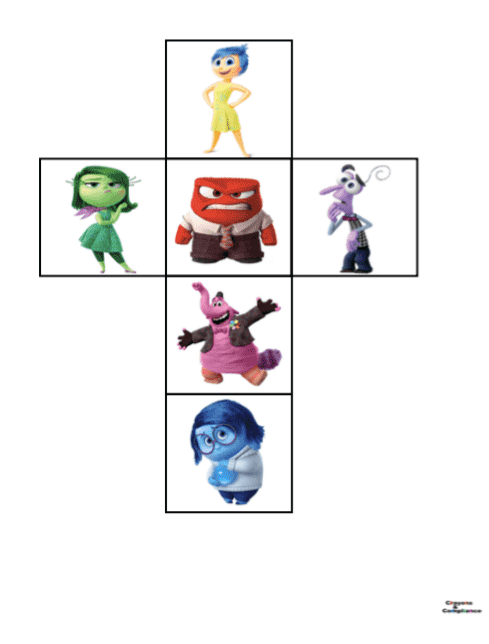
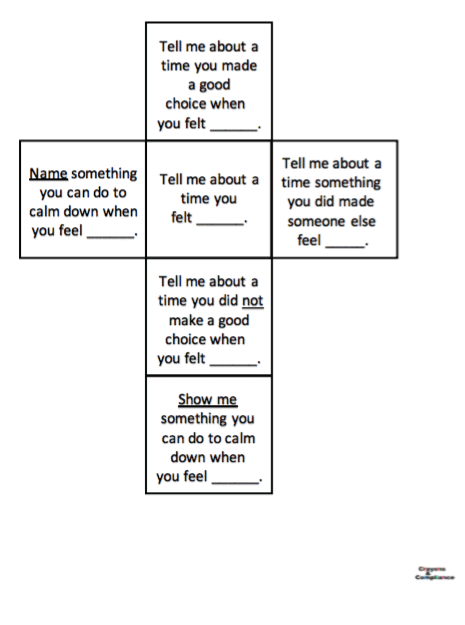
I created two different documents which can be trimmed and folded into cubes, or “dice.”  One has all 6 Inside Out characters on it (Joy, Anger, Sadness, Fear, Disgust, and Bing Bong) and the other has 6 prompts for discussing feelings and calming strategies.  So you would have a kiddo roll both cubes and follow the prompt for whatever Inside Out character (the corresponding feeling) they roll.  You can pick what “feeling” you want to assign Bing Bong – maybe silly, surprised, or embarrassed.

So if I roll both cubes and get “Joy” and “tell me about a time you felt ___,” then I would talk about a time I felt happy.  If I rolled “Sadness” and “Show me something you can do to calm down when you feel _____,” then I would demonstrate a calming strategy that I use when I’m sad.

If you want to use a simplified version of the activity, you could just use the Inside Out character cube and pick one prompt to use for each roll.

The character cube looks like this (printable version here):
Screen Shot 2018-03-01 at 8.10.16 PMThe prompt cube looks like this (printable version here):
Screen Shot 2018-03-01 at 8.10.29 PM


Inside Out Situation/Feeling Matching Worksheets

I know I’ve said it before, but Inside Out is such a great tool for teaching and practicing feelings identification with kiddos.  It’s a great way to get some serious learning done, but the movie characters are fun and make it more bearable for children.  Feelings identification can seem really simple to adults, but lots of children need help in order to be successful identifying how they feel.  Ultimately, the goal is to get them to then be able to regulate those emotions, but we have to start with being able to identify them first.

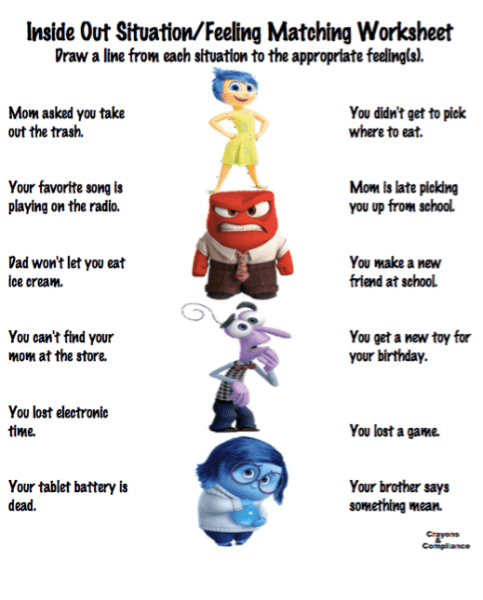
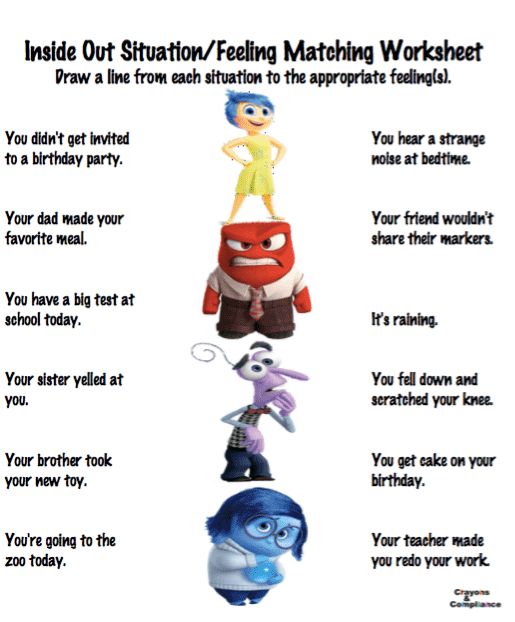
Below you can find two different worksheets which allow children to match situations to the appropriate feeling(s) that someone would feel in that situation.    Each worksheet has 12 different scenarios.  Some may trigger a few different feelings in children.  For example, there are a few situations which may make a child feel both sad and mad.  Additionally, one child might identify a feeling different from another.  For example, one child might be happy that it’s raining (maybe a kiddo who likes to jump in mud puddles) while another might feel sad that it’s raining.

I encourage any caregivers using these worksheets to be open-minded when going over this with a child.  If a child identifies a feeling that doesn’t seem to make sense to you at first, let them talk about it instead of immediately telling them they’re wrong.  Sometimes I’ve been surprised by a child’s perspective of a situation.  The different situations provide plenty of prompts to talk about feelings.  If a child doesn’t seem to be grasping a situation, it can also be helpful to role-play it and have them try to identify a feeling during the role-play.

Inside Out Matching Worksheet 1 (click link to print):

Screen Shot 2018-02-05 at 8.11.11 PM

Inside Out Matching Worksheet 2 (click link to print):

Screen Shot 2018-02-05 at 8.11.19 PM

Inside Out Emotions Ice Breaker

When I see a kiddo for their first therapy session, I usually give them an easy, getting-to-know-you assignment to complete before their second session.  For kiddos who are dealing more with emotional issues than behavioral, I like to have them make a list of 5 things that make them feel happy, 5 things that make them feel sad, 5 things that make them feel worried, and 5 things that make them feel mad.

This list is a great way to “break the ice” and going over it is beneficial for building rapport.  It also helps give me an idea of their knowledge and awareness of emotions.  Additionally, it’s easy to fit in questions about how they cope with the situations, which also gives me an idea of how they are at coping with emotions.

To make the assignment more fun, I created an easy worksheet with the Inside Out characters for kids to take and fill out.  Some kids are turned off when they hear the words “assignment” or “homework,” but show them a piece of paper with an Inside Out character on it, and it doesn’t seem so bad. 🙂

Here’s what the worksheet looks like:Screen Shot 2018-01-01 at 7.26.19 PM

Printable version here.

A Crash Course on Body Signals: What They Are and How to Use Them

When I have a kiddo struggling with emotion regulation, one of the first things I do is teach them about body signals.  This isn’t knowledge that people are born with and EVERYONE (yes, adults as well!) can benefit from understanding what body signals are, how to identify them, and how to use them to help with overwhelming emotions.


What are Body Signals?  

Body signals are the physiological symptoms that happen because someone is feeling a certain way.  Basically, it’s your body’s automatic response to emotions. People can differ on what body signals they experience – so my body signals for angry feelings might be different than someone else’s. Also, some people may experience the same body signal for different (and opposite!) feelings.


Identifying Body Signals

Most people aren’t really aware of their body signals until they start thinking about them.  Think back to the last time you were extremely happy/mad/sad/worried… do you remember feeling certain sensations in your body?  A lot of times just THINKING about something that makes you feel a certain way can elicit some of these body signals.  Common body signals for happy feelings include heart beating quickly, can’t sit still, and smiling.  Some others I’ve heard from kids include “ants in pants,” singing, crying, and “want to run!”  Common body signals for sad feelings include crying, slow movements, slumped shoulders, and talking in a quiet voice.  Common body signals for angry feelings include clenched fists, red or hot face, yelling and heart beating quickly.  Some others I have heard are “want to hit,” “want to kick,” sweating, growling/groaning, and stomping feet.  Common body signals for worried/scared feelings include butterflies in stomach, heart beating quickly and loudly, and shaking.


How Is This Information Useful?

Once you are aware of your body signals for certain emotions, you can have a better awareness of when you need to do something to calm down.  It’s called a Body SIGNAL for a reason – it’s a signal that you’re becoming overwhelmed with an emotion and need to use a calming/coping strategy to help you calm down and regulate those emotions.  It takes practice though, especially for kiddos!  If you see your kiddo clenching their fists or crying or with slumped shoulders, it might be time for a hug and to prompt them to do something that will help them feel better!

Inside Out Feelings and Calming Strategies Worksheets

love using Inside Out when working with kids on emotion identification and emotion regulation.  It’s a fun movie and kids generally have a positive response when they see any of the characters from Inside Out, which mean the activity usually goes rather well.

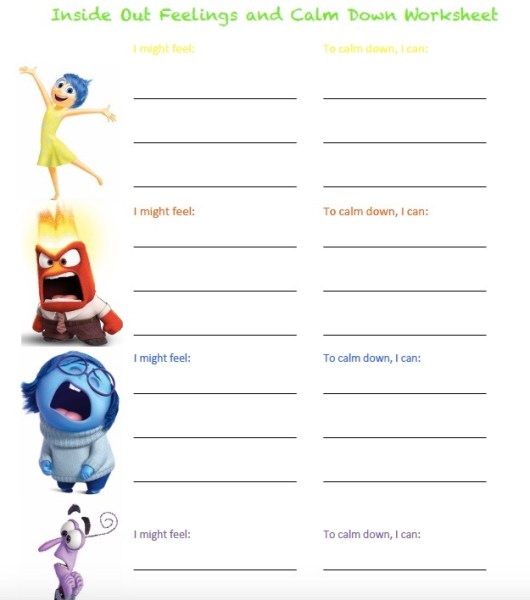
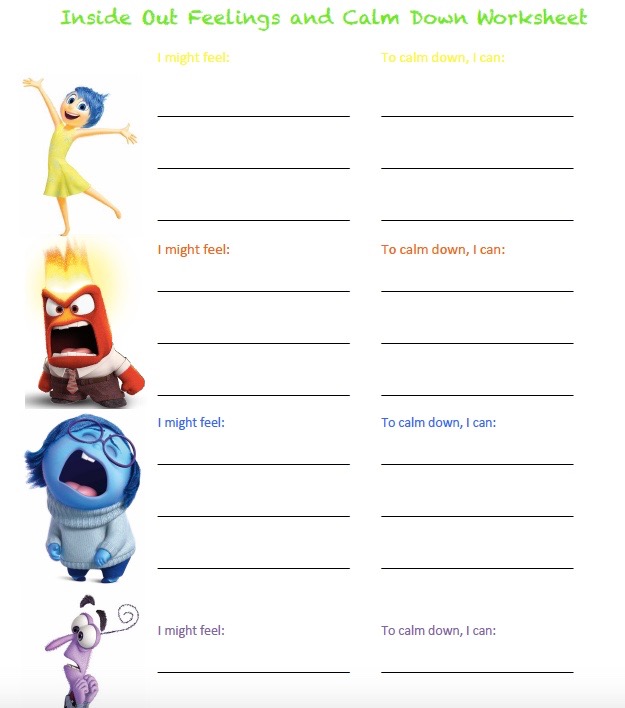
I have created this worksheet to help kids identify how they’re feeling, how their body might be feeling, and some calming strategies they can use to help calm down.  This is similar to the Inside Out Feelings Book that I posted, but this worksheet is all on one piece of paper… and the reason for that is that I thought it would be nice to print this worksheet out and put it somewhere in the home (on the fridge, maybe?) as a visual prompt from kiddos.

Screen Shot 2017-10-16 at 12.39.39 PM

Download it here: Inside Out Feelings and Calming Strategies Worksheet

What I would do is sit down and help your kiddo fill in the blanks on the worksheet – for each of the four emotions (joy, anger, fear, sadness) there are 3 lines to write in body signals (how their body feels when they feel that emotion) and 3 lines to write an appropriate calming strategy.  Some of the body signals and calming strategies might overlap, but it would probably be beneficial to make sure there’s some variety!

Once it’s all filled out, put it somewhere your kiddo can see it.  Then, when you notice your child getting upset, prompt them to go find their Inside Out Feelings Worksheet, identify how they feel (help them, if needed due to age or development), then identify a calming strategy to use to calm down.

Inside Out Feelings Chart

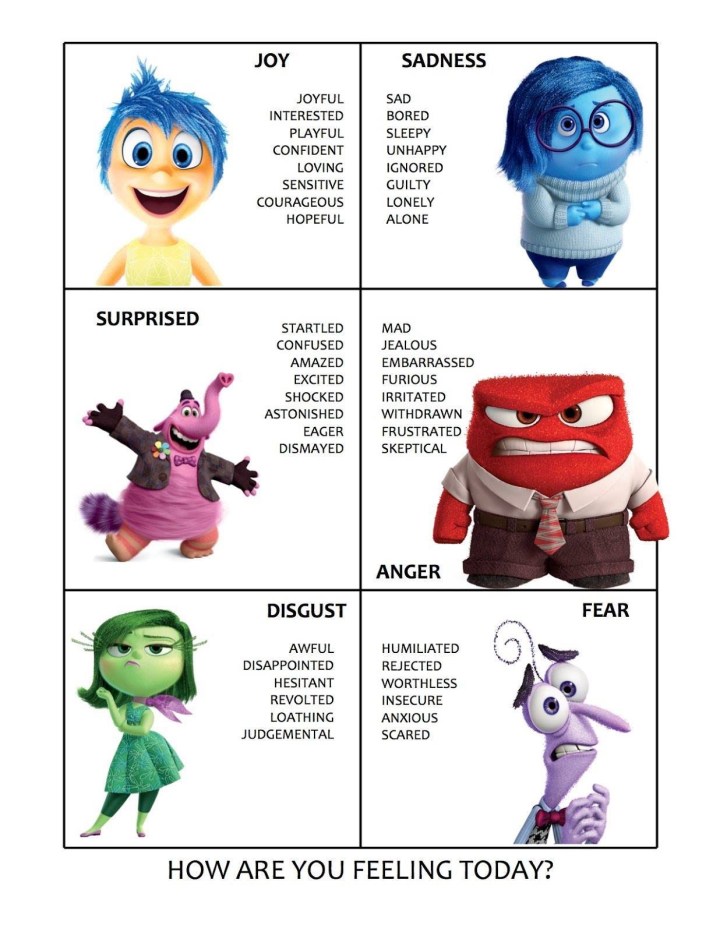
I just found the coolest feelings identification chart.  It uses Inside Out characters… I always get excited when I find something therapeutic that also relates to children!  Kids have a hard time identifying their emotions sometimes… and it can be because they don’t know the right words.  Ninety percent of the time I ask a kiddo how they’re feeling, I get “happy” or “sad,” but emotions are more complicated than that!  This is a great tool to promote kiddo’s knowledge about the spectrum of feelings and be able to identify what they’re feeling.

img_6091

This is NOT mine… it was posted on this site/blog: http://whatscookinsister.blogspot.com/2016/02/emotions-chart-for-kids_9.html

I found it on Facebook, where it was shared by The Gottman Institute (a great resource for marriage/relationship counseling material).

Find the printable version of the Inside Out Feelings Chart here.  I will be printing this and using it with my kiddos.