CBT Strategy: Ask “What Would I Tell a Friend?”

Did you ever watch Who Wants to Be a Millionaire? It might still be running, but I remember watching it years ago, and seeing how contestants were able to “phone a friend” when they needed help.

In CBT, there’s a common question that’s similar to “phone a friend.” (But no, you’re probably not going to be able to use this strategy to win a million dollars.) First, if you need a refresher on CBT, go find out more about it: Crash Course on CBT and the Cognitive Triangle.

When confronted with negative thoughts that are making you feel miserable (e.g., worried, sad, angry), it can be really helpful to ask, “what would I tell a friend in this situation.” Pretend your friend just pushed the “phone a friend” button and called to ask your advice for what to do in a given situation or with a negative thought. And pretend that situation or negative thought is what YOU’VE been going through.

For example, if I’m heading into an IEP meeting at my child’s school, I might be thinking a thought similar to, “the school isn’t going to listen to what I have to say or do what’s helpful for my child.” This thought is bound to make me feel hopeless, sad, or frustrated… and the meeting hasn’t even started!

So use the “what would I tell a friend?” strategy. Pretend a friend just called you, and said, “Krista, I’m really struggling. I’m headed to JJ’s IEP meeting and I’m worried the school isn’t going to listen to what I have to say, and that they aren’t going to do anything to help him.” Can you imagine your friend calling you to tell you all of that, and you respond, “yeah, you’re probably right. Maybe it’s best just not to go; just don’t even try.” Can you imagine?! Most people are not going to respond like that. Nobody I personally know would!

We are typically much, much kinder and encouraging to other people than we are to ourselves. It’s usually much easier to think of what advice/encouragement we would give to someone else who is in our situation. A few options:

  • “I’m so sorry you’re feeling worried about this. I’m sure it won’t be as bad as you’re thinking it will be.”
  • “I don’t think that’s going to happen! The teachers have been so great, I’m sure they’ll continue doing what’s best for JJ.”
  • “Even if they tried to do that, you’ve done so well for advocating for JJ! You can do it!”
  • “That’s stressful! Would it help to make some notes to take with you? Would it help to talk through your thoughts with me before you go to practice what you want to say?”

The great thing about this is that there is not just one right answer. If it’s true and helpful (meaning it causes positive emotions), then it’s “right.” When asked what you would tell a friend, a funny thing happens… typically we give encouragement/advice that we most need to hear. So if you use this strategy, you’ll like be able to say something that will be incredibly helpful for you.

Then what? Repeat it to yourself, often and with confidence! When the negative thought starts to creep in again, remember what you said earlier and replay it in your head.

This tactic is more helpful with some people than it is with others, but a great strategy to try if you’re struggling with negative thoughts that you’re having a hard time getting rid of!

So… in the above situation, what would YOU tell a friend?

Disclaimer: I am a licensed independent mental health practitioner and certified professional counselor, but I am not your therapist. The information in this article is for general informational purposes only. This article does not create a therapist-client relationship. If you need specific recommendations based on your individual circumstances, please consult with a mental health practitioner near you.

Cognitive Behavioral Therapy: Crash Course on CBT and the Cognitive Triangle

If you’ve taken a psychology course or have done any therapy, there’s a good chance you’ve heard the term Cognitive Behavior Therapy or Cognitive Behavioral Therapy (CBT). However, I’m guessing most people would have a difficult time describing what it is or how it works. Which is understandable; I’ve been using CBT for years and feel as if I have barely scratched the surface!

Cognitive Behavioral Therapy (CBT) is a widely used, evidence-based form of psychotherapy that focuses on identifying and changing unhelpful/unrealistic/unhealthy thought patterns, beliefs, and behaviors. CBT is grounded in the idea that our thoughts, feelings, and behaviors are interconnected.

This is illustrated with a “Cognitive Triangle.”

The Three Points of the Cognitive Triangle:

  1. Thoughts – What we think or believe (e.g., “I’m not good enough”).
  2. Feelings – What we emotionally experience (e.g., sadness, anxiety, anger).
  3. Behaviors – How we act or respond (e.g., avoiding a task, withdrawing from others).

How it Works:

  • thought can lead to a certain emotion, which then drives a behavior.
  • For example:
    • Thought: “I’m going to fail this presentation.”
    • Feeling: Anxiety or fear.
    • Behavior: Avoiding the presentation or procrastinating.

Why This is Useful?

The cognitive triangle is used in therapy to break negative cycles (e.g., anxiety, depression, low self-esteem). Once people are aware of their thoughts and the cognitive triangle, typically they have a higher chance of changing their thought and how they respond. This also facilitates use of healthier coping strategies!

Back to CBT:

The Cognitive Triangle shows that if you change one part, it can influence the others. That’s why CBT often focuses on identifying and changing unhelpful thoughts to improve emotional well-being and behavior. If you can challenge and change your thought, you can change your feelings (or at least decrease the severity of negative feelings) and change your behavior.

During CBT sessions, therapists work collaboratively with clients to examine negative thought patterns, and build practical coping skills. There are many different techniques used to do this, but the first step is to practice being able to identify your thoughts. Some people tell me that sounds silly, but sometimes it can be difficult for people to tell me what their thought is. So we practice during session, and they practice outside of session as part of their homework.

From there, we move on to strategies clients can use to change their thoughts. CBT is highly effective for a range of issues, including anxiety, depression, PTSD, OCD, and more. But it takes effort. It takes lots of practice and building habits that may seem difficult at first, but will get easier and easier the more you do it.

Another amazing thing about CBT is it can be generalized into so many different areas. A client who comes in for CBT to help with work stress will learn skills that can be helpful in all aspects of their life, from dealing with difficult family members to handling parent stress.

Yet another amazing thing about CBT is that it can be helpful with children and teenagers too! The process and strategies look a little different, but I’ve had children as young as 5 or 6 be able to challenge negative thoughts and feel “better” as a result.

Don’t get me wrong – there are a plethora of other amazing forms of therapy out there, also evidenced-based and wildly successful. CBT is just one option, and it’s the one that makes the most sense to me as a therapist.

More about CBT will be coming soon! What’s something else about CBT you’d like to learn about? Drop a comment and ask!

Disclaimer: I am a licensed independent mental health practitioner and certified professional counselor, but I am not your therapist. The information in this article is for general informational purposes only. This article does not create a therapist-client relationship. If you need specific recommendations based on your individual circumstances, please consult with a mental health practitioner near you.
In Times of High Anxiety: Controlling What You Can Control

You may not control all the events that happen to you, but you can decide not to be reduced by them.” — Maya Angelou

Everywhere you turn, there seems to be possible sources of anxiety. Recent clients have brought up anxiety related to politics, weather events, family conflict, job-related stressors, acts of public violence, and so on. If you are looking for a reason to be anxious, you don’t need to look far.

It can be incredibly easy to get sucked into an anxiety spiral when our focus is on all the things we worry about. And once we’re in that spiral, it can be incredibly difficult to get out of it. I have added and will continue adding ideas for avoiding the anxiety spiral, and getting out of it (see here). One idea is to focus on what you CAN control.

First, let’s look at just a small sample of things that are outside of our control:

I cannot who is president. I cannot control what difficult task my manager assigns to me. I cannot control the never-ending heat or tornados. I cannot control my spouse’s words when we are arguing. I cannot control if my neighbor gives me a dirty look when she sees me outside.

I could go on and on and on, but you get the idea: there is SO much in our lives that we are unable to control, no matter how hard we might try.

When we focus on those things, it’s easy to feel anxious, stressed, worried, frustrated, and hopeless. However, if we can switch our focus to what we CAN control, it’s likely that we’ll begin to feel less dysregulated, more positive, and more like ourselves.

So what CAN we control? I’ll be honest, when you make a list of what you CAN control and a list of what you CANNOT control, sometimes the latter feels very overwhelming. BUT there ARE things we can control.

I can control who I spend time with.

I can control how I speak to others and about others.

I can control how I speak to myself and about myself.

I can control what I spend my time doing.

I can control my thoughts (though this may be difficult sometimes).

I can control the amount of water I drink.

I can control what foods I choose to eat to fuel my body.

I can control the amount of sleep I get.

I can control the amount of time I look at a screen.

I can control the amount of exposure I get to the news.

I can control what coping skills I use.

I can control the amount of time I spend on social media.

I can control who I follow on social media.

I can control how much physical activity I get each day.

I can control what boundaries I set with other people.

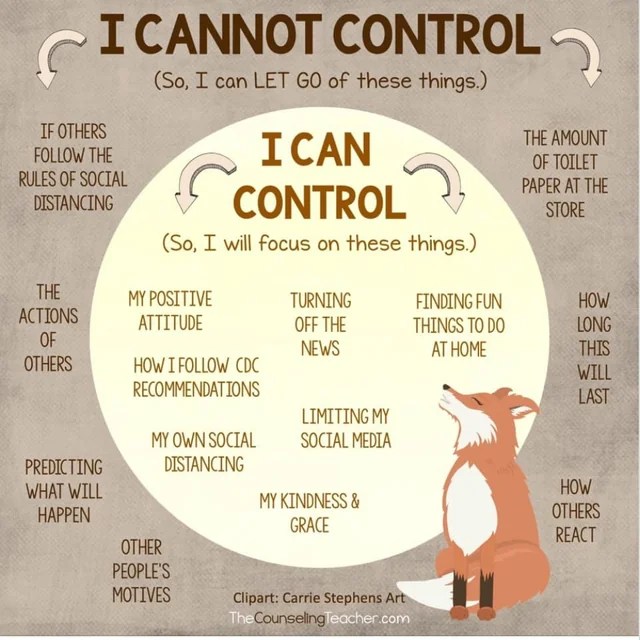
Back in 2020, I saw the below image making the rounds on social media (source is at the bottom of the image). What a time to be alive, right? COVID hit, and so many things that were outside of our control changed.

Those things outside of our control could feel SO big, SO heavy, SO overwhelming. Many people, though, found comfort in focusing on what they COULD control. It’s a tactic that can work well in lots of different situation. And see at the top where it says “So, I can LET GO of these things” in parentheses? First of all, easier said than done, right? BUT TRUE.

I believe self-talk is one of the greatest tools we have to tackle negative thinking and anxiety. It can be monumentally helpful to have a script to help you focus on what you can control. Maybe it will sound like this:

“Self, you cannot control ______. That’s a fact. So Iet’s choose to focus on _____ instead, because that is something you can control.”

Make it your own, and use it as a script to pull your focus back to what is within your control. If you’re struggling, reaching out to a family member or a friend who may help you identify what is within your control can help. Of course, a mental health provider can also help with this strategy.

Drop a comment with your script, or something within your control that you’re choosing to focus on!

Disclaimer: I am a licensed independent mental health practitioner and certified professional counselor, but I am not your therapist. The information in this article is for general informational purposes only. This article does not create a therapist-client relationship. If you need specific recommendations based on your individual circumstances, please consult with a mental health practitioner near you.
Self-Diagnosis

There have been several times (more than I can count) over the past few years a client has come for an initial session and told me that they believe they have a specific diagnosis, without having input from a professional. Many times, when I ask why they believe this, they tell me that they saw something on a social media platform that really resonated with them and aligned with symptoms they are experiencing. A lot of these answers start with “I saw this video on TikTok…”

First off, I want to say that I think people talking about mental health on social media can be a really great thing. The more we share, the more “normalized” mental health concerns are, and this is decreasing the negative stigma related to mental health symptoms and diagnoses, counseling, psychiatry, etc. I think it’s awesome that individuals are finding videos that they can relate to and get to see that there are others out there going through the same (or similar) experience(s). This makes mental health concerns and diagnosis seem less scary and less isolating. This is normalizing, and I AM HERE FOR IT!

However, self-diagnosis can be so super tricky and complicated, and here’s why:

A set of symptoms alone does not equal a diagnosis.

What I mean here is that there are other diagnostic criteria to take into consideration. For most, if not all, diagnosable mental health disorders in the Diagnostic and Statistical Manual of Mental Disorders (DSM-5TR) there are criterion in addition to a set of symptoms that must be met. For example, let’s look at the diagnostic criteria for Generalized Anxiety Disorder. Yes, there is a list of symptoms, but you also have to meet the following criteria:

  • The anxiety and worry has to occur more days than not for at least 6 months and must be about a number of events or activities.
  • The individual must find “it difficult to control the worry.”
  • The anxiety, worry, or symptoms must cause clinically significant distress or impairment in social, occupational, or other settings.
  • The symptoms cannot be attributable to the effects of substance abuse, and lastly
  • The symptoms cannot be better explained by a different metal health disorder

We’ll talk about that last criteria next, but first notice that anxiety has to have occurred for the past 6 months or more. So if you are feeling anxious about something specific, and it has been going on for 2 months, you don’t meet diagnostic criteria for Generalized Anxiety Disorder (GAD). If you feel extreme anxiety only one day each week because of a specific activity you have to go to, you don’t meet diagnostic criteria for GAD. If you have worries that pop up about certain things, but are able to let those worries/thoughts go easily, you don’t meet the second diagnostic criteria, therefore cannot be diagnosed with Generalized Anxiety Disorder. These are things most of the TikTok videos don’t mention. And again, I’m not trying to “bash” social media videos. They are great at giving information and normalizing, but shouldn’t be used on their as a diagnostic tool. It’s unlikely that you’ll reach a correct diagnosis by watching a video about a set of symptoms.

There is a lot of overlap between separate diagnoses.

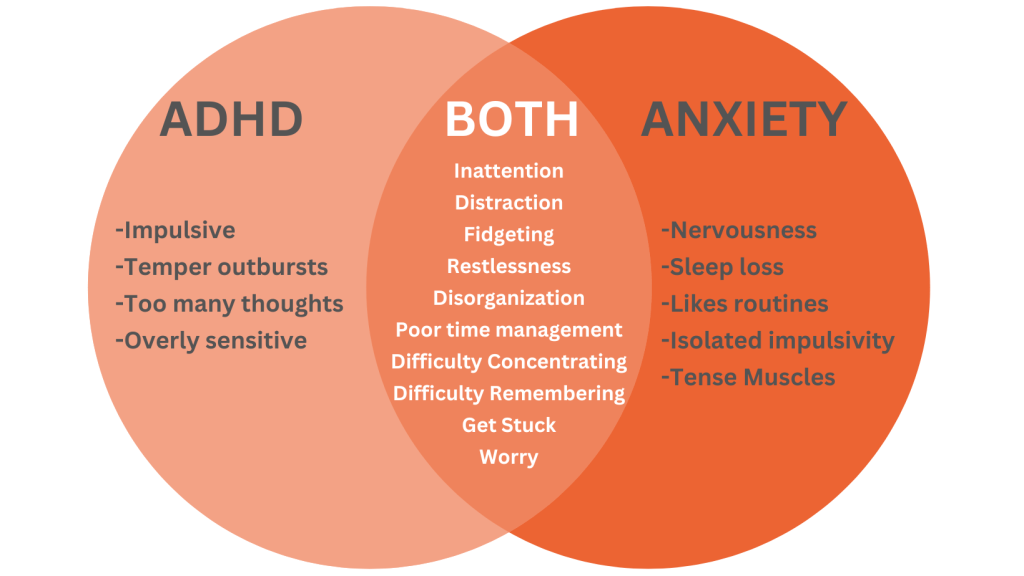
This can be really difficult to untangle, even for professionals. Under each diagnosis in the DSM-5TR, is a section called “Differential Diagnosis.” The experts who created and revised the diagnostic manual deemed this a necessary component because of the amount of overlap of symptoms between different diagnoses. Take a look at some informational Venn diagrams other sources have created that highlight how similar symptoms can be between two completely different diagnoses:

This one, from the NESCA website (https://nesca-newton.com/#), shows similarities in symptoms of ADHD and Anxiety.

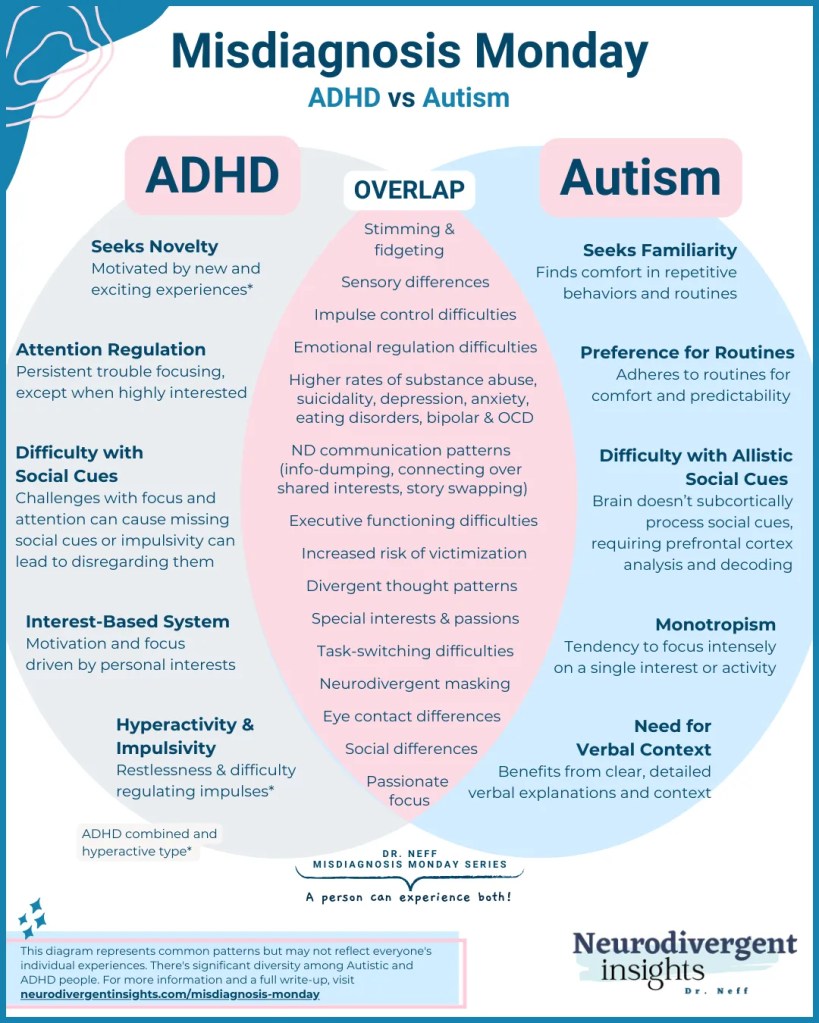
And this one shows similarities between ADHD and Autism.

Most people will be able to relate to symptoms for several diagnoses over their lifetime.

I saved this point for last, because this is a point that has stuck with me from an introductory psychology course I took in college. Prior to beginning lessons into diagnosis, the professor warned the young students in class that we would likely see symptoms that we have experienced. He encouraged us not to begin worrying about having a diagnosable disorder just because we can related to 1 or 2 symptoms when looking at a disorder. Why? Because almost all of us have experienced symptoms of mental health. But that doesn’t mean we have a diagnosable mental health disorder.

If I look at the diagnostic criteria for Autism Spectrum Disorder, I can identify that I experience “Hyper- or hyporeactivity to sensory input…” I’m pretty sensitive to loud noises, bright lights, lots of movement, etc. I get stressed pretty easily when I’m in an environment with random, loud noises (helping at my daughter’s school), bright lights, or just a lot going on in general. Does this one symptom mean I might qualify for an Autism Spectrum diagnosis? Absolutely not.

To summarize, though this is not an exhaustive list of why diagnosis is complicated, hopefully it provides some insight into why self-diagnosis is really difficult to get right.


So what do you do if you see a social media video (or read an article, talk to a friend, etc.) that makes you suspect you have several symptoms of a specific diagnosis? Number one, do more research from legitimate sources. Some legitimate sources include (I am not affiliated with any of these sites):

Also, I’d recommend that you find and complete a questionnaire from a reputable site. However, keep in mind that, just as with videos on social media, these questionnaires cannot be used alone to make a diagnosis. Mental Health America has a set of questionnaires for several diagnoses (https://screening.mhanational.org/screening-tools/).

If you do more research, and are interested in a formal diagnosis for treatment or other purposes, I’d recommend talking to a professional who is qualified to diagnosis. In the meantime, it would be accurate for you to make comments such as “I experience some symptoms of anxiety,” or “I suspect I might have a depressive disorder.” These are ways for you to acknowledge and share your symptoms, if you have not been formally diagnosed by a professional.

Disclaimer: I am a licensed independent mental health practitioner and certified professional counselor, but I am not your therapist. The information in this article is for general informational purposes only. This article does not create a therapist-client relationship. If you need specific recommendations based on your individual circumstances, please consult with a mental health practitioner near you.