Hot Chocolate Breathing (A Calming Skill)

Who loves hot chocolate/cocoa? I do! So yummy, especially in the winter after we’ve been building snowmen or shoveling. Most kids I know LOVE hot chocolate, so Hot Chocolate Breathing is such a FUN way to calm down. It’s not uncommon for kids to be resistant to using calming skills when prompted, but when you make them fun, usually kids are more willing.

So what is hot chocolate breathing? It’s pretending to have a mug of hot chocolate in your hands, blowing on it because it’s too hot, then sipping it. It’s a way to get kids to take some deep breathes to calm down.

This is what I would say to engage a child in hot chocolate breathing:

“Put your hands out in front of you like you’re holding a mug, and pretend that mug is full of hot chocolate. Pretend you can see the steam coming off the mug, so you know it must be very, very hot. Let’s blow on it to try to cool it down. Take a big breathe, then slowly blow on your hot chocolate. Not too fast – you don’t want to spill! Okay, good, let’s do it again. Big breath in, then slowly blow out on your hot chocolate. Okay, let’s try a sip… wow! Still too hot! Let’s do two more big breaths to try to cool it down. Okay, let’s try it okay. Mmmmm… this is perfect, and so yummy.”

You can also make it more fun by adding marshmallows… before you take deep breathes, you could say, “I like marshmallows in my hot chocolate. How many marshmallows should we put in today? 12? Sounds good! Let’s pretend our marshmallows are here on the side. Let’s pick them up one at a time and count them until we get to 12.”

Adding the marshmallows can make this calming skill even more effective because you’re combining counting (another great calming skill) with deep breaths.

Some tips for getting kids to learn and use calming skills:

  • Teach calming skills when your kids are calm. It’s not very beneficial to try to teach your child a new calming skill when they’re escalated.
  • It’s usually best to do this WITH your child. Rather than say, “go do your hot chocolate breathing,” say instead, “let’s do your hot chocolate breathing together.” This makes it much more likely that your child will comply with the prompt.
  • Praise your child for using coping skills – both prompted and unprompted! This makes it much more likely that they will continue to use them.

I’m excited to hear how you’ve used this with children, and any modifications you’ve added (like counting marshmallows). Let me know with a comment!

Disclaimer: I am a licensed mental health therapist, but I am not your therapist. The information in this article is for general informational purposes only. This article does not create a therapist-client relationship. If you need specific recommendations based on your individual circumstances, please consult with a mental health practitioner near you.
Using Stress Balls for Emotional Regulation (and How to Make Your Own)

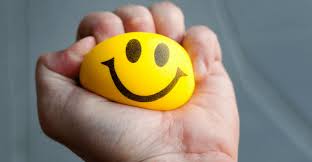
Stress balls can be a very effective tool for calming down when overwhelmed with emotions.  I think it helps for a few reasons… One reason is that it’s an activity to distract you from triggers and negative thoughts.  Another is that it involves muscle tensing and relaxing (while you squeeze the stress ball).  And a third reason is that it might be a little cathartic… squeezing something with a lot of force.

You can find stress “balls” in all shapes, colors, and sizes.  I even have one shaped and designed like a zebra… though my 1-year-old is currently using that with her Noah’s Ark Little People set.  A quick Amazon search for “stress ball” will bring up stress balls shaped like cats, emoji stress balls, and even one shaped like a breast (I don’t recommend buying that one for your kiddo).

In lieu of buying one online, you can easily make your own – or turn it into a family activity.  All you’ll need is a balloon, either rice or flour, and some sort of funnel to get the rice or flour into the balloon.  Then just follow these easy steps:

  • Stretch out the balloon a bit.
  • Use the funnel to get the rice/flour into the balloon.
  • Squeeze the air out of the balloon.
  • Tie off the balloon.
  • Cut off any excess rubber at the end (if necessary/desired).

This way, your kiddo can choose what color they want and could even possibly draw on the balloon with permanent marker to make it unique!

Keep in mind, as with any calming strategy, that children may need LOTS of reminders and practice to use calming strategies when they get upset.  So practice, practice, practice!  And don’t be afraid to offer a simple reminder like, “I can see you’re upset.  Why don’t you use your stress ball for a few minutes.”

Five Different Counting Strategies for Emotion Regulation

One of the more common calming strategies discussed in therapy is counting.  The idea behind many counting strategies is that the brain cannot think about two things at one time.  So if someone is thinking about counting, they cannot be thinking about how angry they are.  It disrupts the thought process, which can make it a lot easier to calm down.

Since the same calming strategies don’t work for everyone, it can be beneficial to try out different strategies to see what works for your child (or you!).  Here are 5 different counting strategies to try:

  1. Regular counting – this is what most people think of when they think of “counting.”  You start with 1 and count up to a specific number.  For younger kiddos, counting to ten might be challenging enough to do the trick, but older kiddos may need to count to a higher number to sufficiently distract themselves and calm down.
  2. Counting backward – start with a specific number and count down to 1 (or 0).  This can require a little more effort and concentration than regular counting.
  3. Counting objects – this combines counting with making lists.  Pick something to list/name as you count.  I’ve had kiddos count and name dinosaur types after each number.  I’ve also had kiddos count Disney princesses, pizza toppings, and types of trains.  This would sound like, “one Cinderella, two Sleeping Beauty, three Snow White, 4 Tiana, etc.).
  4. Counting by a number (3s, 4s, 8s, etc.) – count by multiples of a certain number as high as you can.
  5. Counting in a second language – if your kiddo knows another language, you could have them count in another language.

These are all great counting strategies for kids to know and try.  The more “tools” a child has to calm down, the better!

Get Grounded! A Strategy for Regulating Emotions

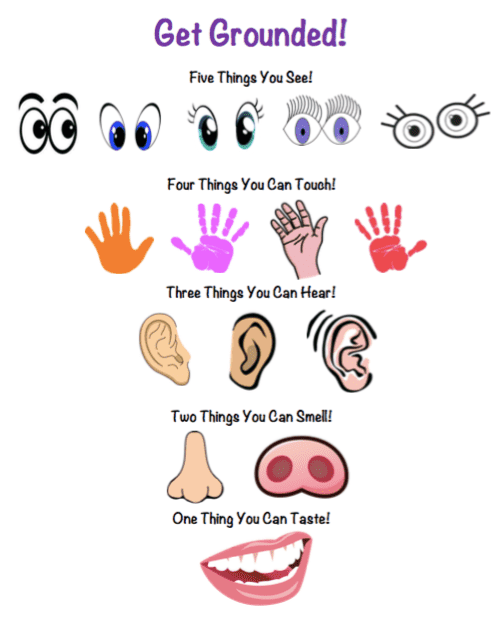
One grounding technique (to assist those dealing with overwhelming emotions) is to list 5 things you can see, 4 things you can feel/touch, 3 things you can hear, two things you can smell, and one thing you can taste.

I use this myself when I am trying to stay in control of my emotions and think it could be a great strategy for children.  To help kiddos remember to use the strategy and how to do it, I created a sign that can be printed (get the pdf here.)

Screen Shot 2017-12-05 at 11.37.22 AM

Five Things I Do for Self-Care

To prove that I practice what I preach (that caregivers should engage in regular self-care), I thought I’d share what I do to help me manage the stress and anxiety of adulthood/parenthood.

1. Exercise – this is the most important one for me. I can tell a HUGE difference in my mood if I don’t exercise 2-3 times per week. When it was nice outside I would jog or walk with the baby and dog. Now that it’s cold, it’s more difficult to get in, but I try to get on the elliptical or treadmill a few times per week.

2. Read – when I’m not SUPER tired (so maybe 3-4 times per week), I try to read before bed. Earlier this week I finished Dan Brown’s new book, Origins.

3. Get out of the house – I get real bad cabin fever if I don’t leave the house every few days. Yes, it can be a pain to get the baby out, but I get pretty grumpy if I don’t get out and make an extra trip to target or hobby lobby, or just walk around the mall.

4. Play games on my iPad – this is going to sound soooo childish and I’m a little embarrassed to admit it, but I’m hooked on Cooking Fever and it’s one of the first things I do after the baby goes to bed. It just helps me disconnect from the stress of the day.

5. Play the piano – full disclosure: I don’t get to do this as much as I want to. Every time I start playing the piano, the baby crawls over and wants to bang on the keys. I’m happy to let her do that, but I cannot play and hold her in my lap at the same time!

My challenge for EVERYONE is to do at least one thing each day that is for you only and makes you feel happy, calm, and/or less stressed. If you make it a priority, you’ll see positive results!

Inside Out Feelings and Calming Strategies Worksheets

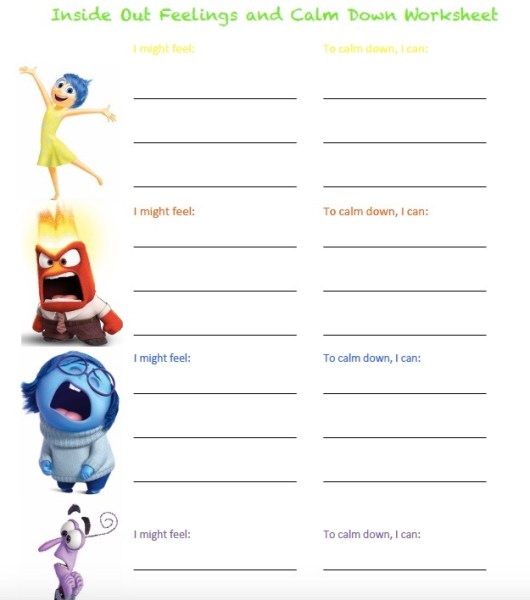
love using Inside Out when working with kids on emotion identification and emotion regulation.  It’s a fun movie and kids generally have a positive response when they see any of the characters from Inside Out, which mean the activity usually goes rather well.

I have created this worksheet to help kids identify how they’re feeling, how their body might be feeling, and some calming strategies they can use to help calm down.  This is similar to the Inside Out Feelings Book that I posted, but this worksheet is all on one piece of paper… and the reason for that is that I thought it would be nice to print this worksheet out and put it somewhere in the home (on the fridge, maybe?) as a visual prompt from kiddos.

Screen Shot 2017-10-16 at 12.39.39 PM

Download it here: Inside Out Feelings and Calming Strategies Worksheet

What I would do is sit down and help your kiddo fill in the blanks on the worksheet – for each of the four emotions (joy, anger, fear, sadness) there are 3 lines to write in body signals (how their body feels when they feel that emotion) and 3 lines to write an appropriate calming strategy.  Some of the body signals and calming strategies might overlap, but it would probably be beneficial to make sure there’s some variety!

Once it’s all filled out, put it somewhere your kiddo can see it.  Then, when you notice your child getting upset, prompt them to go find their Inside Out Feelings Worksheet, identify how they feel (help them, if needed due to age or development), then identify a calming strategy to use to calm down.

Push-Pull-Dangle for Emotional Regulation

An amazing kiddo that I work with taught me a new calming strategy that can be used at while sitting in a chair.  I love this idea for two BIG reasons.  First, it can be done at school without being disruptive.  Second, it can be done discreetly – I have worked with lots of kids who don’t want people to see/know that they’re trying to calm down.

So the strategy is called “push-pull-dangle” and there are 3 steps.

  1. Put your hands on the top of your chair seat and push as hard as you can.  Depending on how long your arms are and how strong you are, your bottom might come off the seat.
  2. Put your fingertips on the underside of your chair and pull, so that you’re pulling your bottom/body into your chair seat.
  3. Let your arms dangle loosely at your side.

This seems to be a form of a muscle tension/relaxation calming strategy – you tense your muscles by pushing and pulling, then relax them by letting them dangle.

Give it a try yourself, and maybe teach it to your kiddo to give them another tool to use to help them stay calm when overwhelmed with negative emotions!