Using Stress Balls for Emotional Regulation (and How to Make Your Own)

Stress balls can be a very effective tool for calming down when overwhelmed with emotions.  I think it helps for a few reasons… One reason is that it’s an activity to distract you from triggers and negative thoughts.  Another is that it involves muscle tensing and relaxing (while you squeeze the stress ball).  And a third reason is that it might be a little cathartic… squeezing something with a lot of force.

You can find stress “balls” in all shapes, colors, and sizes.  I even have one shaped and designed like a zebra… though my 1-year-old is currently using that with her Noah’s Ark Little People set.  A quick Amazon search for “stress ball” will bring up stress balls shaped like cats, emoji stress balls, and even one shaped like a breast (I don’t recommend buying that one for your kiddo).

In lieu of buying one online, you can easily make your own – or turn it into a family activity.  All you’ll need is a balloon, either rice or flour, and some sort of funnel to get the rice or flour into the balloon.  Then just follow these easy steps:

  • Stretch out the balloon a bit.
  • Use the funnel to get the rice/flour into the balloon.
  • Squeeze the air out of the balloon.
  • Tie off the balloon.
  • Cut off any excess rubber at the end (if necessary/desired).

This way, your kiddo can choose what color they want and could even possibly draw on the balloon with permanent marker to make it unique!

Keep in mind, as with any calming strategy, that children may need LOTS of reminders and practice to use calming strategies when they get upset.  So practice, practice, practice!  And don’t be afraid to offer a simple reminder like, “I can see you’re upset.  Why don’t you use your stress ball for a few minutes.”

Five Different Counting Strategies for Emotion Regulation

One of the more common calming strategies discussed in therapy is counting.  The idea behind many counting strategies is that the brain cannot think about two things at one time.  So if someone is thinking about counting, they cannot be thinking about how angry they are.  It disrupts the thought process, which can make it a lot easier to calm down.

Since the same calming strategies don’t work for everyone, it can be beneficial to try out different strategies to see what works for your child (or you!).  Here are 5 different counting strategies to try:

  1. Regular counting – this is what most people think of when they think of “counting.”  You start with 1 and count up to a specific number.  For younger kiddos, counting to ten might be challenging enough to do the trick, but older kiddos may need to count to a higher number to sufficiently distract themselves and calm down.
  2. Counting backward – start with a specific number and count down to 1 (or 0).  This can require a little more effort and concentration than regular counting.
  3. Counting objects – this combines counting with making lists.  Pick something to list/name as you count.  I’ve had kiddos count and name dinosaur types after each number.  I’ve also had kiddos count Disney princesses, pizza toppings, and types of trains.  This would sound like, “one Cinderella, two Sleeping Beauty, three Snow White, 4 Tiana, etc.).
  4. Counting by a number (3s, 4s, 8s, etc.) – count by multiples of a certain number as high as you can.
  5. Counting in a second language – if your kiddo knows another language, you could have them count in another language.

These are all great counting strategies for kids to know and try.  The more “tools” a child has to calm down, the better!

Get Grounded! A Strategy for Regulating Emotions

One grounding technique (to assist those dealing with overwhelming emotions) is to list 5 things you can see, 4 things you can feel/touch, 3 things you can hear, two things you can smell, and one thing you can taste.

I use this myself when I am trying to stay in control of my emotions and think it could be a great strategy for children.  To help kiddos remember to use the strategy and how to do it, I created a sign that can be printed (get the pdf here.)

Screen Shot 2017-12-05 at 11.37.22 AM

Inside Out Feelings and Calming Strategies Worksheets

love using Inside Out when working with kids on emotion identification and emotion regulation.  It’s a fun movie and kids generally have a positive response when they see any of the characters from Inside Out, which mean the activity usually goes rather well.

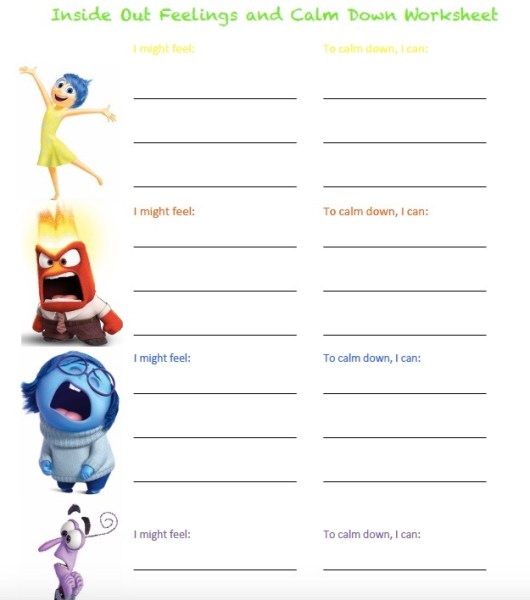
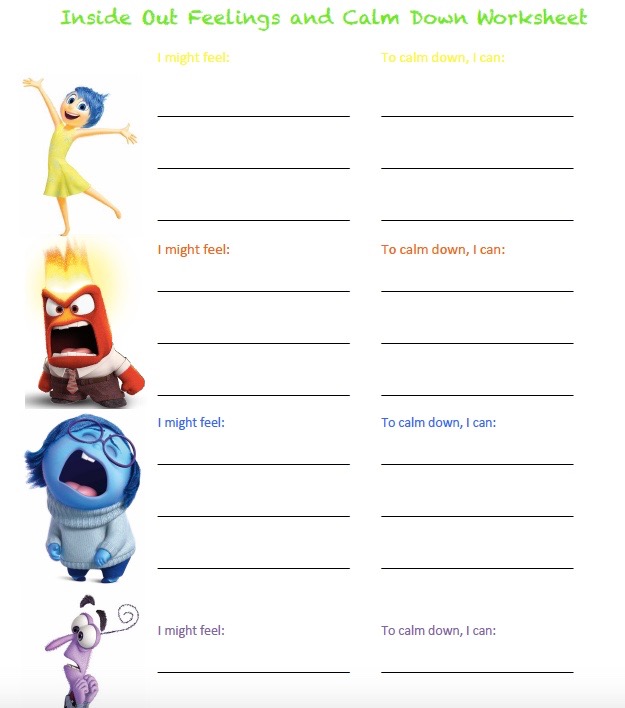
I have created this worksheet to help kids identify how they’re feeling, how their body might be feeling, and some calming strategies they can use to help calm down.  This is similar to the Inside Out Feelings Book that I posted, but this worksheet is all on one piece of paper… and the reason for that is that I thought it would be nice to print this worksheet out and put it somewhere in the home (on the fridge, maybe?) as a visual prompt from kiddos.

Screen Shot 2017-10-16 at 12.39.39 PM

Download it here: Inside Out Feelings and Calming Strategies Worksheet

What I would do is sit down and help your kiddo fill in the blanks on the worksheet – for each of the four emotions (joy, anger, fear, sadness) there are 3 lines to write in body signals (how their body feels when they feel that emotion) and 3 lines to write an appropriate calming strategy.  Some of the body signals and calming strategies might overlap, but it would probably be beneficial to make sure there’s some variety!

Once it’s all filled out, put it somewhere your kiddo can see it.  Then, when you notice your child getting upset, prompt them to go find their Inside Out Feelings Worksheet, identify how they feel (help them, if needed due to age or development), then identify a calming strategy to use to calm down.

Push-Pull-Dangle for Emotional Regulation

An amazing kiddo that I work with taught me a new calming strategy that can be used at while sitting in a chair.  I love this idea for two BIG reasons.  First, it can be done at school without being disruptive.  Second, it can be done discreetly – I have worked with lots of kids who don’t want people to see/know that they’re trying to calm down.

So the strategy is called “push-pull-dangle” and there are 3 steps.

  1. Put your hands on the top of your chair seat and push as hard as you can.  Depending on how long your arms are and how strong you are, your bottom might come off the seat.
  2. Put your fingertips on the underside of your chair and pull, so that you’re pulling your bottom/body into your chair seat.
  3. Let your arms dangle loosely at your side.

This seems to be a form of a muscle tension/relaxation calming strategy – you tense your muscles by pushing and pulling, then relax them by letting them dangle.

Give it a try yourself, and maybe teach it to your kiddo to give them another tool to use to help them stay calm when overwhelmed with negative emotions!