Problem Solving Flower Worksheet

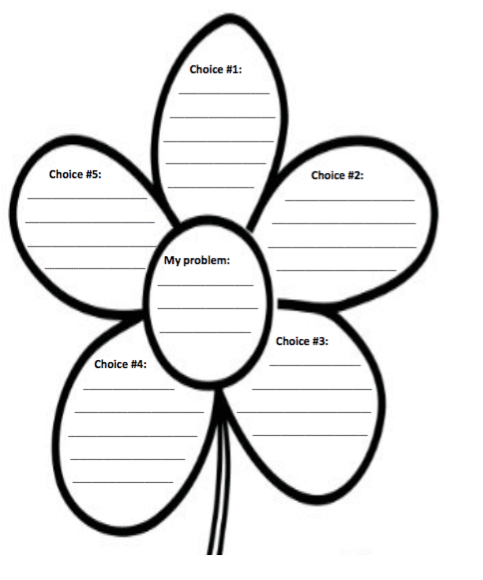
Due to the way kids’ brains develop, they’re not always great at problem-solving.  It can be difficult for them to think about all the choices they have in a situation, think about the outcomes of those situations, then make a decision based on that information.  BUT with some help from an adult, they’re usually capable of doing so… they just need some help going through the steps.  Also, a visual representation usually helps make the process more entertaining for the child.  Below, you’ll find a problem-solving worksheet that can be used to help guide a child through the problem-solving process (printable copy here).
Screen Shot 2018-01-21 at 8.09.21 PM

Start by having your child write (or write for them) the “problem” in the center of the flower.  Then, have them come up with 5 different choices they could make to try to solve their problem.  If it’s a not-so-great choice (or a TERRIBLE) one, go ahead and let them write it down.  After each choice they come up with, have them identify what the outcome might be and talk about it.  So, if their “problem” is that their brother is calling them names and the “choice” is to kick him, talk about how his/her brother might get hurt, and that your kiddo will get in trouble for kicking his/her brother.

If you need more than 5 spaces, fill up the back.  Once you and your kiddo have all the choices you can think of, sum up each choice and the outcomes, then help your kiddo pick the best option and follow through on it.

Note: this worksheet can also be used if your kiddo has ALREADY acted (and made a not-so-great choice).  Just have them write out all the choices and outcomes, pick which one would have been a better choice, then practice it.  We can’t go back in time and change what they did, but going through this will make it more likely that they’ll make a better choice if/when the same situation (or a similar one) comes up in the future.

Behavior is a Choice (and How Parents Can Use This Knowledge)

It may not feel like it, but every behavior is a choice. I went into our master bathroom today and, as usual, my husband has neglected to pick up the hangers from his clothes (and for some reason this drives me crazy). Before I sighed and rolled my eyes, I thought to myself… I can either get mad about it, or I can just do it myself and move on with my day. So I picked them up and moved on with my day.

Some behaviors don’t feel like choices. When I pay my mortgage, I don’t feel like I have a choice to do otherwise. But I do! I can choose to pay my mortgage, or I can choose not to and suffer the consequences of late fees, a hit on my credit, and potentially (eventually) foreclosure and homelessness. My husband may not feel like he has a choice about employment, but that’s only because to choose not to work would mean choosing to not be able to pay bills and provide for the family.

As adults, most of us are pretty good at using our well-developed brains to think through what the consequences of each of our behaviors are. I know that if I run a red light, I might get pulled over and get a ticket. I know that if I don’t do laundry, I won’t have clean clothes to wear. I know that if I eat a bunch of junk food I feel sluggish and my face breaks out.

Children’s brains aren’t as developed and they probably have a difficult time thinking about the consequences of their actions without a reminder or repetition. That’s why consistent consequences are so important. If you are consistent with putting your child in a timeout every time they hit their sibling, it won’t take long for them to catch on that hitting = timeout. Once you know that your child is aware of the consequences of a behavior, you know that they are making the choice to misbehave even though they know there will be a consequence. This, to me and many of the parents I’ve worked with, makes discipline a little easier. It makes you, as a parent, feel less like “the bad guy.” Your kiddo knew that they had a choice to make and chose something that would lead to consequences, so they take on that responsibility.

It’s also really helpful to frame it that way to a child by telling them the choice they made, followed by the consequence. Some examples:

  • “You chose not to eat your vegetables at dinner and the consequence is no bedtime snack.”
  • “You chose to argue when told it was time for bed, so now you won’t get a bedtime story.”
  • “You chose not to complete your worksheet at school, so now you won’t have any free time until it’s completed here at home.”
  • “You chose not to clean your room when I told you to, so now you owe me an extra chore after you clean your room.”

Speaking this way let’s your kiddo know that the consequence is a result of a behavior (choice) that they made, not because you’re a “mean” mom or dad. It can also be beneficial to remind your child of their choices and consequence if they are struggling to make the right choice. If you tell your child it’s time for bed and he begins arguing, reminding him that choosing to go to bed right away results in a bedtime story, while choosing to argue results in no bedtime story, you can help him make a better choice. Granted, he may choose to argue anyways, but at least you can be 100% sure that he knew what the consequence was before making his choice.