
Tips for Identifying What “Function” is Fueling Your Child’s Behavior

If you haven’t heard of the Four Functions of Behavior, read about it here. Basically, the Four Functions of Behavior are the reasons your child is behaving the way they are. Sometimes it’s really easy to identify the function of their behavior. Sometimes it can be a little tricky.

One thing that might help is to make a timeline of what happened just before, during, and after their behavior. Here’s an example:
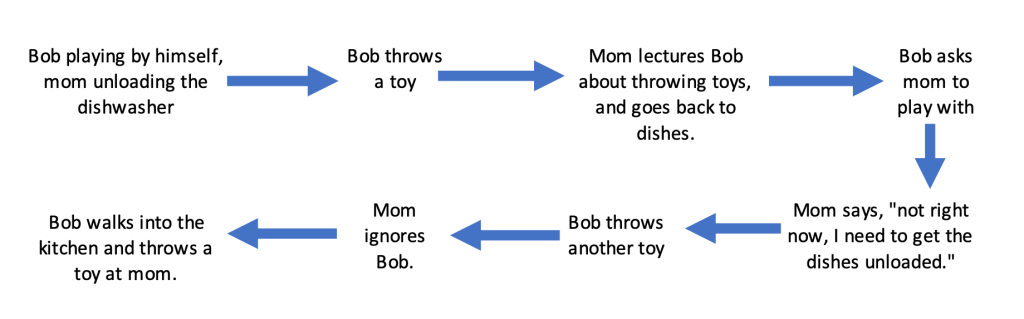
In this situation, the most likely function of Bob’s negative behavior was the desire for attention. How do we know this? Look at what immediately happens prior to Bob’s negative behavior (which was throwing toys)… he was either not getting any attention at all, or had just been told by his mother that she couldn’t give him attention. Whether he would have been able to verbalize the need or not, Bob wanted attention and was willing to do anything to get it.

Another tip to help determine the function of behavior is to think about these questions…

  • What happened just prior to the negative behavior?
  • What finally got my child to stop?
  • Was my child trying to get something?
  • Had my child just been told they couldn’t have something?
  • Was my child trying to get out of doing something?
  • Had my child just been told to do something they likely didn’t like?
  • Was my child feeling overwhelmed with negative emotion?
  • Immediately after the negative behavior, did they seem calm?

A final tip is to use an ABC chart to track Antecedents, Behaviors, and Consequences. This can be helpful to track patterns of behavior over time. You can just use a piece of paper and draw 4 columns (Day, Antecedent, Behavior, and Consequence), or you can download the one I created here.

If you’re still having a hard time and the behaviors are creating disturbances at home or school, it may be time to talk to a therapist/counselor for help!

Disclaimer: I am a licensed mental health therapist, but I am not your therapist. The information in this article is for general informational purposes only. This article does not create a therapist-client relationship. If you need specific recommendations based on your individual circumstances, please consult with a mental health practitioner near you.

7 Tips For Success With Remote Learning

Remote learning. As my 3 year old would say… HOLY GUACAMOLE. I have so much respect for parents who are having to navigate remote learning with their child(ren). Especially those who are doing so while working a first time job!

Remote learning is coming up a lot during my therapy sessions with parents of school-aged kiddos. It’s a struggle for every family I’m working with. Every. Single. Family. The issues? Kids refusing to log in and participate. Kids having a difficult time staying engaged. Technology issues. Kids doing inappropriate things on devices (even school devices!) during school time. Kids lying about having “break time.” Kids interrupting parents who are trying to work-from-home in the same room. ALL kinds of concerns. So if you think you’re alone in dealing with these behaviors, you definitely are not!

And let’s all just take a second and think about how hard this is on our kids. Yikes. Eight year olds are not meant to spend 7 hours a day in front a screen doing “school.” Not only is sitting in front a screen all day bad, but add in that many kids aren’t seeing friends, extended family members, aren’t engaging in clubs and other extracurricular activities, and aren’t going out for “fun” (movie, bowling, skating, etc). Their whole worlds have been turned upside down. So remember to have realistic expectations and lots (LOTS!) of grace. For yourself and the tiny humans you’re responsible for.

To help with succeeding at remote learning, here are SEVEN things you can try:

  1. Set expectations and clearly communicate these expectations to your child(ren). My expectation would be that they treat their remote school learning as they would a regular school day. No getting out of your chair unless given permission, no distracting items on your desk, and no snacks except during break. Definitely no electronics (other than what is needed to complete school sessions/work).
  2. Set up a school space. This doesn’t have to be anything fancy, but have a set school space. It’s probably not a good idea to let your child do school work on their bed or on the living room floor with the television on. Have them sit at a desk or a table if possible. Try to remove as many distractions as you can. Have their supplies ready and accessible from their seat. You may not be able to anticipate every need, but do the best you can to have everything ready for their school day.
  3. Monitor your child(ren)! There are so many more distractions/temptations at home and anyone who has children knows that attention spans are a struggle. Be in the room to prompt them back to their work when needed. (Note: I’m well aware that this step may be near impossible for some parents, depending on their work situation – do what you can, cut yourself some slack when it’s not a choice for you. You are a super-parent, but there are some things you can’t control).
  4. Offer praise and small rewards throughout the day. For kiddos who are really struggling to stay engaged, offer a small reward periodically throughout the day. Maybe after each class session, depending on how their school is structured. Or once per hour (or half hour, if the struggle is really, really real).
  5. Offer a reward at the end of the day. This can either be done on its own or in addition to a small reward throughout the day. If your child stays engaged and gets all their work done, let them pick out a preferred snack at the end of the day. Or allow an extra 15 minutes of electronics time. Pick something that is motivating for them, but make sure they earn it!
  6. Use break time wisely. Most parents I’ve talked to who have kiddos doing remote learning have told me that their kiddos get break times throughout the day. Instead of letting them use that time to zone out on YouTube or lay down, get them up and moving around! This will help get energy out and help them be able to focus better when it’s time to get back to their school screen. Create a list of physical activity for them to do – jumping jacks, squats, lunges, starfish jumps, etc. Have them do a KidzBop dance video. Have them walk up and down the stairs a few times. Have them go outside and run around the house (if this is safe and the weather cooperates).
  7. Consider fidget toys and/or fidget seat. I’ve heard from all of my families with ADHD kiddos that focus is more difficult when remote learning than in class. One thing that may help your child is to have a toy (or several) to fidget with, or a seat that they can move around in. You can find several variations of the fidget seats… wiggle seat, wobble chair, etc. OR try a big medicine ball. OR, I saw a neat idea the other day where a parent turned their kiddo’s bike into a stationary bike for them to ride while they do their school work. Note: some kiddos may be extra distracted with these options, so it may take some trial and error.

Good luck! You can do it! Have any suggestions of your own or things that have worked well with your kids? Drop a comment and share!

Disclaimer: I am a licensed mental health therapist, but I am not your therapist. The information in this article is for general informational purposes only. This article does not create a therapist-client relationship. If you need specific recommendations based on your individual circumstances, please consult with a mental health practitioner near you.

Tips for Getting Your Child to Wear a Mask

I don’t want this to be a political post… I’m not going to say whether or not I agree with mask-wearing or whether or not I think requiring them is infringing on our freedom. That’s not what this site is for. The reality is that with the COVID-19 pandemic (which probably isn’t just going to go away any time soon), many states/schools/businesses are requiring people to wear masks when in public places. Whatever your reasons for encouraging your child to wear a mask (because it’s required or because you’re an advocate of mask-wearing), here are some tips for getting your child to wear one:

  • Wear a mask yourself. This doesn’t work for every child, but many children will be more likely to wear a mask if they see their caregivers wearing a mask. My daughter is highly motivated to wear a mask because she’s (somehow) thinks her mom and dad are pretty cool, so if we wear masks, she’s more than happy to wear hers.
  • Provide rationales/reasons. Talk to your kids (depending on age) about why it’s important to wear a mask. You don’t have to scare them, but give them just enough information to explain why wearing a mask is important. This might be, “the store won’t let us shop here if we don’t have it on,” or might be “masks help protect people from germs.” Try not to overthink it. Depending on the age of your child, knowing WHY they need to wear a mask might make them more likely to follow through.
  • Take baby steps – get them used to wearing a mask a little bit at a time. If your child is going to be required to wear a mask ALL DAY at school, or if you’re going to have your child wear a mask on a long plane ride, it’s in your and their best interest to have them “practice” for smaller amounts of time leading up to those longer periods of time. Start with 10-15 minutes and work your way up.
  • Praise and speak positively about masks. Anyone familiar with this site knows I’m a big believer in praise. It can do wonders. So praise your child for wearing a mask. Tell them they’re doing a great job. Also, talk positively about masks and mask-wearers when you’re around your child. If it’s your opinion that nobody should be required to wear a mask and masks are worthless, then great – you have the right to that opinion. AND you have the right to share that opinion with anyone you want. But I’m here to tell you that if you’re bashing masks and people who wear them while your child is within earshot, your kiddos is going to be less likely and less motivated to wear a mask if/when you need them to.
  • Make it fun. Turn mask-wearing into a sort of game… your a special kind of super hero and your mask if you “cape.” Find masks with fun prints. Turn “practice” time into a game, to see who can keep their mask on the longest. Find ways to make it fun and you’re sure to have a kiddo who enjoys wearing a mask.
  • Reward. If all else fails, offer a reward. If your child is required to wear a mask at school, let them know that they can have a favorite snack when they get home if they make it through the day with their mask. Offer a few extra minutes of screen time if your kiddo complies with mask-wearing. Do what you need to do.

Good luck! Comment with any ideas that have worked for you that you’d like to share!

Disclaimer: I am a licensed mental health therapist, but I am not your therapist. The information in this article is for general informational purposes only. This article does not create a therapist-client relationship. If you need specific recommendations based on your individual circumstances, please consult with a mental health practitioner near you.

Using a Token Economy with Kids

Do you know what a token economy is? Never fear, you’re about to find out! The term might sound a little intimidating, but using a token economy with kiddos is a great way to improve behavior. A token economy means that they are getting small objects (tokens) for instances of good behavior – then, once they earn enough “tokens,” they trade them in for a prize.  Just like how I earn money for working, then turn it in for a prize to pay bills after I get paid… that’s a lot less fun, but the concept is the same.

A few examples:

  • I might give my daughter a “token” every time she follows a direction the first time asked. When she has collected 10 total, she gets some electronic time.
  • I might give my kiddo a “token” every time he completes his homework. Once he has 10 tokens, he gets to pick a fun family outing.

A token economy is a great way to use big rewards for many instances of good behavior, while also making sure you’re giving praise and a small reward (the token) immediately… because immediacy is important, remember? If you don’t, read Tips for Making Praise Effective.

So how do you get started? First, pick a positive behavior you want to increase. It could be just about anything that you want your kiddo to do more of.  Second, pick what you will use as a “token.” You want it to be something fun, something easy to keep track of, and something that your kiddo won’t find around the house (and cheat by adding to the pile they’ve been given).

A few ideas (in no particular order):

  • Stickers
  • Marbles
  • Colored or marked Q-tips
  • Rubber bracelets
  • Rubber bands (marked)
  • Colored paper clips
  • Fake coins
  • Laminated pieces of paper

**I feel like I shouldn’t have to say this, but… don’t use any smaller items if your kiddo is young enough that the item could be a choking hazard.**

Next, pick a reward AND decide what the goal is – how many small objects does your child need in order to earn the reward.  You don’t want to make this goal too easy or too hard, but remember: if you do, you can always bump that goal up or down.  As for choosing a reward, you can enlist the help of your child if you need to – just ask them what they’re interested in earning.  Or, you could also do a reward menu, where the kiddo would get to choose from a list of rewards once they meet their goal.  There really are a lot of options!

After you’ve made all of these decisions, explain what’s happening to your child – that they will earn a small object (whatever you’ve chosen) each time they do whatever positive behavior you’ve chosen, then they will be able to turn those small objects in, once they’ve earned a certain amount, for a bigger reward.  The next step?  Catch them being good and be consistent with handing out those small objects.  Not too difficult, right?  Good luck!

Three Steps (Tell-Show-Do) for Encouraging Compliance with Young Children

Little kids, especially those under 3 years of age, can have a VERY difficult time following directions – which is completely age-appropriate!!  For one, their communication skills are developing, so they may not understand a lot of commands that are said to them.  Secondly, their attention spans are extremely short!  Also, they’re testing their independence and may show a defiant streak!

I do not believe it’s appropriate to give a negative consequence to a child for something that they don’t understand or are unable to do, due to age and development.  BUT you still want to have kiddos of all ages follow through on every task you give them.  So how do you get a child under the age of 3 with limited verbal skills to do this?  You follow 3 steps:

  1. TELL your child what you want them to do.  Keep it short – recommended length of a prompt/direction is one word per age of life (which isn’t always possible, but keep it short)!  Also attempt to be specific.  You might tell your 2-year-old to “pick up toys.”  If she doesn’t…
  2. SHOW your child what you want them to do.  If you told your 2-year-old to “pick up toys” and she looks at you, then keeps playing, get her attention again and show her what you want her to do by picking up a toy and putting it in the box.  Then repeat your prompt (“pick up toys”) and give her the opportunity to pick up.  If she doesn’t, then…
  3. DO the task with your child, hand-over-hand.  Take your daughter’s hand, pick up a toy together, and put it in the toy box.  Once you complete one part together, start over with step one by verbally repeating the prompt.

This is more of a teaching and practicing method – your goal is to help your little one understand what prompts mean, but you’re also teaching them that it’s important to follow through with what mom/dad say!

Disclaimer: I am a licensed independent mental health practitioner and certified professional counselor, but I am not your therapist. The information in this article is for general informational purposes only. This article does not create a therapist-client relationship. If you need specific recommendations based on your individual circumstances, please consult with a mental health practitioner near you.

Three Steps (Tell-Show-Do) for Encouraging Compliance with Young Children

Little kids, especially those under 3 years of age, can have a VERY difficult time following directions – which is completely age-appropriate!!  For one, their communication skills are developing, so they may not understand a lot of commands that are said to them.  Secondly, their attention spans are extremely short!  Also, they’re testing their independence and may show a defiant streak!

I do not believe it’s appropriate to give a negative consequence to a child for something that they don’t understand or are unable to do, due to age and development.  BUT you still want to have kiddos of all ages follow through on every task you give them.  So how do you get a child under the age of 3 with limited verbal skills to do this?  You follow 3 steps:

  1. TELL your child what you want them to do.  Keep it short – recommended length of a prompt/direction is one word per age of life (which isn’t always possible, but keep it short)!  Also attempt to be specific.  You might tell your 2-year-old to “pick up toys.”  If she doesn’t…
  2. SHOW your child what you want them to do.  If you told your 2-year-old to “pick up toys” and she looks at you, then keeps playing, get her attention again and show her what you want her to do by picking up a toy and putting it in the box.  Then repeat your prompt (“pick up toys”) and give her the opportunity to pick up.  If she doesn’t, then…
  3. DO the task with your child, hand-over-hand.  Take your daughter’s hand, pick up a toy together, and put it in the toy box.  Once you complete one part together, start over with step one by verbally repeating the prompt.

This is more of a teaching and practicing method – your goal is to help your little one understand what prompts mean, but you’re also teaching them that it’s important to follow through with what mom/dad say!

Inside Out Feelings Cube Activity

Games are such a great way to get children to talk about feelings.  Have you seen the episode of The Office where Michael has to complete some therapy sessions with Toby (whom he dislikes a lot)? In the episode, Michael REFUSES to talk to Toby about anything, but when Toby recommends a board game, Michael agrees, then suddenly starts opening up, then realizes that Toby has “tricked” him and is livid.  Now, I don’t try to “trick” kids into talking to me, but games and activities are certainly excellent tools to facilitate discussion.  It’s a lot more enjoyable!

I created two different documents which can be trimmed and folded into cubes, or “dice.”  One has all 6 Inside Out characters on it (Joy, Anger, Sadness, Fear, Disgust, and Bing Bong) and the other has 6 prompts for discussing feelings and calming strategies.  So you would have a kiddo roll both cubes and follow the prompt for whatever Inside Out character (the corresponding feeling) they roll.  You can pick what “feeling” you want to assign Bing Bong – maybe silly, surprised, or embarrassed.

So if I roll both cubes and get “Joy” and “tell me about a time you felt ___,” then I would talk about a time I felt happy.  If I rolled “Sadness” and “Show me something you can do to calm down when you feel _____,” then I would demonstrate a calming strategy that I use when I’m sad.

If you want to use a simplified version of the activity, you could just use the Inside Out character cube and pick one prompt to use for each roll.

The character cube looks like this (printable version here):

Screen Shot 2018-03-01 at 8.10.16 PMThe prompt cube looks like this (printable version here):

Screen Shot 2018-03-01 at 8.10.29 PM


Using Bracelets as a Reminder to Increase Praise

Old habits can be hard to break and new ones can be hard to keep up with.  I’ve heard numerous parents share that they “just don’t think about praising” on a regular basis, so it can be very hard for some caregivers to increase the frequency of praise they’re using.  But praise is so, so important!  Therefore, it’s important to do whatever it takes to retrain yourself to praise your children more often.

The “gold standard” for ratio of praise to correction is 4:1.  This means that for every behavior I correct, I should be praising my daughter 4 times.  I call this the “gold standard” because it can be extremely hard to meet.  All kinds of things can get in the way… parents are busy doing chores, paying bills, busy with multiple children, or spending time with their spouse.  So you may not meet the 4:1 ratio all the time, but it’s something to strive for.

One way to prompt yourself to praise more often is to use bracelets (or rubber bands).  There’s a few ways you can use them as a reminder:

  • You can have 5 bracelets, 4 of the same color (representing praise) and 1 of a different color (representing correction).  For example, I might use yellow for praise and green for correction.  We’re working on that 4:1 ration with this method!  Start with all the bracelets/bands on one wrist, then move them to the other wrist when you praise or correct.  So when I correct my kiddo, I move the green over to the other wrist.  Then my goal is to get all the 4 yellows moved over (by praising 4 different times) before I correct another behavior.  If you correct again before praising 4 times, just start again with trying to get 4 praise statements again before correcting a behavior (don’t give yourself an impossible task to make up the praise you missed in addition to 4 more!).
    • TIP: Start small by doing this for a small amount of time (maybe an hour?) at first.  If you haven’t been praising much, it will be exhausting to do this all day.
  • You can also set a goal for how often you want to praise in a specific time frame, then put that many bracelets on and move one over to the other arm every time you praise.  With this method, we’re just working on increasing frequency of praise!  So if I decide that I want to praise my kiddo 8 times in 10 minutes, I would start with 8 bracelets/rubber bands on one arm and move one over every time I praise, with my goal being that all 8 of the bracelets will be on the other arm when my 10 minutes is up.

Again, rubber bands are just as easy to use for this.  If you want to work on improving your ration and don’t have two different colored rubber bands, you could also mark 4 of them with “P” and 1 with “C” in permanent marker (“P” for praise and “C” for correction).  The little rubber bracelets are fairly cheap, though.  You can get a pack of 12 on amazon for $3.99.  I’m sure you can find them easily in stores too.

Remember to just do your best!  If you find it impossible to meet the 4:1 ratio, it’s Okay!  Maybe with your specific circumstances, a 3:1 ratio is more realistic.  The point is that most parents can definitely praise their children more than they do.  We’re striving for improvement, not perfection. 🙂


*If you need tips on praising, check out Tips for Making Praise Effective!

Why You Shouldn’t Use Warnings for Negative Behavior

Negative consequences can be difficult for caregivers to use and follow through with.  Few people actually want to discipline their children, and negative consequences can be inconvenient for caregivers.  These, perhaps, may contribute to a parent using warnings with children.  I’m sure these examples will sound familiar, as most adults have probably used warnings with their own kids, heard other parents use warnings, or heard warnings as a child from their parents.

  • “Do you want a timeout?”
  • “I’ll give you to the count of 3 to stop.”
  • “If you do that ONE more time, you’re going to be in trouble.”

Sure, these “warnings” might sometimes work to change behavior, but using warnings with children have some drawbacks.

  1. Your child may not take the warning seriously, which means they won’t be motivated to change the behavior.  If a parent uses warnings without a lot of follow through, the child won’t take the warnings seriously.  The child sees the warning as an empty threat.  The last time I was pulled over for speeding, all I got was a warning.  Trust me, I’m grateful for that, but it didn’t do much to change my driving speed.
  2. Your child may come to expect a warning each time they choose a negative behavior, so behavior won’t change long-term.  If a parent gives a child one warning every day for the same behavior, the kiddo is basically getting a free pass to behave that way once per day with no negative consequence.  If I knew that I would only get a speeding ticket if I was pulled over twice in one month (and only get a warning for the first time each month), I would only be concerned about speeding if I’d already gotten my warning for the month.  But as soon as the 1st of the month came, I’d be back to speeding again because I knew I’d get a warning first.  If you have a parent who counts to 3 (or higher) before issuing the consequence, you’re essentially giving them a few seconds to do whatever they please, because they don’t have to stop right away, just as long as they stop by the time mom or dad gets to 3!

Instead of using warnings, issue the negative consequence as soon as the behavior happens.  This is called immediacy and is one of the important factors in making consequences effective (see Tips for Making Consequences More Effective).  Nobody is perfect, lots of amazing parents use warnings on occasion, but being aware of the drawbacks may help you to reduce the number of warnings you use (and go straight to issuing a negative consequence)

If you’ve been using lots of warnings and suddenly begin issuing consequences without warnings, be prepared for an angry child who thinks it’s “not fair.”  My opinion is that once your child knows a behavior is unacceptable, earning a consequence is their choice (see Behavior is a Choice (and How Parents Can Use This Knowledge)).  They can choose acceptable behavior or they can choose unacceptable behavior and the consequence that comes with it.  Motivating children to choose acceptable behavior will happen a lot faster if you skip the warnings!

Using Stress Balls for Emotional Regulation (and How to Make Your Own)

Stress balls can be a very effective tool for calming down when overwhelmed with emotions.  I think it helps for a few reasons… One reason is that it’s an activity to distract you from triggers and negative thoughts.  Another is that it involves muscle tensing and relaxing (while you squeeze the stress ball).  And a third reason is that it might be a little cathartic… squeezing something with a lot of force.

You can find stress “balls” in all shapes, colors, and sizes.  I even have one shaped and designed like a zebra… though my 1-year-old is currently using that with her Noah’s Ark Little People set.  A quick Amazon search for “stress ball” will bring up stress balls shaped like cats, emoji stress balls, and even one shaped like a breast (I don’t recommend buying that one for your kiddo).

In lieu of buying one online, you can easily make your own – or turn it into a family activity.  All you’ll need is a balloon, either rice or flour, and some sort of funnel to get the rice or flour into the balloon.  Then just follow these easy steps:

  • Stretch out the balloon a bit.
  • Use the funnel to get the rice/flour into the balloon.
  • Squeeze the air out of the balloon.
  • Tie off the balloon.
  • Cut off any excess rubber at the end (if necessary/desired).

This way, your kiddo can choose what color they want and could even possibly draw on the balloon with permanent marker to make it unique!

Keep in mind, as with any calming strategy, that children may need LOTS of reminders and practice to use calming strategies when they get upset.  So practice, practice, practice!  And don’t be afraid to offer a simple reminder like, “I can see you’re upset.  Why don’t you use your stress ball for a few minutes.”