
Inside Out Feelings and Calming Strategies Worksheets

love using Inside Out when working with kids on emotion identification and emotion regulation.  It’s a fun movie and kids generally have a positive response when they see any of the characters from Inside Out, which mean the activity usually goes rather well.

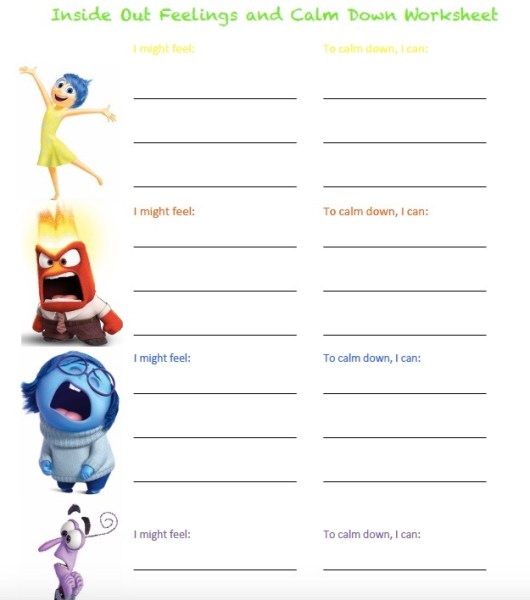
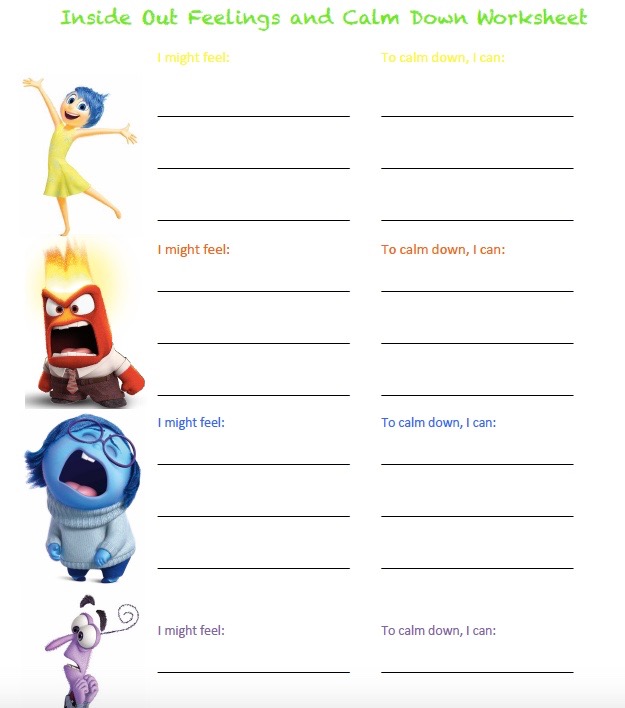
I have created this worksheet to help kids identify how they’re feeling, how their body might be feeling, and some calming strategies they can use to help calm down.  This is similar to the Inside Out Feelings Book that I posted, but this worksheet is all on one piece of paper… and the reason for that is that I thought it would be nice to print this worksheet out and put it somewhere in the home (on the fridge, maybe?) as a visual prompt from kiddos.
Screen Shot 2017-10-16 at 12.39.39 PM

Download it here: Inside Out Feelings and Calming Strategies Worksheet

What I would do is sit down and help your kiddo fill in the blanks on the worksheet – for each of the four emotions (joy, anger, fear, sadness) there are 3 lines to write in body signals (how their body feels when they feel that emotion) and 3 lines to write an appropriate calming strategy.  Some of the body signals and calming strategies might overlap, but it would probably be beneficial to make sure there’s some variety!

Once it’s all filled out, put it somewhere your kiddo can see it.  Then, when you notice your child getting upset, prompt them to go find their Inside Out Feelings Worksheet, identify how they feel (help them, if needed due to age or development), then identify a calming strategy to use to calm down.
Push-Pull-Dangle for Emotional Regulation

An amazing kiddo that I work with taught me a new calming strategy that can be used at while sitting in a chair.  I love this idea for two BIG reasons.  First, it can be done at school without being disruptive.  Second, it can be done discreetly – I have worked with lots of kids who don’t want people to see/know that they’re trying to calm down.

So the strategy is called “push-pull-dangle” and there are 3 steps.

  1. Put your hands on the top of your chair seat and push as hard as you can.  Depending on how long your arms are and how strong you are, your bottom might come off the seat.
  2. Put your fingertips on the underside of your chair and pull, so that you’re pulling your bottom/body into your chair seat.
  3. Let your arms dangle loosely at your side.

This seems to be a form of a muscle tension/relaxation calming strategy – you tense your muscles by pushing and pulling, then relax them by letting them dangle.

Give it a try yourself, and maybe teach it to your kiddo to give them another tool to use to help them stay calm when overwhelmed with negative emotions!

Vague Praise VS Specific Praise

Praise is extremely important with children if you want to shape behavior (increase the good AND decrease the bad).  All praise can be effective, but specific praise is typically more effective than specific praise.  So what’s the difference?  Specific praise includes exactly what the child is being praised for doing.  So here’s an example: when a child makes their bed without being told to do so, an example of vague (or general) praise would be, “good job!” and an example of specific praise would be, “wow! You made your bed without having to be asked!”  Both are praise and both are great, but with the second example, there is no doubt in the child’s mind what they did to make their caregiver so happy.

Vague praise can be confusing, as it can be difficult for kiddos to pinpoint what behavior they are being praised for.  Think about a child playing in the living room.  He is playing quietly, rolling the cars gently, and sharing with his brother.  Mom walks by and says, “nice job!”  The kid will likely LOVE the praise, but he might not know exactly what he’s being praised for.  For playing with cars?  For sharing?  For playing quietly?  It might be all of the above!  In this example, the mom didn’t do a single thing wrong and should be commended for praising her child.  However, being specific can make that praise more meaningful.  Mom could’ve instead said, “awesome job sharing with your brother,” “thank you for playing quietly,” or “I’m so proud of you for playing nicely together.”

More examples of specific praise:

  • “Awesome job asking first before getting a snack!”
  • “Look at you! You finished your homework without help!”
  • “Thank you for emptying the dishwasher.”
  • “Wow!  You put your shoes in the right spot!”
  • “Thank you for cleaning up your art supplies.”
  • “I’m so proud of you for helping your friend.”

Don’t get me wrong – vague or general praise is great!  It is definitely better than no praise at all.  But if you can get in some specific praise, more power to you!

Disclaimer: I am a licensed independent mental health practitioner and certified professional counselor, but I am not your therapist. The information in this article is for general informational purposes only. This article does not create a therapist-client relationship. If you need specific recommendations based on your individual circumstances, please consult with a mental health practitioner near you.

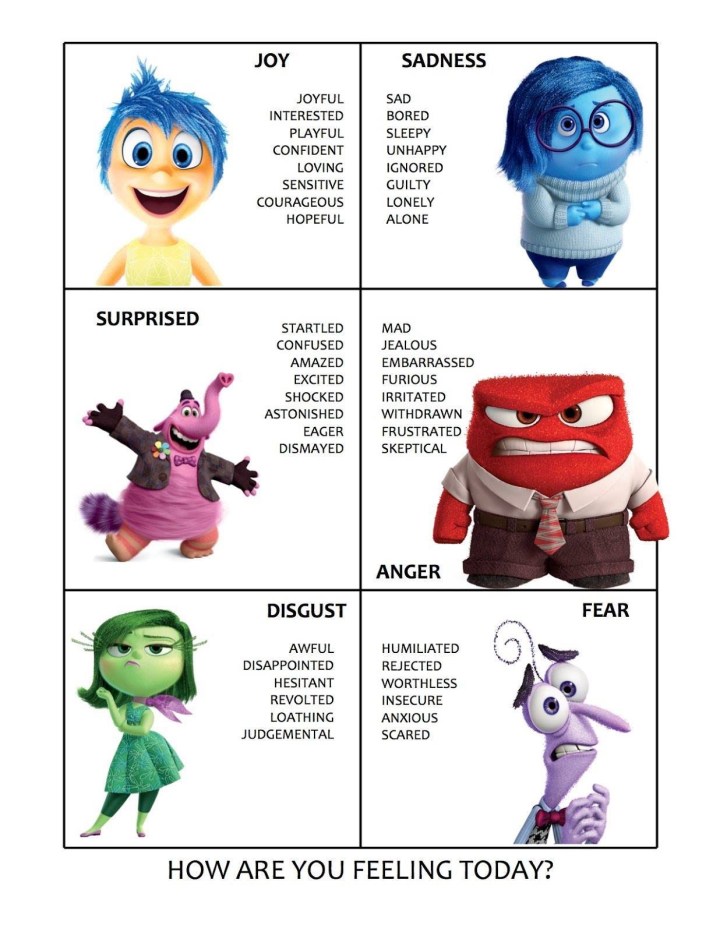
Inside Out Feelings Chart

I just found the coolest feelings identification chart.  It uses Inside Out characters… I always get excited when I find something therapeutic that also relates to children!  Kids have a hard time identifying their emotions sometimes… and it can be because they don’t know the right words.  Ninety percent of the time I ask a kiddo how they’re feeling, I get “happy” or “sad,” but emotions are more complicated than that!  This is a great tool to promote kiddo’s knowledge about the spectrum of feelings and be able to identify what they’re feeling.

img_6091

This is NOT mine… it was posted on this site/blog: http://whatscookinsister.blogspot.com/2016/02/emotions-chart-for-kids_9.html

I found it on Facebook, where it was shared by The Gottman Institute (a great resource for marriage/relationship counseling material).

Find the printable version of the Inside Out Feelings Chart here.  I will be printing this and using it with my kiddos.