In Times of High Anxiety: Controlling What You Can Control

You may not control all the events that happen to you, but you can decide not to be reduced by them.” — Maya Angelou

Everywhere you turn, there seems to be possible sources of anxiety. Recent clients have brought up anxiety related to politics, weather events, family conflict, job-related stressors, acts of public violence, and so on. If you are looking for a reason to be anxious, you don’t need to look far.

It can be incredibly easy to get sucked into an anxiety spiral when our focus is on all the things we worry about. And once we’re in that spiral, it can be incredibly difficult to get out of it. I have added and will continue adding ideas for avoiding the anxiety spiral, and getting out of it (see here). One idea is to focus on what you CAN control.

First, let’s look at just a small sample of things that are outside of our control:

I cannot who is president. I cannot control what difficult task my manager assigns to me. I cannot control the never-ending heat or tornados. I cannot control my spouse’s words when we are arguing. I cannot control if my neighbor gives me a dirty look when she sees me outside.

I could go on and on and on, but you get the idea: there is SO much in our lives that we are unable to control, no matter how hard we might try.

When we focus on those things, it’s easy to feel anxious, stressed, worried, frustrated, and hopeless. However, if we can switch our focus to what we CAN control, it’s likely that we’ll begin to feel less dysregulated, more positive, and more like ourselves.

So what CAN we control? I’ll be honest, when you make a list of what you CAN control and a list of what you CANNOT control, sometimes the latter feels very overwhelming. BUT there ARE things we can control.

I can control who I spend time with.

I can control how I speak to others and about others.

I can control how I speak to myself and about myself.

I can control what I spend my time doing.

I can control my thoughts (though this may be difficult sometimes).

I can control the amount of water I drink.

I can control what foods I choose to eat to fuel my body.

I can control the amount of sleep I get.

I can control the amount of time I look at a screen.

I can control the amount of exposure I get to the news.

I can control what coping skills I use.

I can control the amount of time I spend on social media.

I can control who I follow on social media.

I can control how much physical activity I get each day.

I can control what boundaries I set with other people.

Back in 2020, I saw the below image making the rounds on social media (source is at the bottom of the image). What a time to be alive, right? COVID hit, and so many things that were outside of our control changed.
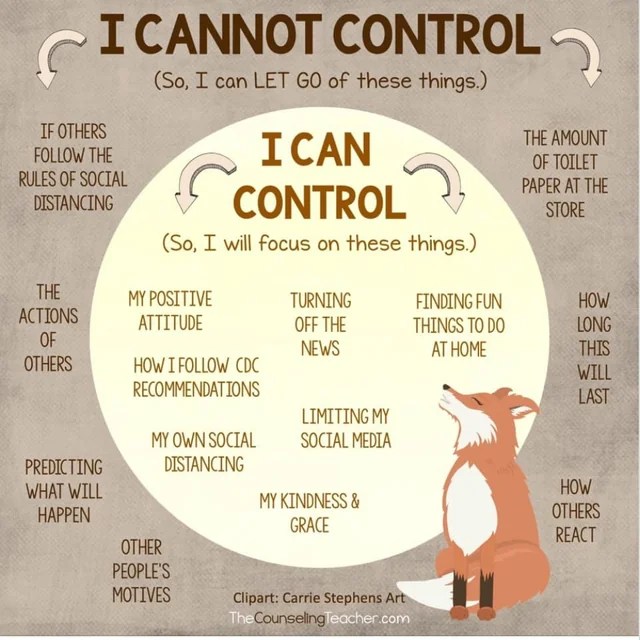
Those things outside of our control could feel SO big, SO heavy, SO overwhelming. Many people, though, found comfort in focusing on what they COULD control. It’s a tactic that can work well in lots of different situation. And see at the top where it says “So, I can LET GO of these things” in parentheses? First of all, easier said than done, right? BUT TRUE.

I believe self-talk is one of the greatest tools we have to tackle negative thinking and anxiety. It can be monumentally helpful to have a script to help you focus on what you can control. Maybe it will sound like this:

“Self, you cannot control ______. That’s a fact. So Iet’s choose to focus on _____ instead, because that is something you can control.”

Make it your own, and use it as a script to pull your focus back to what is within your control. If you’re struggling, reaching out to a family member or a friend who may help you identify what is within your control can help. Of course, a mental health provider can also help with this strategy.

Drop a comment with your script, or something within your control that you’re choosing to focus on!

Disclaimer: I am a licensed independent mental health practitioner and certified professional counselor, but I am not your therapist. The information in this article is for general informational purposes only. This article does not create a therapist-client relationship. If you need specific recommendations based on your individual circumstances, please consult with a mental health practitioner near you.
Self-Diagnosis

There have been several times (more than I can count) over the past few years a client has come for an initial session and told me that they believe they have a specific diagnosis, without having input from a professional. Many times, when I ask why they believe this, they tell me that they saw something on a social media platform that really resonated with them and aligned with symptoms they are experiencing. A lot of these answers start with “I saw this video on TikTok…”

First off, I want to say that I think people talking about mental health on social media can be a really great thing. The more we share, the more “normalized” mental health concerns are, and this is decreasing the negative stigma related to mental health symptoms and diagnoses, counseling, psychiatry, etc. I think it’s awesome that individuals are finding videos that they can relate to and get to see that there are others out there going through the same (or similar) experience(s). This makes mental health concerns and diagnosis seem less scary and less isolating. This is normalizing, and I AM HERE FOR IT!

However, self-diagnosis can be so super tricky and complicated, and here’s why:

A set of symptoms alone does not equal a diagnosis.

What I mean here is that there are other diagnostic criteria to take into consideration. For most, if not all, diagnosable mental health disorders in the Diagnostic and Statistical Manual of Mental Disorders (DSM-5TR) there are criterion in addition to a set of symptoms that must be met. For example, let’s look at the diagnostic criteria for Generalized Anxiety Disorder. Yes, there is a list of symptoms, but you also have to meet the following criteria:

  • The anxiety and worry has to occur more days than not for at least 6 months and must be about a number of events or activities.
  • The individual must find “it difficult to control the worry.”
  • The anxiety, worry, or symptoms must cause clinically significant distress or impairment in social, occupational, or other settings.
  • The symptoms cannot be attributable to the effects of substance abuse, and lastly
  • The symptoms cannot be better explained by a different metal health disorder

We’ll talk about that last criteria next, but first notice that anxiety has to have occurred for the past 6 months or more. So if you are feeling anxious about something specific, and it has been going on for 2 months, you don’t meet diagnostic criteria for Generalized Anxiety Disorder (GAD). If you feel extreme anxiety only one day each week because of a specific activity you have to go to, you don’t meet diagnostic criteria for GAD. If you have worries that pop up about certain things, but are able to let those worries/thoughts go easily, you don’t meet the second diagnostic criteria, therefore cannot be diagnosed with Generalized Anxiety Disorder. These are things most of the TikTok videos don’t mention. And again, I’m not trying to “bash” social media videos. They are great at giving information and normalizing, but shouldn’t be used on their as a diagnostic tool. It’s unlikely that you’ll reach a correct diagnosis by watching a video about a set of symptoms.

There is a lot of overlap between separate diagnoses.

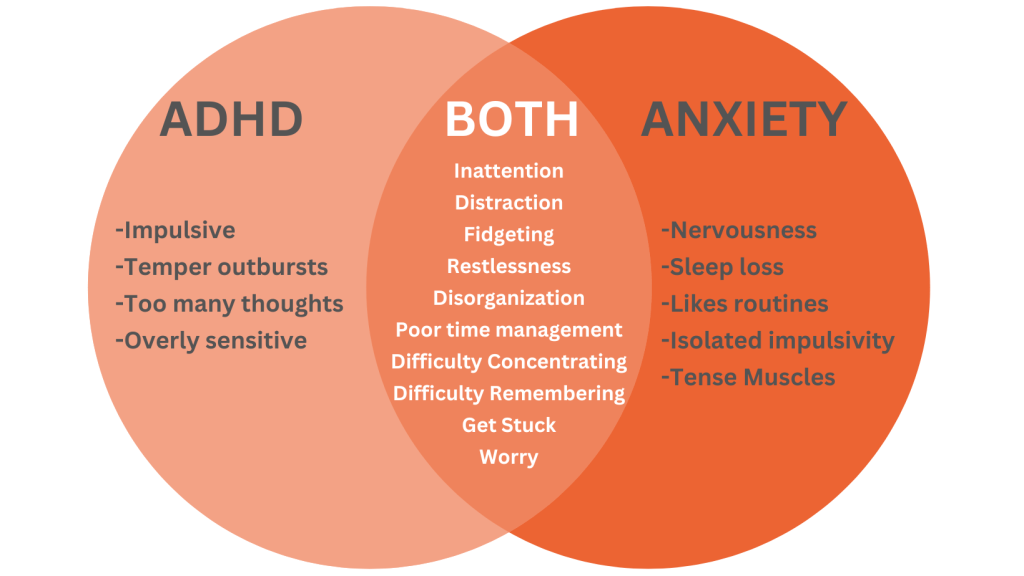
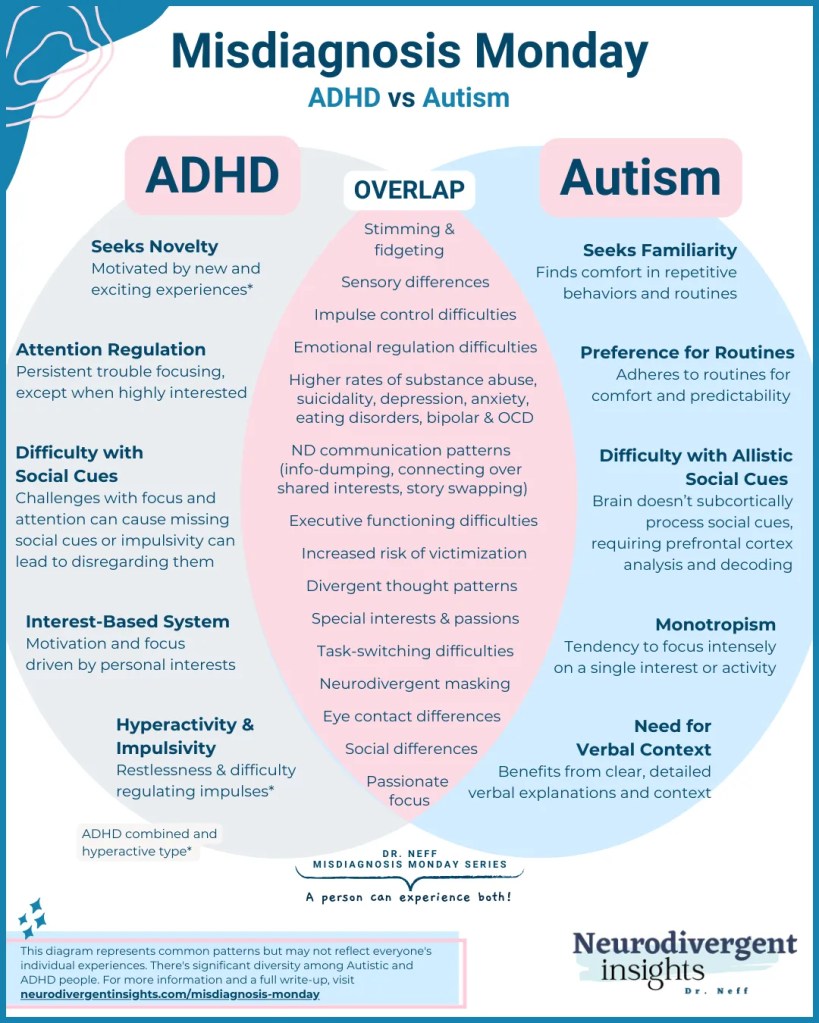
This can be really difficult to untangle, even for professionals. Under each diagnosis in the DSM-5TR, is a section called “Differential Diagnosis.” The experts who created and revised the diagnostic manual deemed this a necessary component because of the amount of overlap of symptoms between different diagnoses. Take a look at some informational Venn diagrams other sources have created that highlight how similar symptoms can be between two completely different diagnoses:

This one, from the NESCA website (https://nesca-newton.com/#), shows similarities in symptoms of ADHD and Anxiety.

And this one shows similarities between ADHD and Autism.

Most people will be able to relate to symptoms for several diagnoses over their lifetime.

I saved this point for last, because this is a point that has stuck with me from an introductory psychology course I took in college. Prior to beginning lessons into diagnosis, the professor warned the young students in class that we would likely see symptoms that we have experienced. He encouraged us not to begin worrying about having a diagnosable disorder just because we can related to 1 or 2 symptoms when looking at a disorder. Why? Because almost all of us have experienced symptoms of mental health. But that doesn’t mean we have a diagnosable mental health disorder.

If I look at the diagnostic criteria for Autism Spectrum Disorder, I can identify that I experience “Hyper- or hyporeactivity to sensory input…” I’m pretty sensitive to loud noises, bright lights, lots of movement, etc. I get stressed pretty easily when I’m in an environment with random, loud noises (helping at my daughter’s school), bright lights, or just a lot going on in general. Does this one symptom mean I might qualify for an Autism Spectrum diagnosis? Absolutely not.

To summarize, though this is not an exhaustive list of why diagnosis is complicated, hopefully it provides some insight into why self-diagnosis is really difficult to get right.


So what do you do if you see a social media video (or read an article, talk to a friend, etc.) that makes you suspect you have several symptoms of a specific diagnosis? Number one, do more research from legitimate sources. Some legitimate sources include (I am not affiliated with any of these sites):

Also, I’d recommend that you find and complete a questionnaire from a reputable site. However, keep in mind that, just as with videos on social media, these questionnaires cannot be used alone to make a diagnosis. Mental Health America has a set of questionnaires for several diagnoses (https://screening.mhanational.org/screening-tools/).

If you do more research, and are interested in a formal diagnosis for treatment or other purposes, I’d recommend talking to a professional who is qualified to diagnosis. In the meantime, it would be accurate for you to make comments such as “I experience some symptoms of anxiety,” or “I suspect I might have a depressive disorder.” These are ways for you to acknowledge and share your symptoms, if you have not been formally diagnosed by a professional.

Disclaimer: I am a licensed independent mental health practitioner and certified professional counselor, but I am not your therapist. The information in this article is for general informational purposes only. This article does not create a therapist-client relationship. If you need specific recommendations based on your individual circumstances, please consult with a mental health practitioner near you.
5 Berenstain Bears Books That Teach Social Skills

Berenstain Bears was one of my favorite book/tv series as a child (you can find out more about the entire series at Home of the Berenstain Bears).  They’re fun reads, but there are also some valuable lessons found in most of the books.  When working with kids, you have to find a way to hold their interest, so if you can find an entertaining book that also teaches social skills?  Jackpot!

Here are 5 Berenstain Bears books that I’ve used (both in individual and group therapy sessions) to discuss social skills:

  • The Berenstain Bears and The Truth – Brother and Sister Bear tell a lie in an attempt to get out of trouble (I’m pretty sure everyone has been there!) and readers get to see how the cubs have to tell more and more lies to cover up their first lie, then deal with the consequences of being dishonest.
  • The Berenstain Bears Forget Their Manners – Mama Bear has to take pretty drastic measures to motivate Papa Bear and the cubs to use some basic manners.
  • The Berenstain Bears Learn About Strangers – Sister Bear is a little too friendly and has to learn about stranger danger.  There’s a neat analogy in the book about how strangers can “look” nice on the outside, but that doesn’t mean they’re always nice people.
  • The Berenstain Bears and the Trouble with Friends – Sister Bear befriends a new neighbor, but they end up fighting and have to learn to take turns and compromise.
  • The Berenstain Bears Learn to Share – the cubs learn that sometimes it’s necessary to share in order to have fun because it can be awful lonely playing by yourself all the time.

These are my top 5 favorite books to use for teaching/discussing social skills, but there are many, many more valuable lessons found in the series!

What I Can/Can’t Control Worksheet

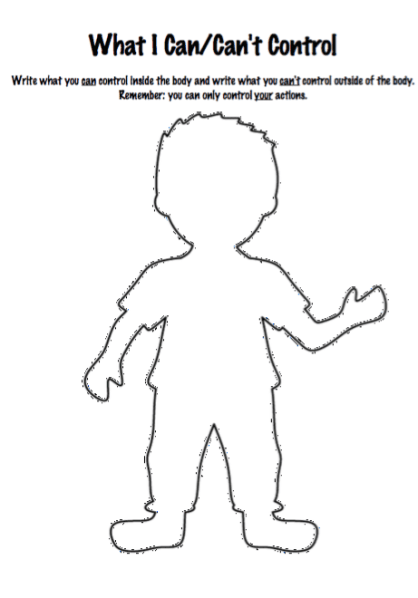
It is extremely common to hear children “blame” others for their behavior.  I’ve worked with kiddos who instantly argue with “but he did it first” when they are corrected for misbehavior.  They might be right… maybe a peer did initiate, but that doesn’t mean the child has to do the same (or retaliate).  It can take a lot of discussion to get a kiddo to acknowledge that they only have control of their own bodies and that they can choose to make good choices regardless of what others are doing around them.

The worksheet below is to help kiddos identify things that are within their control and things that are not within their control.  I typed “to help kiddos,” but guess what?  I’ve met my fair share of adults that would benefit from thinking about this as well!

What I Can/Can’t Control Worksheet (click here to print):

Screen Shot 2018-02-08 at 8.15.50 PM

Favorites Ice Breaker Worksheet

When I start seeing a new kiddo for therapy, I like to give them an easy assignment to do before their second session.  I usually have kiddos with emotional concerns do a worksheet pertaining to feelings (see Inside Out Emotions Ice Breaker), but for kiddos with more behavioral concerns I usually start with a “favorites” worksheet.

Having kids write down their favorites (and least favorites) is a great “ice breaker” tool for me to get to know them and start building rapport in that second session.  As a bonus, it’s also a great tool for me to use to recommend rewards (from the kiddo’s list of favorites) and negative consequences (from their list of least favorites) to the child’s parents for behavior contracts.

I created a super simple worksheet that I hand out to kiddos when they’re getting ready to leave that first session.  It looks like this:

Favorites screenshot


You can find a printable version here.

Inside Out Emotions Ice Breaker

When I see a kiddo for their first therapy session, I usually give them an easy, getting-to-know-you assignment to complete before their second session.  For kiddos who are dealing more with emotional issues than behavioral, I like to have them make a list of 5 things that make them feel happy, 5 things that make them feel sad, 5 things that make them feel worried, and 5 things that make them feel mad.

This list is a great way to “break the ice” and going over it is beneficial for building rapport.  It also helps give me an idea of their knowledge and awareness of emotions.  Additionally, it’s easy to fit in questions about how they cope with the situations, which also gives me an idea of how they are at coping with emotions.

To make the assignment more fun, I created an easy worksheet with the Inside Out characters for kids to take and fill out.  Some kids are turned off when they hear the words “assignment” or “homework,” but show them a piece of paper with an Inside Out character on it, and it doesn’t seem so bad. 🙂

Here’s what the worksheet looks like:Screen Shot 2018-01-01 at 7.26.19 PM

Printable version here.