Finding Balance: Teaching Your Child to be Well-Behaved While Still Letting Them Be a Kid

I was in church on Sunday, sitting near the end of the pew and a little girl walked over to the side, in the middle of the service, and admired the way the stained glass window reflected colors on her drawing. She would put it on the floor and giggle, then pick it up, then put it back down and giggle again. After only 30 seconds or so her mom walked up and, looking embarrassed, took her daughter back to their seats.  Let me be clear: I’m not mommy-shaming here. That mom didn’t do anything wrong. In fact, I would have probably done the same thing in that situation. It was a church service and I’m sure she didn’t want her daughter to be a distraction.

But I couldn’t help but think about that little girl… it’s possible that she perceived she was doing something wrong. She was in complete awe and wonder over the reflections of the stained glass and it’s a shame that it was interrupted… though maybe it was necessary at the time.

Another story… at my very first month of an internship I was working in a therapeutic setting with kiddos.  We gave out small prizes to kiddos who participated and followed directions during the session and after one session the kiddo I had been working with picked out bubbles.  He began blowing bubbles in the lobby and SQUEALED in delight.  One of my fellow interns “shushed” him and my supervisor was in the room.  She (very politely) said to let him squeal… basically to let him be happy and enjoy the bubbles.  The child wasn’t necessarily doing anything wrong… maybe he was using an “outside voice” by squealing, but he wasn’t hurting anyone.

What I’m trying to get at here is that I would hate to see parents squash their children’s happiness, joy, wonder, curiosity and/or awe… all in the name of being “well-behaved.”  That may sound odd coming from a behavior therapist, but I’m all about meeting goals to increase child/family functioning, not creating a little robot child who says “yes, ma’am” and never has any fun.

One of my favorite song lyrics is “let your eyes get wide when you look at the stars, with the same sense of wonder as a child’s heart.”  Yes, we want children to be well-behaved and to listen.  And yes, sometimes, depending on the social setting, we may have to interrupt them.  But maybe we go back and JOIN them in their discovery once it’s appropriate.  Maybe the mom at church can take her daughter back over to the stained glass windows after the service and enjoy the reflections.  Sometimes it might not be possible, but foster that child-like joy and wonder whenever you can!

My Experience With Sleep Training

I put it off for as long as I could, but we ended up having to do Sleep Training with my daughter (she was a little over 8 months old).  She had been sleeping in a Rock and Play, which was AWESOME for helping with her acid reflux, but she had been sleeping really poorly for a few nights and seemed to be uncomfortable in it, so it was time.  As a behavior therapist, the process and theory behind sleep training make total sense to me.  However, I’ve heard horror stories of babies “crying it out” and knew that it was going to be SO hard for me not to pick her up and comfort her if she was crying.  Fortunately, it wasn’t THAT bad.

A few things to know (that makes our situation unique):

  • My daughter was already a good self-soother.  From what I read, one of the goals of Sleep Training is to teach babies to self-soothe so that they don’t need help from caregivers to get back to sleep at night (with a bottle, or rocking, or singing, etc…).  Our baby girl had already been sleeping 11-12 hours at night and would wake up occasionally, but get herself back to sleep.  I think this was a huge advantage for us!
  • My daughter had already been napping in her crib, but naps were only 20-30 minutes long.  As soon as she would wake up, she’d cry to get up/out!


Here are the rules we decided on:

  • She would start bedtime routine sometime between 6:45 and 7:45.  She was already really consistent with this, so not a change.
  • Once she was in the crib, we could soothe for 1-2 minutes, then had to leave the room.  No matter what.
  • We would wait 3 minutes (4 if we had to go in a second time, 5 if we had to go in a third or more times) then go back into the room and soothe for another 1-2 minutes, if needed.
  • We also decided that if she wakes up after having been asleep, we would wait 3 minutes to go in and soothe.
  • Wake up time would be anytime after 7:00am – no getting out of the crib before then, unless she had a poopy diaper or was in danger.


Here’s how it went:

Night One: This was, by far, the worst night.  We started Hailey’s bedtime routine at 7:00pm and put her in the crib at 7:23.  She must’ve been tired because she only fussed for about 20 seconds then fell asleep.  She then woke up at 8:40 and began crying.  We went in after 3 minutes, left after a minute, and had to go back in after another 3 minutes, but she fell asleep after that.  She woke up again at 10:40pm and cried for 3 minutes until I went in and soothed.  To summarize the next few hours… she woke up SIX TIMES between 10:47 and 12:50.  However, she then slept from 1 – 3:15, and then 3:25 to 5:15.  She then woke up once at 5:55, then slept until 7:40.

Thoughts after Night One?  I got about as much sleep as I expected, but the crying really wasn’t anywhere near what I thought it would be.  I only had to leave the room once when she was still crying.  Don’t get me wrong… it was rough, but not as bad as I thought!

Night Two: I saw clients and didn’t get home until after 8pm.  Here’s what my husband said went down… started bedtime routine at 6:50 and in crib by 7pm.  Husband said she was FURIOUS and he had to go back in 5 times until she finally fell asleep at 7:30.  He said that she was standing in the crib and crying very loudly.  She woke me up at 12:40 and I just had to go in once and she fell back asleep.  She woke up again at 5:15 and cried for a minute, but soothed herself back to sleep.  She then woke up at 8:05am in SUCH A GOOD MOOD.  She didn’t even start crying right away… I stopped in her doorway and her eyes were opened; when she saw me she just smiled (yes, my heart melted).

Thoughts after Night Two?  Making progress!

Night Three: Bedtime routine started at 6:45, in crib by 7pm.  She fussed and cried on and off for about 3 minutes, but soothed herself to sleep.  At 11:00pm I woke up and saw that she was just sitting up in her crib (quietly).  I went in and laid her down and she fell asleep right away.  At 12:45am she woke up and was crying; I waited 3 minutes and went in to lay her back down.  It took her about 15 minutes to fall asleep, but she was quiet the entire time.  The night she woke up once more and cried for a few seconds, but soothed herself back to sleep (I have NO idea what time this was).  She then woke up at 7:20am.

Night Four: Kiddo was in bed by 7:15, she fussed for about 15 seconds, but then went to sleep.  At 3:45am I went in and readjusted her and put her pacifier in her mouth – she wasn’t crying, but had coughed a few times and I thought the pacifier might help.  She went right back to sleep and didn’t wake up until 7:10am.

Night Five: Went down around 7:15 again.  It was a bit of a rough night… she woke up every 30-40 minutes between 1am and 3 am.  She would cry each time, but we only actually had to go in her room a total of 3 times because the other times she would soothe herself back to sleep. *We talked about why she might have had a rough night, but didn’t come up with anything*

Night Six: She was in her crib by 7:15 and fell asleep right away. She woke up around 8:45 and cried for 10 seconds, but went back to sleep.  She woke up again around 6:23am, but soothed herself back to sleep right away.  She then woke up for the day at 7:20am.

Night Seven: It was a busy day, so bedtime came a little early… she was in her crib by 6:55pm.  She woke up and cried for just a few seconds around 8:15, but went back to sleep and didn’t wake up until 7:10am.


After about a week, we’ve had two nights in a row where she has been in her crib for 12+ hours and my husband and I haven’t had to go in at all!  Was it rough those first few nights?  Absolutely!!  But I think it was totally worth it.  I’m such a light sleeper and I’ve been sleeping so much better now that she’s sleeping better (and in the other room).  Also, naptime is going so much better now!  It’s not GREAT, but better than it was… before we did sleep training, she was napping 20-30 minutes at a time and sometimes it would take longer to get her to sleep than she would actually sleep.  She still fights it sometimes, but is now fighting it less often, for less amount of time, and is sleeping longer.  Today, for example, she napped from 9:45 to 11:20 and only fussed for about 10 seconds before falling asleep, AND I put her down about half an hour ago and she cried for about a minute before falling asleep.  I’m hopeful that naps will continue to get better!

To Argue or Not to Argue (in front of your kids) + 10 Rules for Fair Fighting

All couples disagree/argue/fight. It happens, whether people want to admit it or not. And guess what? It’s healthy to argue and disagree, if you can do so appropriately.  So let’s look at the pros and cons of arguing in front of your kids.

  • Pro: It normalizes arguing. If your child NEVER sees their parents disagree or argue, they may grow up with unrealistic expectations and think they should never argue with a partner/friend/spouse.
  • Con: It can cause stress on kiddos. I’ve had lots of kiddos disclose to me seeing parents argue or fight, and feeling worried about it.
  • Pro (if you can argue in a healthy way): you get to model for your kids what healthy disagreements and resolutions look like – having you as an example makes it more likely that they can be healthy arguers.
  • Con (if you can not argue in a healthy way): you set a bad example of arguing, which makes it way more likely that your kids won’t learn how to argue or disagree in a healthy way.
  • Pro (for caregivers): it might help you argue in a more healthy way if you have an audience. Knowing that the children are watching might motivate you to disagree appropriately.
  • Con: if the kiddos are around, it can be easier to pull them into the argument, which can have a negative effect on the child’s emotional state.


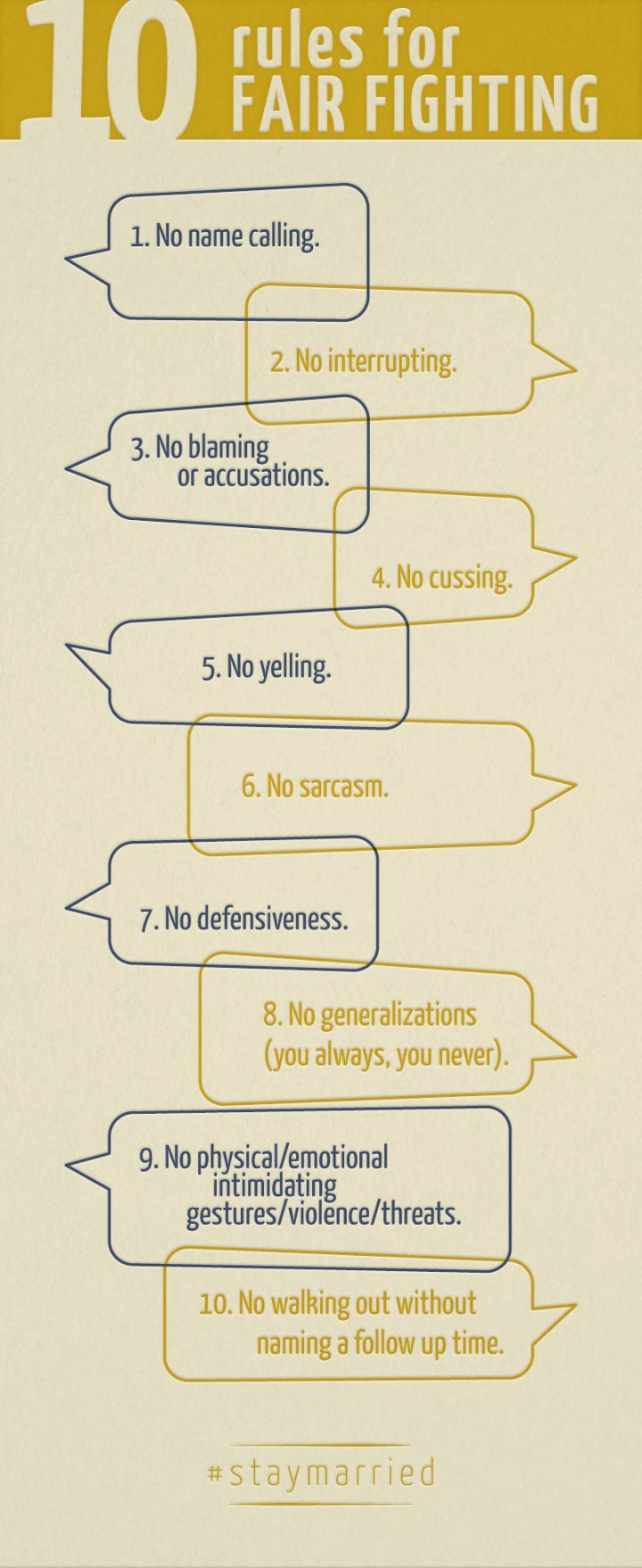
So to argue or not to argue (in front of your kids)? My opinion is that it’s Ok to argue/disagree in front of kids, ONLY as long as you can do so calmly and appropriately.  What does “appropriately” mean?  I like these rules I found online:

10RulesForFairFighting1

IF you can argue and stick to these rules, I don’t see anything wrong with arguing in front of your children.  As mentioned before, everyone disagrees and argues.  If you can do so following the rules above, you’ll be setting a good example of disagreeing appropriately.  IF you CANNOT stick to the rules above, table the discussing/arguing/disagreeing for later.  IF you find yourself in the middle of a disagreement in front of the kids and realize you (or your spouse) is not capable of following the rules above, STOP and take a break.  You can say something like, “I cannot talk about this calmly right now.  Let’s talk about it after the kids have gone to bed.”  A statement like that is also a great thing to model for children!

Vague Praise VS Specific Praise

Praise is extremely important with children if you want to shape behavior (increase the good AND decrease the bad).  All praise can be effective, but specific praise is typically more effective than specific praise.  So what’s the difference?  Specific praise includes exactly what the child is being praised for doing.  So here’s an example: when a child makes their bed without being told to do so, an example of vague (or general) praise would be, “good job!” and an example of specific praise would be, “wow! You made your bed without having to be asked!”  Both are praise and both are great, but with the second example, there is no doubt in the child’s mind what they did to make their caregiver so happy.

Vague praise can be confusing, as it can be difficult for kiddos to pinpoint what behavior they are being praised for.  Think about a child playing in the living room.  He is playing quietly, rolling the cars gently, and sharing with his brother.  Mom walks by and says, “nice job!”  The kid will likely LOVE the praise, but he might not know exactly what he’s being praised for.  For playing with cars?  For sharing?  For playing quietly?  It might be all of the above!  In this example, the mom didn’t do a single thing wrong and should be commended for praising her child.  However, being specific can make that praise more meaningful.  Mom could’ve instead said, “awesome job sharing with your brother,” “thank you for playing quietly,” or “I’m so proud of you for playing nicely together.”

More examples of specific praise:

  • “Awesome job asking first before getting a snack!”
  • “Look at you! You finished your homework without help!”
  • “Thank you for emptying the dishwasher.”
  • “Wow!  You put your shoes in the right spot!”
  • “Thank you for cleaning up your art supplies.”
  • “I’m so proud of you for helping your friend.”

Don’t get me wrong – vague or general praise is great!  It is definitely better than no praise at all.  But if you can get in some specific praise, more power to you!

Disclaimer: I am a licensed independent mental health practitioner and certified professional counselor, but I am not your therapist. The information in this article is for general informational purposes only. This article does not create a therapist-client relationship. If you need specific recommendations based on your individual circumstances, please consult with a mental health practitioner near you.