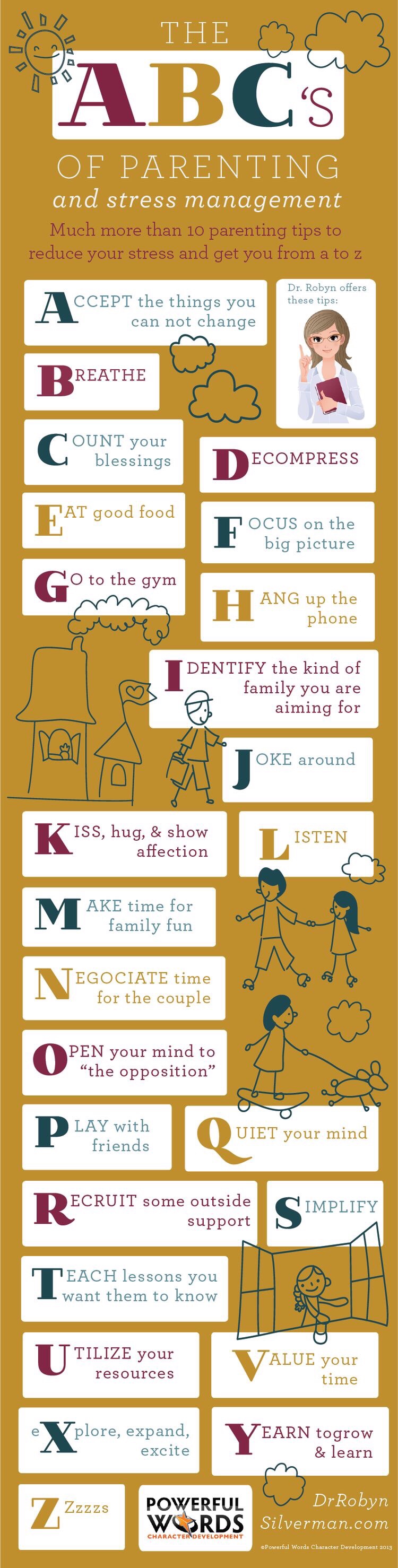
The ABCs of Parenting (for Stress Management)

Parenting can be extremely stressful and it can be hard to stay on top of managing that stress! I found this while researching and was so impressed, I thought I’d share. There are a lot of great tips on here! “Accept the things you cannot change” and “Negotiate time for the couple” are ones that are difficult in my home. Pick one that you’d like to do more and go for it!

Super Simple Sticker Charts (They Don’t Have to Be Complicated!)

I’m all for fancy behavior charts and sticker charts, but they’re not absolutely necessary.  Your child might be content with a simple table and some fun stickers.  If you don’t want to mess with finding the perfect one or tweaking one that someone else made, it can be fairly easy to make your own.  I have two examples to share below.

Screen Shot 2017-12-04 at 7.45.16 PM

This first one would be an example of a sticker chart to work on bedtime routine – you have your days of the week running along the top and the tasks of the routine along the side.  The kiddo would get to put a sticker for each task on each day, so potentially a total of 4 stickers per day.


Screen Shot 2017-12-04 at 7.51.47 PM

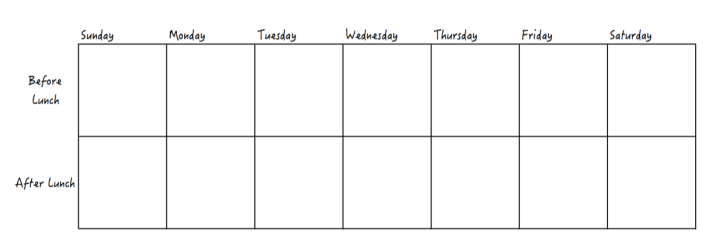
This second one could be for any behavior and splits the day up into two different time frames.  So, for example, if you’re working on Following Directions, your kiddo would get to put a sticker in the “Before Lunch” on Monday square if they follow directions between waking up and lunchtime.

These are simple to make in Microsoft Word or Excel or by hand (I’d want a ruler because I’m a bit of a perfectionist).  They look boring to start, but most kids LOVE putting stickers on, so it won’t be long before that chart will be filled up with shiny (possibly glittery) stickers.

Six Tips for Increasing Your Child’s Compliance with Homework

Maybe you’re lucky and have a kiddo who sits down every day after school, with a smile on their face and does their homework. Maybe. But if you’re not so lucky and you have a kiddo who whines or complains about homework, or takes forever to do it, or refuses to do it completely, I have a few tips that might help. As always, these are general tips and may not be appropriate for you or your kiddo, depending on your individual situation. If homework completion truly is an issue, consider seeing a behavior therapist for a few sessions!

  • Be consistent.  If you want to have your child do homework as soon as they get home, go for it.  Or give them 30 minutes to relax, then have them do homework until it’s done.  Whatever you do, be as consistent with it as you can.
  • Have certain activities that have to be “earned” by doing homework.  One option would be to set the expectation that there will be no television time until homework is completed.  Pick something your child enjoys so that it motivates them.
  • Practice using calming strategies both before beginning homework and during, if they become upset or frustrated.
  • If you think your child struggles with confidence, practice positive self-statements, like “I got this” or “I can do it.”
  • FOLLOW THROUGH.  Make sure that homework gets done… if your child doesn’t complete the homework before school the next day, have them do it the next evening after their new homework.  This might seem harsh and, yes, it might keep accumulating.  But if you let your kiddo get out of doing homework just one night, they’ll know that they can get out of it in the future.
  • Praise your kiddo for completing their homework, especially if they do so without arguing or whining!

Parenting Doesn’t Always “Feel” Good

During the second night of doing the whole “sleep training” thing with my daughter to transition her to sleeping in her crib in her own room, I sent my mom a text message about how bad I felt.  It wasn’t fun leaving her in the crib while she cried and wanted out.  It was a little easier because I knew she was tired and just being stubborn, but still really difficult for me not to run in and just hold her.  My mom responded with this pearl of wisdom:

“Parenting doesn’t always ‘feel’ good, even though you know you’re doing the right thing.”

How true that is!  I experience the same dilemma when my daughter gets her vaccinations.  I know vaccinations are a hot topic right now, but my belief is that they are good for her and the benefits outweigh any risks.  Still, it was difficult to sit there and let the doctors poke her.

This could also apply to setting boundaries, having clear expectations, and using consequences with children.  It may not “feel” good to say “no” when your child cries for a candy bar in the checkout lane at the store.  It may not “feel” good to tell your child they’ve lost their electronics privileges because of a bad choice they may have made.  It may not “feel” good to tell your child they cannot do something their friends are doing (that you believe may be unsafe).  A lot of the things that we KNOW are good for our children (including discipline) may not “feel” good, but it helps to remember why you’re doing it and that everyone will be better off in the long run.

Five Things I Do for Self-Care

To prove that I practice what I preach (that caregivers should engage in regular self-care), I thought I’d share what I do to help me manage the stress and anxiety of adulthood/parenthood.

1. Exercise – this is the most important one for me. I can tell a HUGE difference in my mood if I don’t exercise 2-3 times per week. When it was nice outside I would jog or walk with the baby and dog. Now that it’s cold, it’s more difficult to get in, but I try to get on the elliptical or treadmill a few times per week.

2. Read – when I’m not SUPER tired (so maybe 3-4 times per week), I try to read before bed. Earlier this week I finished Dan Brown’s new book, Origins.

3. Get out of the house – I get real bad cabin fever if I don’t leave the house every few days. Yes, it can be a pain to get the baby out, but I get pretty grumpy if I don’t get out and make an extra trip to target or hobby lobby, or just walk around the mall.

4. Play games on my iPad – this is going to sound soooo childish and I’m a little embarrassed to admit it, but I’m hooked on Cooking Fever and it’s one of the first things I do after the baby goes to bed. It just helps me disconnect from the stress of the day.

5. Play the piano – full disclosure: I don’t get to do this as much as I want to. Every time I start playing the piano, the baby crawls over and wants to bang on the keys. I’m happy to let her do that, but I cannot play and hold her in my lap at the same time!

My challenge for EVERYONE is to do at least one thing each day that is for you only and makes you feel happy, calm, and/or less stressed. If you make it a priority, you’ll see positive results!
What to Do If Your Child Talks About Suicide and Self-Harm

October was Suicide Awareness month… I’m 15 days late, but felt like this would be a good topic for a blog post.  I know it’s not a fun topic to think about, but I believe every parent can benefit from knowing what to do if (just in case) their child says they are thinking about self-harm or suicide (or attempting either).

First and most importantly… ASSESS FOR SAFETY.  Do not leave your child unsupervised unless you know they are safe.  If you feel like your child needs help right away, get help immediately!  Call 911 or call the National Suicide Prevention Hotline at 1-800-273-8255.  Your child may need to be taken to and admitted to an inpatient behavioral hospital – I know that sounds scary, but if they don’t get the help they need, the result could be devastating.  Always err on the side of caution.

If you believe your child is not in immediate danger, it’s still a good idea to keep an eye on them and remove anything they may use to harm themselves (think razors, medications, knives, any firearms in the home, etc.).  They would also benefit from talking to a professional, whether it’s a therapist (sometimes referred to as counselors or mental health practitioners) or a psychologist.  A professional will be able to help your kiddo figure out why they’re feeling this way and what they can do to feel better.  A professional will also likely be able to work with you, as a parent, to discuss what specifically you can do for your child.

Here’s some other things to keep in mind.

  1. It’s important for parents to remain calm (at least on the outside).  The last thing you want is for your response to make your child feel like they cannot talk to you about these tough topics.  Even though it’s uncomfortable, you WANT your child to be able to come to you to discuss self-harm and suicidal thoughts.  If they feel like they can’t talk to you, you won’t know about it and you won’t be able to help.  Thank them for telling you, empathize with them, and let them know you’re on their team and will do everything in your power to help.
  2. Don’t dismiss your child’s thoughts/statements as them just being dramatic or seeking attention.  Even if that is the case, you always want to take it seriously.  Again, err on the side of caution.
  3. Seek support yourself – whether it’s a spouse, friend, co-worker, pastor/priest, or therapist.  It can be extremely helpful to sit with someone and talk about this situation and how you’re feeling about your child disclosing thoughts of suicide or self-harm.

Using Rewards and Consequences at Home to Reinforce School Behavior

It’s very, very common for me to hear from parents that their child is struggling with behavior at school, but is a great kid at home.  I’ve had a lot of frustrated parents in my office because they just don’t know what to do.  Unfortunately, there can be a lot of barriers in the school system, including teachers with too many kids in their classroom.  I’ve also heard some kids name “punishments” at school that are actually positively reinforcing their negative behavior… this isn’t necessarily because the school is clueless; sometimes what is “punishing” for one kiddo can be reinforcing for another.

So what can you, as a parent, do?  One thing you can do is use a reward or consequence at home for your child’s behavior at school.  This would require you to work with your kiddo’s teacher to somehow (phone call, email, note sent home, etc) get a message EACH DAY from the teacher about how the child’s day went.  TIP… you’re going to want to pick one or two “problem behaviors” to get feedback on – this could be aggression, compliance with schoolwork, or anything else your kiddo might be struggling with – make sure your child’s teacher knows what specifically to report on.  I’ve had a mom send a “smiley chart” to school, with the teacher’s approval, to be completed each day.  I’ve also had moms who just get a short email update from the teacher.

From there, you get to decide whether you want your child to earn something extra if they behaved well, or if they lose a privilege or earn some other kind of consequence if they displayed any negative behaviors.  A few examples:

  • Reward: Child can earn an extra 30 minutes of electronics time if the teacher says they did well that day.
  • Reward: Child can earn a special after-school snack if the teacher says they did well that day.
  • Reward: Child can stay up 10 minutes late if the teacher says they did well that day.
  • Consequence: Child has to complete an extra chore if the teacher reports negative behavior.
  • Consequence: Child loses television time if the teacher reports negative behavior.
  • Consequence: Child has to complete an extra math/reading/writing worksheet if the teacher reports negative behavior.

Pick something that you know will motivate your child, give them a heads up about the change, then be as consistent with it as possible!  Eventually, once your child is successful, you will want to fade the consequence or reward.  So you might start offering a reward every other day instead (for good behavior on both days), then eventually just once per week (for good behavior 5 out of 5 days per week).

*Note: I’m not recommending that all parents use a reward/consequence system for school behavior… this is more for the kiddos who are struggling with something specific at school*