What I’ve Been Reading: Unf*ck Your Brain: Using Science to Get Over Anxiety, Depression, Anger, Freak-Outs, and Triggers

Welcome to the What I’ve Been Reading series. Note about me: I love to read. Both fiction and non-fiction. Since no one on the planet (probably) has enough time to read all the self-help books out there, I decided to share about what I’m reading to help others decide if it’s something they may be interested in. Enjoy a brief review of the book (my opinion only) and some vague take-aways.

I recently finished Unf*ck Your Brain: Using Science to Get Over Anxiety, Depression, Anger, Freak-Outs, and Triggers, by Faith G. Harper. This book was recommended to me by a client who found it incredibly helpful, so I decided to give it a try. My one-sentence review would be: incredibly helpful if you can get past all the curse words.

Seriously… a lot of cursing in this one. Some readers may love it, some may hate it, some may tolerate it. I’m in the tolerate group. It was just a lot of expletives and it got to the point where I sort of rolled my eyes when the author would drop another f-bomb.

BUT cursing aside, this book was great. The author comes across as very genuine (I listened to the audiobook, which helped me come to this conclusion), has a great sense of humor, and definitely worded things in ways that would make sense to readers with no knowledge of the brain and/or psychology. She went in deep to explain what is going on in our brains that causes anxiety and depression. She explains how trauma affects our thought/behavior patterns, and that it all is how our brain is trying to cope. I believe many will find this helpful, as sometimes, especially with anxiety, it helps to just know why we feel/think the way we do.

One of the biggest takeaways for me was that “emotions are supposed to last 90 seconds, but we continue to fuel them with our thoughts”… and “with our behaviors.” Wow. Reading that was like a light-bulb moment for me. How often do we let our thoughts make our moods last for hours… days… even weeks or months?

Another big takeaway was that “rumination is a way of insisting on processing over and over in a nonsensical way. Avoiding is just refusing to acknowledge it at all.” And that both of these are our efforts to take control over our experiences, instead of accepting it, processing it, and moving on. She says, “If I can fixate on it, I can control it from happening again. If I avoid it, I can erase it from existence in the past, present, and future.” I see these patterns so frequently in my clients (and sometimes myself!), and this explanation is a game-changer for me.

The author also discusses some helpful coping techniques… including talking to someone about it. And reminding yourself that you’re in control NOW, even if you weren’t in the past. There were other practical ideas for dealing with emotions included as well.

If you’re dealing with anxiety and/or depression, and you can at least tolerate all the cursing, I highly recommend this book. I’d have something to write with and write on handy, as you are probably going to want to take notes – I took notes in the Notes app on my phone. If you’re currently in therapy, you could also see if your therapist is willing to discuss the concepts in this book – as I therapist, I always am willing if a client wants to discuss something they’ve read.

Lastly, I want to remind readers about access to books at their local libraries. I put this book on hold via my library’s website, and picked it two days later. Many libraries also have a website or mobile app where library patrons are able to borrow ebooks or audiobooks. I was unable to find an audiobook version of this book, but it’s possible my library just doesn’t own rights to one.

Happy reading!

Disclaimer: I am a licensed independent mental health practitioner and certified professional counselor, but I am not your therapist. The information in this article is for general informational purposes only. This article does not create a therapist-client relationship. If you need specific recommendations based on your individual circumstances, please consult with a mental health practitioner near you.
Navigating Insurance for Therapy Services

I really just want to start this post about health insurance off by saying that insurance is sooooo complicated. So, just know that it’s confusing. Majorly confusing. One of the most confusing things about insurance is that each plan, even from the same insurance company, can be very different. So if I have two clients with BCBS insurance, their “patient responsibility” (what they owe) may not be the same. Here is some general information about types of plans.

If you have a community health plan (Medicaid/Medicare), services are typically covered 100% for you. Medicaid/Medicare is more likely to require pre-authorization, though it varies between companies. They are also more likely to limit the number of therapy sessions they will cover in a calendar year or 12-month period.

For private insurance plans (plans purchased through Marketplace or through your/your spouse’s employer), there are 3 types of plans I’ve seen:

  • HIGH DEDUCTIBLE PLAN: This type of plan means that you, the patient, owe 100% of service costs before you hit your deductible. If your individual deductible is $2,500, your insurance plan will not pay out until you meet that deductible. You will be sent a bill for any charges. Once you met your deductible, your insurance may cover 100% of charges, or they may cover a certain percentage and leave you with the rest. I personally had a high deductible plan where I still owed 20% after meeting my deductible. However, you may see that your bill drops due to the difference in what your provider charges and the insurance plans “contractual rate.” I may charge a $115 fee per session, but if my contracted rate with an insurance company is $95, the insurance company will drop your bill down to $95.
  • COPAY PLAN: This means that you will owe a set amount per visit, and your insurance company will pay the rest. Most of the clients I’ve seen with copay plans owe $20-$30 per session, but it can be a lower or higher amount. Check your copay amount for mental health – some insurance companies may consider therapists/counselors “specialists,” and some insurance companies charge a higher copay for “specialist visits.”
  • COINSURANCE PLAN: I don’t come across these plans as much, but coinsurance plans exist, and with these types of plans, the patient will owe a certain percentage of all medical charges. The percentage varies between plans.

When I have a new client starting, I always recommend that they call their insurance company, if they haven’t already, to verify some information, including:

  • That I, the provider, am in-network for their plan.
  • That behavioral/mental health (outpatient) is covered under their plan.
  • IF behavioral/mental health is covered, is there a limit on sessions per year.
  • If telehealth is covered for outpatient mental health.
  • What their patient responsibility may be (see note below).
  • If authorization is required.

Your insurance company will give out information regarding your plan – if it’s a deductible, copay, or coinsurance plan. If it’s a deductible plan they will also tell you how much of your deductible has been met, and how much is left.

Your insurance company may or may not tell you what to expect, as far as cost. My cost per session varies significantly between insurance. Some pay out around $70 per session, some are a little over $100. I do not decide this cost – each insurance company decides what their contractual amount is. Also, your first session will be a slightly higher rate, as insurances pay out more for the initial assessment.

For Employee Assistance Programs (EAP), charges are typically covered 100%, BUT authorization is needed, and they only allow a certain number of sessions and those sessions must be completed in a specific amount of time (usually 6 months). Once you have completed the number of sessions authorized, you can call and ask for more (in my experience it’s hard to get additional sessions approved). You can also switch over and start using your regular insurance plan.

I hope that answers some questions and clears some things up. I’m happy to answer questions for my clients, and sometimes I end up calling insurance companies as well. While I try to be helpful, ultimately it is the client’s responsibility to verify insurance coverage.

When will you pay? Company policies vary, but for the company I contract with, copays and cash rates are due at the time of session. For coinsurance or deductible plans, we will not send you a bill until we receive an Explanation of Benefits (EOB) from your insurance (you should receive one from them as well). The EOB lets us know what charges your insurance allows, how much they cover, and how much the patient owes. At that time, we’ll send you a bill.

How do you reach out to your insurance company? There should be a “member services” number on the back of your insurance card, or one listed on your website. Some insurance plans have a website you can register an account with, then log in to view your coverage.

If you think of other questions you think should be included in this post, ask away in the comments!

Disclaimer: I am a licensed independent mental health practitioner and certified professional counselor, but I am not your therapist. The information in this article is for general informational purposes only. This article does not create a the

What I’ve Been Reading: Learned Optimism: How to Change Your Mind and Your Life

Welcome to the What I’ve Been Reading series. Note about me: I love to read. Both fiction and non-fiction. Since no one on the planet (probably) has enough time to read all the self-help books out there, I decided to share about what I’m reading to help others decide if it’s something they may be interested in. Enjoy a brief review of the book (my opinion only) and some vague take-aways.

I recently finished Learned Optimism: How to Change Your Mind and Your Life, by Martin E.P. Seligman. This book is a little older (in the psychology world at least), being published in 1990, though there was a new edition published in 2006.

This book focused on thinking types and how your thoughts affect your mood, stress levels, mental health. As a therapist who generally uses Cognitive Behavior Therapy, I appreciated the link between how we think and how we feel. The book made sense, with lots of research to back the concepts the author expressed. I will say that there were several sections of the book that covered concepts I was already familiar with, but I still found this book helpful. Included is a quiz at the beginning to get an idea of where you fall on the optimism/pessimism spectrum.

There are some excellent tools for thinking more realistically/positively – I made note of these and will likely use them in my own life or with therapy clients. The most useful tool I found was a simple 4-step process for confronting your thoughts and developing alternative ones. Seligman even makes it easy to remember these tools with acronyms and same letter patterns.

If you’re interested in learning about how your patterns of thinking affect your mental health, I highly recommend this book. I’d have something to write with and write on handy, as you are probably going to want to take notes. If you’re currently in therapy, you could also see if your therapist is willing to discuss the concepts in this book – as I therapist, I am always willing if a client wants to discuss something they’ve read.

Lastly, I want to remind readers about access to books at their local libraries. I put this book on hold via my library’s website, and picked it two days later. Many libraries also have a website or mobile app where library patrons are able to borrow ebooks or audiobooks. I was unable to find an audiobook version of this book, but it’s possible my library just doesn’t own rights to one.

Happy reading!

Disclaimer: I am a licensed independent mental health practitioner and certified professional counselor, but I am not your therapist. The information in this article is for general informational purposes only. This article does not create a therapist-client relationship. If you need specific recommendations based on your individual circumstances, please consult with a mental health practitioner near you.

Welcome to the Krista H Counseling Blog

Hello! Welcome to the Krista H Counseling blog.

On this site you will find content aimed at helping you handle stress and mental health concerns, such as anxiety and depression, that you might (because we ALL do) be experiencing on a regular or semi-regular basis. You’ll find coping skills, articles, and resources. You’ll find affirmations and questions to challenge negative thoughts. You’ll find ideas, tips, and tricks for handling stressors and all the emotions and thoughts we get to experience as humans.

I also hope you’ll find empathy and validation. My wish is for you to find HOPE. This is a safe space, and I hope you’re able to find tools that will help you feel better, think better, and be better prepared to handle whatever life has thrown your way.

As of August 2023, I’ve merged with Crayons and Compliance. I started Crayons and Compliance in 2017, when I was working with kids in therapy and passionate about providing resources to parents and therapists. I learned a lot while creating that blog, but wanted to switch things up for two reasons.

One reason is that I learned is that the word “compliance” is one that a lot of people have strong negative feelings about. In the behavior therapy word, compliance is a commonly used word and pretty neutral. But to a lot of people, “compliance” evokes images of tiny robot children who can’t think for themselves. I get it. So I’ve had some regret about the name of the blog.

The second reason is that my therapy work has shifted from children to adults. This happened about 3 years ago. I still work with some minors, but typically my youngest client is in middle school. About a year ago, I decided I wanted to set up a website that was more related to my counseling practice, but I was in this weird place with being torn between two blogs.

Because of these reasons, I decided to merge these two blogs. For now, Crayons and Compliance will redirect to Krista H Counseling. This may change, or may stay this way forever. We’ll see what happens. I’m pretty happy with this solution, and a big THANK YOU to my husband for helping me figure out how to make this happen.

Anxiety: Symptoms in Children/PreTeens/Teens

All it takes is a quick Google search to find several articles indicating that anxiety is on the rise in children and teenagers.

An article from the American Psychological Association states:

“Even before the COVID-19 pandemic, growing numbers of young people were experiencing high rates of clinical-level anxiety. About 11.6% of kids had anxiety in 2012, up 20% from 2007. But during the pandemic, those numbers nearly doubled, such that 20.5% of youth worldwide now struggle with anxiety symptoms…”

Children across the nation are experiencing symptoms of anxiety at an increasing, and alarming, rate. Here are some examples of triggers from some of my preteen/teen clients:

  • Anxiety due to bullying at school
  • Anxiety due to parent’s financial troubles
  • Anxiety due to school performance/expections
  • Anxiety due to conflict within their friend group
  • Anxiety due to business/feeling overwhelmed with school, work, extracurriculars
  • Anxiety due to watching news coverage of traumatic events
  • Anxiety due to conflict between their parents
  • Anxiety due to not feeling like they “fit in”
  • Anxiety about body image/weight/clothing size

Because of this increase in anxiety researchers are seeing in children, I thought it prudent to write a series on anxiety in children, pre-teens, and teenagers. Warning: it is always best to consult a medical/mental health provider if you believe your child has anxiety. Leave the diagnosing to the professionals (doctors, psychiatrists, psychologists, therapists, counselors, social workers). I include a post about symptoms not so that you can diagnose your child, but so that you can be aware of what to look for and reach out for help if needed.

To start, here is a list of symptoms for Generalized Anxiety Disorder (GAD) from the Diagnostic and Statistical Manual of Mental Disorders Fifth Edition Text Revision (DSM-5-TR):

  • Excessive anxiety and worry occurring more days than not for at least 6 months
  • Restlessness or feeling keyed up or on edge
  • Being easily fatigured
  • Difficulty concentrating or mind going blank
  • Irritability
  • Muscle tension
  • Sleep disturbance

To meet diagnostic criteria according to the DSM-5, individuals must be experiencing the first symptom, plus at least three of the six other symptoms. The symptoms must be causing them distress or impairment in social, occupational, or other important areas of function. Lastly, the symptoms must not be explained by substances or another mental disorder.

If you seek help from a professional, they will use the DSM-5-TR to make a formal anxiety diagnosis. However, there are many other symptoms kids can report that can indicate an anxiety concern. Symptoms I’ve had reported to me by anxious preteens/teens include:

  • Headaches (often caused by muscle tension)
  • Stomachaches
  • Feeling self-conscious or very sensitive to criticism
  • Avoiding situations/places/people
  • Clingy behavior/reassurance seeking
  • Change in appetite
  • Emotional outbursts
  • Hyper-focused on “perfection”/being perfect
  • Anxiety/panic attacks (these can feel different for different people)
  • Racing thoughts
  • Fidgeting

Other symptoms can be experienced, but these are the ones commonly reported to me by my clients.

I’d like to point out that just because your child/preteen/teenager experiences some or a lot of these symptoms doesn’t mean that they have anxiety or could meet diagnostic criteria for an anxiety disorder. I personally experience several of these symptoms, sometimes on a daily basis, but do not meet criteria for an anxiety disorder. This can make diagnosis hard.

The other thing that can make diagnosing tricky is that many of these symptoms overlap with symptoms of other disorders. This is why diagnosing is best left to the professionals. For example, change in appetite, difficulty concentrating, and sleep disturbance are also symptoms of depression (I’m hoping to do a similar series on depression when we’ve wrapped up anxiety, so keep checking back for that!).

So why is this important to know? My personal opinion is that awareness is important because knowing the symptoms means that you can recognize them and get help faster than if you aren’t aware. Generally with anxiety, the sooner you get help for mental health concerns, the faster you progress in treatment. This isn’t always the case, but it’s much easier to treat anxiety in its early stages than it is if someone has been dealing with anxiety for 2-3 years and it’s reached a higher severity.

A point I want to make is that EVERYONE has anxiety. Some anxiety is healthy. If you didn’t have any anxiety, you might cross the road without looking for cars. Anxiety helps us prepare for the future and prevent harm on a daily basis. The catch is that a “normal” level of anxiety does not cause distress. Remember that piece of diagnostic criteria from the DSM-5-TR… the anxiety must be causing distress or impairment in social, academic, work, or other settings.

So if you notice these symptoms, talk to your child and perhaps a coparent. Decide if the symptoms are causing distress or if they are a barrier to your child being successful at home, school, work, or socially. If the answer is yes, I’d recommend reaching out to a mental health professional for an evaluation and to discuss treatment options.

Stay tuned for posts about treatment options for anxiety, how to support your child with anxiety, and coping skills specifically for anxiety.

Disclaimer: I am a licensed mental health therapist, but I am not your therapist. The information in this article is for general informational purposes only. This article does not create a therapist-client relationship. If you need specific recommendations based on your individual circumstances, please consult with a mental health practitioner near you.

Affirmations for Kids (FREE FUN Printable)

As a CBT therapist, I recommend affirmations to many of my clients, and also use them myself. We have the ability to think negatively, and this affects the way we feel about ourselves. Our children receive direct and indirect messages daily that may lead them to feel badly about themselves. It happens and there’s not much we can do to control it.

But what we can control is making sure that we balance out the negative with positive self-talk. One form of self-talk is affirmations. Affirmations are positive statements that we think or say about ourselves, others, or the world around us. Typically when I recommend affirmations, they are specifically targeted to increase positive thoughts about that individual (not typically about others or the world).

Affirmations can be incredibly helpful for children, even if they don’t realize it. When you fill your brain with positive thoughts, not only is that a period of time when you’re NOT thinking negatively, but it also makes it more like that you will think more positively about yourself in the future. It doesn’t happen over night, but consistently saying/thinking positive affirmations can make a huge impact in increasing self-esteem.

How do you know what to say? Affirmations can be a little tricky, especially for adults, because what resonates with one person may not resonate with another. The good news with kids is that we get to keep them simple, especially for younger kids. Keep it simple so it’s not confusing and so they can remember it. You can find some simple affirmations below (and a free printable!). If you are interested in other affirmations, a quick google search will yield hundreds of other options. Or… you can engage your kid in writing their own, with your help if needed.

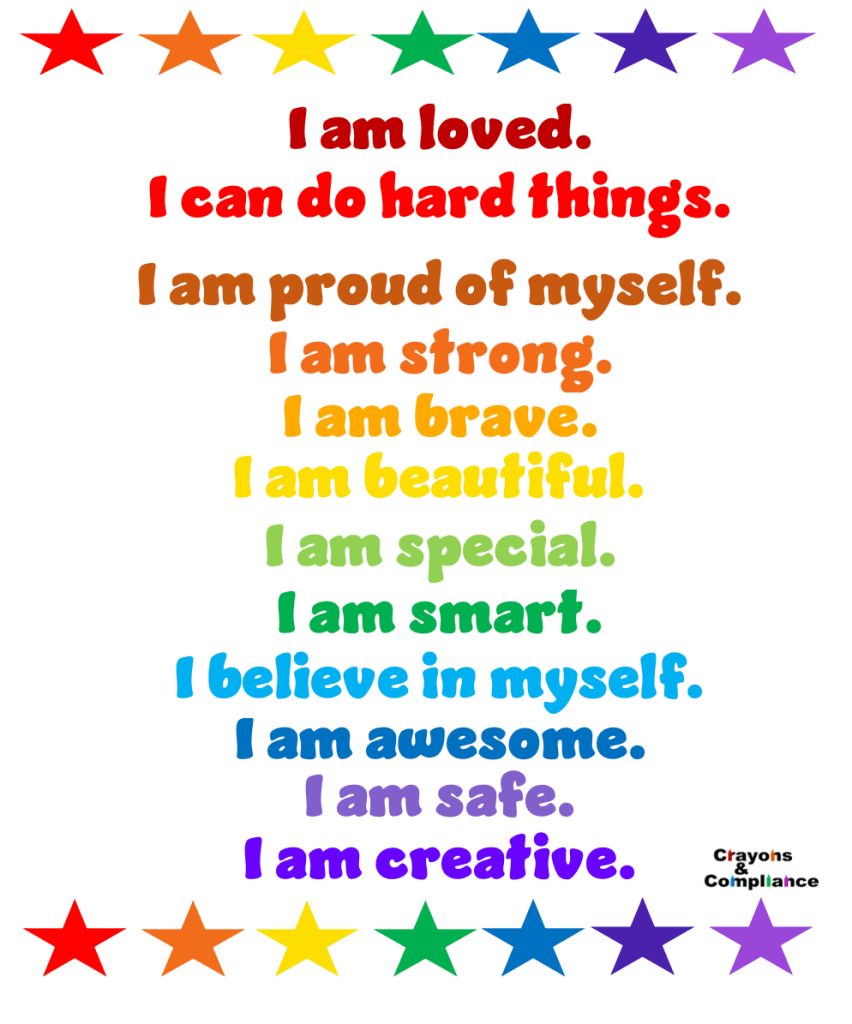
Here are some simple affirmations:

I am loved.

I am special.

I am strong.

I am brave.

I am accepted.

I am important.

I am smart.

I am kind.

I am special.

I can do hard things.

I am safe.

I am creative.

I am beautiful/handsome.

I am proud of myself.

I believe in myself. I am awesome.

I’ve also created a printout with (most of) these affirmations. It’s colorful and fun:

You can click here to download/print this. You can click here for the same printout, but with “handsome” instead of “beautiful.”

When to say these? I usually recommend making them part of a daily routine. I find that for my family, bedtime is the easiest time to add affirmations. Our mornings are rushed, and it’s difficult for us to remember during other parts of the day. Bedtime works for us. I have this printed and on the wall in my daughter’s bedroom and we say these each night before bed. You can also have your child say these on an add-needed basis, like if they are feeling sad or had a bad interaction with someone that left them doubting themselves.

Lastly, kiddos aren’t always great about remembering to do things, so prompt your children. It may also help to actually say the affirmations WITH them. Your children are more likely to do things if they see you do it as well. Also, if your child is resistant, you can try to make it fun. Whisper affirmations, yell affirmations, sing them, say them in a silly voice. It will still have the same benefits.

Good luck! Drop a comment with YOUR favorite affirmation, either for you or a young one in your life.

Disclaimer: I am a licensed mental health therapist, but I am not your therapist. The information in this article is for general informational purposes only. This article does not create a therapist-client relationship. If you need specific recommendations based on your individual circumstances, please consult with a mental health practitioner near you.

Self Esteem Daily Worksheet (FREE printable)

From my experience in working with children, especially those in middle school and high school, issues with self-esteem are fairly common. The culprit? Well, to be honest, the majority of the time it’s their own unhealthy thinking patterns. Once those negative thoughts start, if you don’t stop them, they snowball and will have a negative impact on the way you feel and on your overall self-esteem.

From my work with school-aged clients, it’s mostly interactions with peers at school that trigger these negative thoughts. It doesn’t have to be bullying incidents – even hearing a friend compliment another friend’s hair, but NOT complimenting yours can send out a rush of negative thoughts. Or seeing another classmate get attention for their new, fancy, expensive phone, while you are stuck without one or stuck with last year’s model. Yes, bullying and snide comments from other students hurt tremendously and have a devastating affect on self-esteem, but they aren’t necessary for self-esteem to suffer.

It’s not just interactions with classmates though. Self-esteem can be impacted by all sorts of things, including school performance, interactions with siblings, and interactions with parents. As if that wasn’t enough, another big culprit is social media. Most people walk away from periods of social media scrolling feeling worse about themselves than they did before they logged in. The comparison game is to blame. We compare the whole of our lives to someone’s highlight reel – and sometimes the people we compare ourselves to have tools at their fingertips that we don’t, like hairstylists, personal trainers, makeup artists, personal chefs, and photoshopping tools.

Because it’s actually the negative thoughts about these interactions that affect self-esteem, it’s important to try to balance those negative thoughts with positive ones. How? By prompting your brain to do so. You cannot think 2 thoughts at the same time, so if you’re “forcing” your brain to think about something positive, you cannot be thinking negatively at the exact same time. But try telling your 13 year old to think of something positive…. it’s hard! At any age! Even adults struggle with what to think about, even if they know it would help to think of something more positively.

That’s where this worksheet comes in. Instead of struggling to think about something, this worksheet gives them something to think about – and it’s positive things about themselves. Double win. As you can see below, there are 4 “boxes,” each with a prompt to list 4-5 things about themselves. Five of their favorite things about themselves, 4 things about themselves they are proud of, 5 things they are good at, and 4 reasons they are special.

You can click here for the free printable!

This is something that can be done all at once, or one box at a time over the course of 4 days… or, really, however you and your child want to do it. Once completed, it can be helpful to hold onto the worksheet and keep it around, so that your child can look at it when they’re having negative thoughts about themselves. This completed worksheet can be a great reminder about why they’re so awesome, and looking at it may help get rid of those negative thoughts.

As always, if you believe your child needs some professional help and/or expresses a desire to talk to a therapist/counselor, please seek help. You can read the post on my counseling blog site called How to Find a Therapist if you need/want guidance with finding a provider.

Disclaimer: I am a licensed mental health therapist, but I am not your therapist. The information in this article is for general informational purposes only. This article does not create a therapist-client relationship. If you need specific recommendations based on your individual circumstances, please consult with a mental health practitioner near you.

Social Skills Series: Apologizing

Next up in this Social Skills Series is ApologizingIf you need a reminder on what social skills are and why they’re important, read Social Skills Series: Introduction.

There has been a lot of conflicting views on apologizing lately. Do you force an apology? Do you not? Honestly, I can see both sides. Forcing kids to apologize and recite their apology script doesn’t seem genuine. However, it’s an important skill to learn! Even though it might sound inauthentic, they’re still learning and practicing, which will make it more likely that they will use this skill in the future. My personal and professional opinion is that kids should be taught and prompted to apologize when they do something that causes some kind of harm to others.

Why is apologizing so important? Apologizing is incredibly important in repairing and maintaining relationships. It is inevitable that we will do something that hurts others. Even with the absolute best of intentions, humans do hurtful things to each other… or do things that are perceived in a hurtful way. It happens. Without an apology, it is hard to make a repair to the relationship. To keep relationships healthy, apologies are key. I also think apologies are important for teaching us to take responsibility for our actions, and in validating the feelings of others.

A “trendy” topic lately has been emotional intelligence – you can read about it on the Psychology Today website here. Empathizing with others is one of the skills included in emotional intelligence. Do you have an understanding of how others are feeling, especially after you’ve done something that has hurt them? Can you relate to them?

I think empathizing should be a key factor in apologizing. It takes time, effort, and patience, but I believe it’s important to teach children not only to apologize, but to understand how the person they are apologizing to may be feeling.

What are the steps to apologizing? When teaching any social skill to children, it can be important to practice the steps to successfully completing the skill. Just like any other social skill, these steps can be individualized for your child/family, but here is a simple set of steps for apologizing:

  1. Look at the person.
  2. Apologize (with empathy if you can!)
  3. Ask if there is anything you can do to make it up to them.

That second step isn’t totally straightforward, so you will likely have to provide some examples. They may sound like this:

  • “I’m sorry that I hurt your feelings and made you wait even longer for the slide after I cut you in line.”
  • “I’m sorry I interrupted you. I’m sure that was frustrated when you weren’t able to finish what you were saying.”
  • “I’m sorry that I made you feel sad by taking your stuffed animal.”

Like many of the social skills we’ve covered, role play is one of best ways to practice apologizing. I like to role play with dolls – my daughter seems to be much more receptive to that than if I just try to act it out with her. There are all sorts of scenarios you can pretend with.

Some TIPS for practicing this social skill:

  • Practice when your child is calm/in a good mood. Practice will probably not go well if your child is grumpy or just got in trouble for something.
  • Make sure to praise you child!
  • Give constructive, positive feedback to help your child get the steps to apologizing down.
  • Try to make it fun!
  • If your child becomes uncooperative at any point, just end the practice and revisit it later.

Good luck teaching and practicing peer pressure! I’d love to hear how this went with the child(ren) in your life!

Disclaimer: I am a licensed mental health therapist, but I am not your therapist. The information in this article is for general informational purposes only. This article does not create a therapist-client relationship. If you need specific recommendations based on your individual circumstances, please consult with a mental health practitioner near you.

Social Skills Series: Resisting Peer Pressure

Next up in this Social Skills Series is Resisting Peer PressureIf you need a reminder on what social skills are and why they’re important, read Social Skills Series: Introduction.

Resisting Peer Pressure is a skill that typically doesn’t get practiced until you really need it. What I mean is, most parents don’t usually preventatively teach this social skill – it usually comes about after a child has been pressured to do something they shouldn’t, and caved in to that pressure. While this is a good skill to teach after an incident like that, I think it’s also important to practice with young kids before you know of any peer pressure issues.

(excuse me as I go down a rabbit hold here…) As I type this, I’m thinking about bullying, which is so rampant in schools these days (I know because I hear about it from my middle school clients weekly). I think there are some kids who engage in bullying behavior because they feel pressured to do so by their peers (or a “lead bully”). Now I wonder if maybe some preventative practice with resisting peer pressure practice may have decreased the likelihood of this. Bullying is such a complex issue that it’s hard to say.

So why is resisting peer pressure important? The most motivating rationale for children is that they are less likely to “get in trouble” for being able to resist peer pressure that would cause them to make a negative choice. At my daughter’s school, you get corrected if you go down the slide head first. My daughter will get in trouble for going down head first whether it was her idea or if someone else pressured her to do it. If she can resist that pressure and follow the rules, she will not get in trouble.

Another rationale is that resisting peer pressure can keep kids safe and healthy in some instances. For older kiddos, resisting peer pressure when a friend is trying to convince you to sneak out of your house in the middle of the night will help you avoid any number of disasters that might cause you harm, or may even be fatal. Or resisting peer pressure to try unknown prescription pills that are not yours at a party may prevent you from getting severely sick or even overdosing.

Will teaching and practicing resisting peer pressure with your child guarantee that they will do so in real life? Absolutely not. I wish it would, but there are no guarantees. However, it is more likely that your child will resist peer pressure if you talk about it, give rationales, and practice.

What are the steps to resisting peer pressure? When teaching any social skill to children, it can be important to practice the steps to successfully completing the skill. These can be individualized for your child/family, but here is a simple set of steps for resisting peer pressure:

  1. Look at the person.
  2. Say clearly and calmly that you do not want to do it.
  3. Suggest an alternative.
  4. If the person tries to convince you, keep saying “No.”

Like many of the social skills I’ve covered, role play is one of best ways to practice resisting peer pressure. There are all sorts of scenarios you can pretend with. Here are some examples for several different ages:

  • Resisting peer pressure to go down the slide the wrong way.
  • Resisting peer pressure to try smoking/vaping.
  • Resisting peer pressure to skip school.
  • Resisting peer pressure to sneak out of bounds on the school playground.
  • Resisting peer pressure to be sexually active.
  • Resisting peer pressure to call someone names.
  • Resisting peer pressure to steal something.
  • Resisting peer pressure to do anything without asking permission first.

Some TIPS for practicing this social skill:

  • Practice when your child is calm/in a good mood. Practice will probably not go well if your child is grumpy or just got in trouble for something.
  • Make sure to praise you child!
  • Give constructive, positive feedback to help your child get the steps to resisting peer pressure down.
  • Try to make it fun!
  • If your child becomes uncooperative at any point, just end the practice and revisit it later.

Julia Cook also has a really great and entertaining book to help kids learn about resisting peer pressure. When I did psychotherapy groups with elementary kids, this book was always a favorite! It’s called Peer Pressure Gauge and you can read about it here: https://www.juliacookonline.com/2018/04/02/peer-pressure-gauge/ (I am not an affiliate and receive no incentives for this).

Good luck teacher and practicing peer pressure! I’d love to hear how this went with the child(ren) in your life, if you’d be so kind as to leave me a comment.

Disclaimer: I am a licensed mental health therapist, but I am not your therapist. The information in this article is for general informational purposes only. This article does not create a therapist-client relationship. If you need specific recommendations based on your individual circumstances, please consult with a mental health practitioner near you.

Teaching Emotion Regulation with an Emotion Thermometer

Regulating emotions and the concept that emotions can be more or less severe can be really difficult things to teach to children. It’s a hard concept! One way I’ve been able to help kiddos grasp this concept is with the idea of an Emotion Thermometer.

Think of an Emotion Thermometer as a tool that measures how severe an emotion is. This tool doesn’t actually exist, but you can describe it as a thermometer that measures emotions from small to medium to big. You can also use a scale from 0 to 10. Which one is “better?” The answer is… the one that your kiddo seems to understand more. If it’s easier for them to rate their emotions on a scale from 0 (not at all) to 10 (the WORST), then great! If it’s easier for them to rate their emotions as “small,” “medium,” and “big,” then also great!

You can talk with your child about how, as their emotions fluctuate, the emotion thermometer will go up and down. Talk about how things that make us feel a negative emotion, like anger, will cause the emotion thermometer to rise, while things that help us feel calm, like taking deep breaths or getting a hug, will cause the emotion thermometer to go down. You can also discuss how, typically, the emotion thermometer will go down over time.

The emotion I have found this to be most helpful for is anger (though I’ve used it for sadness and anxiety also), so I have created a visual to help with this concept. See below the Anger Thermometer (you can print a copy here if you like).

As you can see in the image above, I like to also use the thermometer to talk about calming down. On the left side you can see spaces to write in how their body feels when they are experiencing different severity of emotions. Talking about body signals can help with filling these out!

On the right side, you can then fill in spaces with coping skills that will help lower the intensity of the anger – if you need ideas for coping skills, see my blog post with 75 Coping Skills for Kids.

Another point of discussion is how sometimes our “baseline” severity of emotion may be higher, based on many factors, including weather, how we slept, whether we’re dehydrated, whether we have a headache or are sick. So some days we may walk around at a really low level of emotion (none or zero). On these days, small irritations are only going to bump us up to “small” or 2-3 out of 10. But on other days, we may walk around at a higher level of emotions. Maybe we didn’t sleep well, so our baseline for the day is “small” or 3-4 out of 10. On those days, small irritations are going to bump us up to “medium” or 5-6 out of 10. On these days, it’s very important to use lots of coping skills, to prevent those emotions from getting so severe that we have difficulty controlling our behavior.

That about sums up Emotion Thermometers. Again, you can use these for any emotions, but I find them most helpful for anger.

Disclaimer: I am a licensed mental health therapist, but I am not your therapist. The information in this article is for general informational purposes only. This article does not create a therapist-client relationship. If you need specific recommendations based on your individual circumstances, please consult with a mental health practitioner near you.