Crash Course on Reinforcement (Positive and Negative)

I’m taking a break from the Social Skills Series to write about Reinforcement. My post Crash Course on the Four Functions of Behavior is one of my most popular. What this tells me, is that people are actually interested in these terms/theories, and looking for more information. So if you are looking for more information on what Reinforcement is, this post is for you.

So what is Reinforcement? Reinforcement is anything that makes it MORE likely for a behavior to happen. Or, if you prefer dictionary definitions, Merriam-Webster says that Reinforcement is, “the action of strengthening or encouraging something.” In the behavior modification world, the “thing” you are trying to strengthen or encourage is positive behaviors. Check out the chart below (AND/OR download it here) – in this post we’re focusing on the top two boxes – positive and negative reinforcement. As you can see, you are either taking something (unpleasant) away or giving something pleasant in order to make the behavior more likely to happen.

There are a multitude of actions/things that can be used as Reinforcement. Reinforcement can be negative OR positive, and this is where it gets a little tricky. “Negative” in “negative reinforcement” doesn’t mean that it’s a punishment. Both negative and positive reinforcement are “good” things that make a behavior more likely to occur. They are both reinforcing. Let me say it again:

Both positive reinforcement AND negative reinforcement are “good” – BOTH make a behavior more likely to occur again.

Positive Reinforcement is usually easier to understand because it’s giving something good to make it likely the good behavior will reoccur. Think praise, rewards, and positive attention. My child does something “good” that I want them to do again (like cleaning up her socks off the floor, so I give her an extra cookie. Or she is kind to a friend, so I tell her what a great job she did. Or she says “okay” with no whining when I say it’s time to turn off the tv, so I give her 5 minutes of tablet time. Or she gets ready for bed without a fuss, so I read an extra book with her before bed. All of these are examples of positive reinforcement. You get something good for doing something good, which makes it more likely you’ll keep doing something good.

So what does the “negative” in Negative Reinforcement mean? It means you’re taking away something considered “bad” or unpleasant to make the positive behavior more likely to occur again. The most popular example of this is the alarm for seatbelts. In cars, it’s pretty common for an alarm to ding if you don’t put your seat belt on. That ding is pretty obnoxious. Once you put your seatbelt on, the dinging stops. This is negative reinforcement. You’re taking away something unpleasant (the dinging) to reinforce positive behavior (putting on the seatbelt). You get something unpleasant removed for doing something good, which makes it more likely you’ll keep doing something good.

Here’s an example of how both negative and positive reinforcement may be used to reinforce a good behavior. Let’s say your child doesn’t like carrots and typically whines about them, but today they ate all their carrots without any whining or fussing.
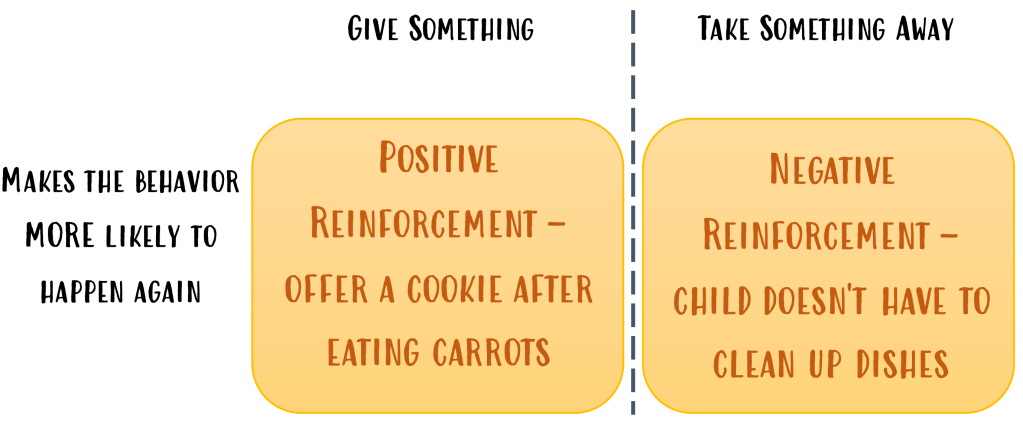
In this scenario, you have the option of giving something good (positive reinforcement) or taking away something “bad” (negative reinforcement) to make it more likely your child will eat their carrots without a fuss next time.

Unfortunately, I think negative reinforcement may be used to reinforce negative/bad/undesired behavior more often than it is to reinforce positive behavior. If you give your child a food they don’t like, then take it away when they whine/scream/complain/yell… that’s negative reinforcement. You are taking away something unpleasant (the yucky food), which reinforces the negative behavior (whining/screaming/complaining/yelling). If you tell your child it’s time to help with a chore, then change your mind when they throw themselves on the floor kicking and screaming… that’s negative reinforcement. You took away the unpleasant chore, which reinforced the “tantrum” behavior.

Let’s revisit our carrot scenario to see how positive and negative reinforcement would be used to actually make the negative behavior more likely. This time, let’s say your kiddo sees the carrots on their plate and yells “you know I don’t like carrots, mom! I’m NOT eating these.” Here’s how you might reinforce his yelling with positive and negative reinforcement:
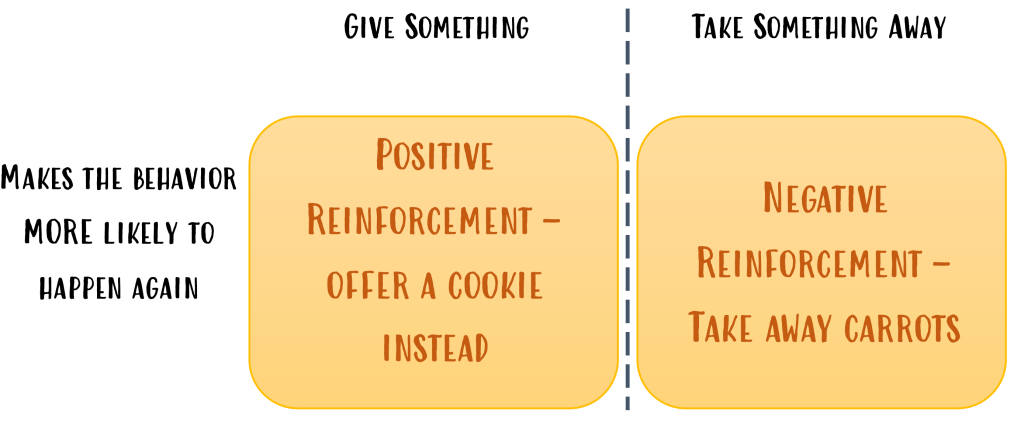
Offer a cookie instead = give something good = positive reinforcement.

Take away carrots = taking away something unpleasant = negative reinforcement.

In this case, both positive reinforcement and negative reinforcement will make it more likely that your child yells at you again – and more likely that they won’t eat their carrots.

The two carrot examples above are also examples of how you can use positive reinforcement AND negative reinforcement at the same time. In the first example, giving a cookie as a reward will be reinforcing. Or letting your child off the hook for cleaning their dishes will be reinforcing. You can use one of these, or you can use both. Using them together will make the behavior even more likely – the reinforcement will be even stronger.

And that’s a wrap on positive and negative reinforcement. The most important thing to remember is this: Both positive reinforcement AND negative reinforcement are “good” – BOTH make a behavior more likely to occur again.

As always, I’d love to read your comments and questions – drop them below!

Disclaimer: I am a licensed mental health therapist, but I am not your therapist. The information in this article is for general informational purposes only. This article does not create a therapist-client relationship. If you need specific recommendations based on your individual circumstances, please consult with a mental health practitioner near you.

Social Skills Series: Saying “Please” and “Thank you”

Good morning/afternoon/evening/night! The next social skill in this Social Skills Series is Saying “Please” and “Thank you.” If you need a reminder on what social skills are and why they’re important, read Social Skills Series: Introduction.

Whether or not you’ve ever said the words “social skill” in relation to saying “please” and “thank you,” most people acknowledge that those words are very important in today’s society. Does that mean everyone uses them consistently? Not at all – even adults are not always great about it. But most people would agree that it’s kind and respectful to say “please” when they want something and “thank you” when they’ve received something.

One rationale for saying “please” is that it makes it more likely that the person will say “yes.” And a rationale for saying “thank you” is that it makes it more likely people will do kind things for you next time. These are pretty solid rationales, in my opinion. Can you think of examples of a time that you were inclined to say “no,” but because the person said “please,” you said “yes” instead? I can! Just a few days ago my daughter asked for “one more time” going down the water slide. I looked at her, considered her “please,” and told her that I was saying “yes” only because she had asked so nicely and said “please.” And how many times have you given something to someone, not gotten a “thank you,” and thought to yourself, “I guess I’m done doing nice things for them” or something similar? Please and Thank You are important!

Books can be a great way to introduce skills to kids! There are two books in the Berenstain Bears series that can be read aloud to your child to introduce them to the concept of using “please” and “thank you.” One if The Berenstain Bears Forget Their Manners and the other is The Berenstain Bears Say Please and Thank You. I have not read the second one, but Forget Their Manners was a favorite of mine when I worked in a treatment facility with children.

So how to practice saying “please” and “thank you?” There are so many ways! One of the easiest ways I’ve practiced is to do a coloring activity with your child. You hold on to all of the crayons/markers/colored pencils, and when your child wants one, they must say “please” when asking and “thank you” once they’ve received. You could also practice with a small treat – carry a small baggie of m&ms or chocolate chips around, and in order to get one, your child must say “please” when asking and “thank you” once they’ve gotten one. Another idea is with a sticker book. My daughter still needs help peeling the stickers, so I can practice with her by making her ask “please” when she is ready for another sticker to put on, then saying “thank you” once I’ve given her one. Yet another option is to use building blocks of some kid – put all the blocks in a pile and before taking one, your child must ask “please,” then say “thank you” once you tell them it’s okay to take one.

Remember to praise and reward (optional) your child when they are successful! You want to praise every time they say “please” or “thank you.” Rewards are, again, optional. With each of these practice ideas, there is a positive consequence built in to the practice – they are getting a sticker for their book, getting a block to use, or getting a crayon to use. And obviously if you are having them practice saying “please” and “thank you” for a small treat, the small treat acts as a reward. If you want to, you can use another reward – my recommendation would be to use a reward for a certain number of successes. Such as, ten successful “please” and “thank you”s will earn something. You can even give a sticker for each success, then give a reward when they earn a certain number of stickers. Ten stickers may equal ten extra minutes of tv time (or any other reward you want to use).

Some TIPS for practicing this social skill:

  • Practice when your child is calm/in a good mood. Practice will probably not go well if your child is grumpy or just got in trouble for something.
  • Make sure to praise you child for saying “please” and “thank you.”
  • Kids LOVE IT when they can turn the tables – let them be in charge during the practice and praise YOU for saying “please” and “thank you.”
  • Try to make it fun! If your child becomes uncooperative at any point, just end the practice and revisit it later.

Good luck! Drop a comment with any other fun ideas for practicing this important social skill!

Disclaimer: I am a licensed mental health therapist, but I am not your therapist. The information in this article is for general informational purposes only. This article does not create a therapist-client relationship. If you need specific recommendations based on your individual circumstances, please consult with a mental health practitioner near you.
Social Skills Series: Accepting “No” For An Answer

Hi all! The next social skill in this Social Skills Series is Accepting “No” For An Answer. If you need a reminder on what social skills are and why they’re important, read Social Skills Series: Introduction.

So… accepting “no” for an answer? Talk about a hard skill for kids! Why is it so hard? Because when kids are told “no,” it’s usually in response to something that they want or want to do. It all relates back to the Four Functions of Behavior. Kids want something and when they’re told “no,” they exhibit all sorts of behaviors to try to get what they want. They may cry, whine, argue, ask again (and again and again), yell, hit, scream, etc. (P.S. Adults do this too; the last time you told another adult “no,” did they accept it the first time?)

Yesterday, my husband and I were at the pool with my daughter for almost 3 hours! We take her at least 3 times per week, so she gets to go a lot. When it was time to leave, she asked if we could stay, and I had to tell her “no.” She had a rough time accepting “no” for an answer. She whined and asked me again (twice more) if we could “please” stay. Gotta at least credit her for saying “please!”

You can certainly correct this behavior when you see it, or issue a consequence. I ended up correcting the behavior and providing a rationale about why it’s important to accept “no” (because we’re more likely to want to take her back to the pool if she can say “okay.” I could tell she still wasn’t happy, but she said “okay” and didn’t whine after that.

One important part of teaching/practicing social skills is to be very clear with your children what exactly they need to do to successfully demonstrate that skill. When I hear parents correct behavior, many times I hear them tell their child what NOT to do. “Stop whining.” “Stop arguing.” Especially with young children, it’s important to let them know WHAT TO DO instead. And saying “accept ‘no’ for an answer” isn’t real clear?

You can decide what “steps” you want your child to follow when accepting “no” for an answer. You may just want them to say “okay.” When I worked at a treatment center, the steps were look at the person and say okay with no arguing. You may want them to say “yes, ma’am” instead. Once you decide, teach your children the steps to accepting “no” for an answer, then have them repeat them back to you.

Now it’s time to practice! As with most skills, there are lots of different ways you can practice this with children. Here are a few I’ve used with my own kiddo or as a therapist:

  • Practice while playing a board game by having children ask permission for their turn – say “no” sometimes and let them practice staying “okay.”
  • When a kiddo asks for a snack, tell them that they must practice accepting “no” by saying “okay” one time before you give them the snack.
  • You can have them think of silly questions to ask (“Can I eat 89 cupcakes for breakfast?” or “Can I wear 4 different hats on my head to school?”) then saying “okay” when you tell them “no.” This is a great way to use humor to make practice fun!
  • Playing Go Fish is another super easy way to practice accepting “no” for an answer. The only thing you’ll really do differently is make sure the child says “okay” after you answer “no” when asked for a specific card.
  • You can also practice while coloring. You can be the “keeper” of the crayons/markers. When the kiddo wants a new color, they must ask nicely and say “okay” when you tell them “no.”
  • You can also have them practice accepting “no” by saying “okay” when waiting for an activity. You might draw up a chalk obstacle course, and they have to ask before they start. Or practice accepting “no” before letting them jump into the pool.

There are lots of other ways to practice this. Just think of any activity that you can make your child ask permission, then tell them “no” so they can practice saying “okay.”

Some TIPS for practicing this social skill:

  • Practice when your child is calm/in a good mood. Practice will probably not go well if your child is grumpy or just got in trouble for something.
  • Make sure to praise you child for saying “okay!”
  • Kids LOVE IT when they can turn the tables and tell YOU “no.” Sometimes it’s fun to let them do so, and then you get to model how to stay calm and say “okay.”
  • To further this practice, you can have kiddos practice staying calm by taking a deep breath before saying “okay.” This reinforces the idea of using calming skills to stay calm.
  • Try to make it fun! If your child becomes uncooperative at any point, just end the practice and revisit it later.

Good luck! Let me know in the comments what ways you’ve practiced accepting “no” for an answer with the kiddos you love!

Disclaimer: I am a licensed mental health therapist, but I am not your therapist. The information in this article is for general informational purposes only. This article does not create a therapist-client relationship. If you need specific recommendations based on your individual circumstances, please consult with a mental health practitioner near you.

Hot Chocolate Breathing (A Calming Skill)

Who loves hot chocolate/cocoa? I do! So yummy, especially in the winter after we’ve been building snowmen or shoveling. Most kids I know LOVE hot chocolate, so Hot Chocolate Breathing is such a FUN way to calm down. It’s not uncommon for kids to be resistant to using calming skills when prompted, but when you make them fun, usually kids are more willing.

So what is hot chocolate breathing? It’s pretending to have a mug of hot chocolate in your hands, blowing on it because it’s too hot, then sipping it. It’s a way to get kids to take some deep breathes to calm down.

This is what I would say to engage a child in hot chocolate breathing:

“Put your hands out in front of you like you’re holding a mug, and pretend that mug is full of hot chocolate. Pretend you can see the steam coming off the mug, so you know it must be very, very hot. Let’s blow on it to try to cool it down. Take a big breathe, then slowly blow on your hot chocolate. Not too fast – you don’t want to spill! Okay, good, let’s do it again. Big breath in, then slowly blow out on your hot chocolate. Okay, let’s try a sip… wow! Still too hot! Let’s do two more big breaths to try to cool it down. Okay, let’s try it okay. Mmmmm… this is perfect, and so yummy.”

You can also make it more fun by adding marshmallows… before you take deep breathes, you could say, “I like marshmallows in my hot chocolate. How many marshmallows should we put in today? 12? Sounds good! Let’s pretend our marshmallows are here on the side. Let’s pick them up one at a time and count them until we get to 12.”

Adding the marshmallows can make this calming skill even more effective because you’re combining counting (another great calming skill) with deep breaths.

Some tips for getting kids to learn and use calming skills:

  • Teach calming skills when your kids are calm. It’s not very beneficial to try to teach your child a new calming skill when they’re escalated.
  • It’s usually best to do this WITH your child. Rather than say, “go do your hot chocolate breathing,” say instead, “let’s do your hot chocolate breathing together.” This makes it much more likely that your child will comply with the prompt.
  • Praise your child for using coping skills – both prompted and unprompted! This makes it much more likely that they will continue to use them.

I’m excited to hear how you’ve used this with children, and any modifications you’ve added (like counting marshmallows). Let me know with a comment!

Disclaimer: I am a licensed mental health therapist, but I am not your therapist. The information in this article is for general informational purposes only. This article does not create a therapist-client relationship. If you need specific recommendations based on your individual circumstances, please consult with a mental health practitioner near you.

Social Skills Series: Taking Turns

Welcome to the first of the social skills in the Social Skills Series (read Social Skills Series: Introduction to learn more about social skills and why I’m writing this series). I’m going to go out on a limb here and suggest that taking turns may be one of the hardest social skills for kiddos. When they like to do something, it is unbelievable difficult for them to step away and let someone else try it. I mean, honestly, it’s hard for adults too!

I’ve seen so many examples of this as a therapist and a parent. Just this morning my daughter had a play date with a sweet friend and the two of them struggled to take turns with the steering wheel on the play set. Luckily, this did not turn into major conflict for them. But a few months ago my daughter had a playdate with some school friends – there were 4 girls and only 3 balls and it got pretty rough. Yelling and “stealing” balls from someone else… eventually there were tears. Taking turns is hard!

Does your child need a diagnosis and therapy if they struggle to take turns? Absolutely not! Having difficulty with this social skills is totally developmentally appropriate. There’s no need for alarm if your child struggles to take turns while playing with others. But that doesn’t mean they wouldn’t benefit from practice!

So how do you practice taking turns? PLAY! Practice does not have to be a super boring activity. Just play something where you can practice taking turns. Some examples from my own family:

  • Take turns being the preferred doll while playing with the dollhouse. My kiddo’s favorite doll and princess is Cinderella and she always wants to “be” Cinderella. Sometimes I stress the importance of taking turns and she lets me be Cinderella for a few minutes.
  • Take turns while playing a board game. This is so easy – you just play like you normally would, but talk about taking turns and point out that you’re taking turns. So simple.
  • We also take turns playing with the dogs and their toys – we all like to throw the toys for the dogs to fetch, but we can’t all throw it each time. This is a great opportunity to talk about taking turns and to practice.
  • We also take turns while coloring or painting – when we want to use the same color, we have to take turns.

Most of these examples are things that happen in “normal” play. The difference is that we don’t normally talk about taking turns while doing it. Simply by calling attention to the social skill, and praising/encouraging your child for taking turns, it can make a world of difference.

Sometimes I’ll do something a bit different with my daughter by acting as if I refuse to take turns – I’m never mean about it, I may just say something like, “I think I want to take another turn.” Then we talk about how she would feel if I DID skip her turn. This is a great way to help kiddos develop some empathy and to understand what their friends may feel like when they don’t do well with taking turns.

Some tips for practice: Always do this when your child is in a good mood. It doesn’t usually go well if you try to practice when your child is super grumpy or after you just corrected their behavior. Also, make sure to praise and encourage them for the skill they are practicing. For example, say, “you’re doing a great job taking turns” or “isn’t it nice to take turns and play together?”

Besides practice, it is incredibly beneficial to pay attention to your child playing and correct them when they struggle to take turns. You probably can’t catch it every single time, but if you see it, walk over and talk about it! Remind them why taking turns is important and prompt them to try again!

Drop me a comment and let me know what ways you practice taking turns with your kiddos!

Disclaimer: I am a licensed mental health therapist, but I am not your therapist. The information in this article is for general informational purposes only. This article does not create a therapist-client relationship. If you need specific recommendations based on your individual circumstances, please consult with a mental health practitioner near you.

Social Skills Series: Introduction

I’m curious as to what comes to mind when someone with a non-clinical background hears the phrase “social skills.” As a therapist with a strong background in behavior modification, I’m familiar with social skills – what they are, why they’re important, how to teach them, how to reinforce them.

So what are social skills? They’re the things (skills) we do to socialize with other people. These skills can be both verbal and non-verbal, and are important for humans to learn in order to be successful building relationships with others. How do we learn social skills? Many times, we learn them through watching others and mimicking their behavior. This is such a great, mostly effort-free way for your kids to learn prosocial skills. But guess what? Kids can also learn inappropriate, negative skills from other kids (and adults!). So it can be helpful for parents to practice these skills with kids – especially those skills that you see your child needs some improvement in.

Some individual social skills include: take turns, respecting boundaries, sharing, asking for help, asking permission, saying “thank you,” saying “sorry,” waiting patiently, following directions, complimenting others, accepting “no” for an answer, resisting peer pressure, greeting others, and saying “no” to others appropriately. This is not an exclusive list by any means. There are many, many more social skills. The blog site And Next Comes L, has a list of 50 social skills, which you can find here on their site.

Why are social skills important? The “big picture” answer is to successfully build relationships with other people. Social skills are how we meet and keep friends. Social skills are how we maintain bonds with family members. Social skills help with interviews, getting jobs, and keeping jobs. Social skills are how we sell items or ideas to other people. Pretty important!

How to teach them? Yes, your children will be exposed to these skills by watching others and may mimic these skills. If you notice your child struggling with a social skills, you can model the skills for them and practice. Then you can reinforce this with praise when you see them do it well (both in practice and outside of it).

What happens if we don’t teach/practice them? We may end up with children who struggle to interact positively with others. As a therapist, I see this in some of my clients. As a parent, I see this in my own kiddo and in other kiddos we interact with. I see my daughter struggle to be a good sport when she loses a game. I see many kids struggle to take turns and wait patiently while playing at playgrounds. I see clients who struggle to show gratitude, which leaves family members feeling resentful. I see clients who have “perfectionist” tendencies struggle to ask for help when they need it.

Now, please hear me out when I say that no child will be “perfect” with social skills. I’m not of the opinion that all parents should be practicing all of these skills with their kids – we have enough to do! There’s no need for alarm if your child is still learning. Maybe they just need a little more time, socializing, and developmental progress to really nail those social skills. But if you see them struggling and it’s affecting their relationships with others, it’s a great idea to practice with them. This series is not to add to the parent load by preaching about ANOTHER thing you must do with your children. This is an informational series for parents who may see their child struggling in an area or two and want to help.

Be on the lookout for posts about individual social skills to be added! I hope to cover each social skill listed in this post. I can’t wait to hear how you’re practicing these skills with your kiddo!

Disclaimer: I am a licensed mental health therapist, but I am not your therapist. The information in this article is for general informational purposes only. This article does not create a therapist-client relationship. If you need specific recommendations based on your individual circumstances, please consult with a mental health practitioner near you.

Practicing Transitions (From Preferred Activities)

Transitions are hard for most kids.  Most kiddos I’ve known and worked with struggle the most with transitioning from electronic use.  When told to turn off the tv/tablet/phone/video game, they are NOT happy.  Any favorite activity that comes to an end can lead to an incredible amount of emotion.  My kiddo’s hardest transition is saying goodbye to grandparents she is having fun with.   

This is all normal.  It’s normal to be sad, or disappointed, or mad, or frustrated that a preferred activity is ending.  For most children, it’s important to show some empathy (“I know it’s hard to say goodbye to grammy and papa”) and a firm repeat that it’s time to go.  Or help leaving, if they need to be carried or led with hand-holding.

However, if your child is throwing a tantrum or engaging in behavior that is distressing to you, it may be time to go a little further.  You have the options of positive or negative consequences.  I’ve often rewarded my daughter with fruit snacks (positive consequence) if she listens without arguing or whining when told it’s time to go.  You could also use a time-out or removal of privileges (negative consequences) to motivate your child.

The intent of this post, though, is to focus on PRACTICE.  Accepting decisions is a social skill, and practicing this social skill will help your kiddo be more successful in real life.  So how to practice?  There are a lot of options, and you can personalize it to what your child struggles with the most.  Here are some steps to help:

1)      Pick a preferred activity that your child struggles with.

2)      Decide what your practice structure (how long the preferred activity will last, what your child “should” do when told it’s time, and what reward they will earn for success) will be.

3)      Tell your child everything from step 2 BEFORE giving them the preferred activity.

4)      Have them start doing whatever they love to do.

5)      Once the time you decided is over, tell them it’s time to be done.

6)      Listen and watch their response.

7)      Praise them for a job well done, OR provide constructive feedback.

8)      Try again!

An example:

1)      I decide my child struggles with turning the tv off, so this is what I want to practice.

2)      I decide that my child will watch tv for 3 minutes, then will need to say “okay” and turn the tv off right away when I tell her it’s time.  If she does so, she can have a chocolate chip.

3)      I tell my child everything from step 2.

4)      I set her up watching tv.

5)      After 3 minutes, I tell her it’s time to turn the tv off.

6)      I listen to her say “okay” and turn it off right away.

7)      I praise her enthusiastically and give her a chocolate chip as a reward.

8)      We continue practicing.

Remember to make your praise big when your child is successful at practice.  Make the practice fun for them!  

One very important note is that you should ONLY PRACTICE WHEN YOUR CHILD IS CALM.  Actually, it’s a good idea to make sure BOTH of you are calm.  It is not a great idea to practice transitions in the middle of your child’s tantrum.  Practice will not go well if your child is escalated – you’ll both just end up frustrated.  Instead, wait until they are in a decent mood.  If at any point your child is becoming emotionally escalated during the practice, just say something like, “it seems like now isn’t a good time, but we can try again later.”  If you find your child becoming consistently escalated, consider increasing the reward/praise, or consider how you might make the practice a little easier for them.

Disclaimer: I am a licensed mental health therapist, but I am not your therapist. The information in this article is for general informational purposes only. This article does not create a therapist-client relationship. If you need specific recommendations based on your individual circumstances, please consult with a mental health practitioner near you.

Crash Course on Differential Reinforcement

Heard of differential reinforcement? It’s one of those terms from the behavior modification world that sounds pretty intimidating. Which is unfortunate because it is incredibly important in changing children’s behavior.

So what does differential reinforcement mean? It means reinforcing (praising or giving a positive consequence for) the behavior that is OPPOSITE of the behavior you don’t like. It means reinforcing only the behavior that you want to see more of, or increase. Which, in turn, means NOT reinforcing the behavior you do not want to reinforce.

I sometimes use this concept with parents who have strongly determined what behavior they DON’T like, but haven’t mentioned what they would like to see instead. I don’t know that I’ve ever used the word “differential reinforcement” with a child’s parents, but I ask, “what do you want your child to do instead of _____?”

As parents, we are pretty good at picking out behaviors we don’t like. I don’t like when my daughter doesn’t follow directions. I don’t like when she throws her shoes in the middle of the entryway. And I certainly don’t like it when, at bedtime, she sings at the top of her lungs.

Once a parent knows what behavior they do NOT like, it’s possible to give a negative consequence or ignore that behavior to decrease it. But the other half of the equation is to figure out what you want your child to do instead, then reinforce it with praise and/or positive consequences.

Most of the opposite behavior is super easy to determine. The opposite of not following directions? Follow direction the first time asked. What would I like my kiddo to do with her shoes instead of throwing them in the middle of the entryway? Put them in her shoe cubby. The opposite of singing in her bed when it’s time to sleep? Lay quietly.

It’s important to decide what you would like your child to do instead of whatever they are doing that’s bothering you. Then, let your child know what you’d like them to do – kids are not always the brightest, and may not even be able to identify what they *should* be doing instead unless you tell them. After that, start praising and/or rewarding the positive behavior.

This two-fold approach can work pretty quickly – a negative consequence for the negative behavior, and a positive consequence for what you want to see instead. Be consistent with it, and the negative behavior will decrease, while the positive one increases.

What would happen if you use a negative consequence for the negative behavior without reinforcing the alternative/positive behavior? You run the risk that your kiddo may replace one negative behavior with another one. If I tell my daughter to stop throwing her shoes in the middle of the entryway without telling her where I’d like her to put them, she may start throwing them in the middle of the living room instead, or leaving them on the stairs.

In summary, when you, as a caregiver, are seeing a behavior you don’t like, think about what you’d like your kiddo to do instead, and positively reinforce THAT behavior.

Disclaimer: I am a licensed mental health therapist, but I am not your therapist. The information in this article is for general informational purposes only. This article does not create a therapist-client relationship. If you need specific recommendations based on your individual circumstances, please consult with a mental health practitioner near you.

Extinction Burst (Why Behavior May Get Worse Before It Gets Better)

If you have a kiddo with a “problem” behavior and you implement a new parenting strategy, chances are you hope that the behavior will get better right away. Wouldn’t that be nice? Don’t get me wrong – SOMETIMES that happens. Sometimes, you start doing things a little differently, such as implementing a consequence or ignoring behavior, and you start to see improvement right away.

Unfortunately, more often than not, most people experience what’s called an “extinction burst.” Doesn’t sound so good? It’s not, but knowing that it may come can help caregivers anticipate it and be prepared for when it happens.

So what IS an extinction burst? It’s the way behavior analysists/therapists describe an increase in the severity of behavior once extinction occurs. Basically, once you take away whatever is reinforcing a child’s behavior (like attention, an item, or getting out of doing something), their behavior gets a little worse before it bets better. Clear as mud?

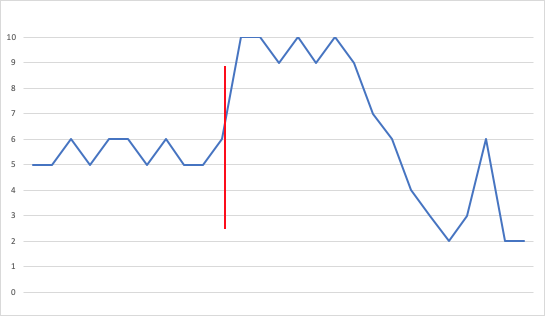
Let’s say I have a boy who throws a tantrum after lunch every day because he wants a brownie. He cries and screams and kicks the walls, and I do my best to hold out, but I eventually cave and give him one. Then one day I decide I’ve had enough and I’m not going to give him a brownie, no matter what. That day his behavior is likely going to be even worse. In addition to crying, screaming, and kicking walls, he might say he hates me, and try to hit me.

The chart below shows how the severity of a behavior (on a scale from 0 to 10) gets worse once extinction (not giving a brownie) begins (this is indicated by the red line). The behavior gets worse, but then starts getting better!

(Severity of outbursts)

Unfortunately, this extinction burst is where some parents might be tempted to give up, or to think that what they’re doing doesn’t work. BUT, an extinction burst is actually a sign that what you are doing is working!

Let’s imagine what is going through the boy’s mind. The little boy wants a brownie, so he cries, screams, and kicks the walls. He’s thinking any minute now, she’ll give up and give me a brownie. But then a few minutes go by and he starts to think well shoot, this isn’t working; she’s usually caved by now. So what does he then think? Oh well, I guess I’ll give up…? Not usually! Probably something more like I better try even harder! What else can I do to convince her to just give it me? Then he starts with the hurtful words and hitting. He has learned that his typical behavior isn’t cutting it, so he amps it up. This is the extinction burst. Just when you thought your kiddo’s behavior was bad enough, you see this burst of something even worse.

Don’t give up! Keep with it, and it WILL get better. You just need to be consistent to get through that extinction burst and see progress. It’s also important to note that, even after the extinction burst, it’s not out of the norm to see some smaller bursts of more severe behavior. You think you’re seeing progress and then BOOM! Your child decides to test the limits again. They’re just testing your resolve to see if you’ll stick it out. Consistently show them you will (that you’re more stubborn than they are), and their negative behavior will fade.

And while you’re going through that extinction burst, remind yourself “this means what I’m doing is working.” Tell yourself whatever you need to in order to get through it. “This will all be worth it in the long run.” “I can do this.” Whatever will work for you to keep your consistency up.

Disclaimer: I am a licensed mental health therapist, but I am not your therapist. The information in this article is for general informational purposes only. This article does not create a therapist-client relationship. If you need specific recommendations based on your individual circumstances, please consult with a mental health practitioner near you.

How To Get Your Child to Stop Acting Out for Attention

Every parent has or will deal with this at some point. Their child is acting out and it’s hard to identify why. Usually your daughter has a meltdown when she asks for M&Ms and doesn’t get them. Or she whines and stomps her feet when told it’s time for bed. That behavior is due to wanting something (M&Ms) and wanting to get out of something (bed). Of the Four Functions of Behavior, attention is one of the hardest two to deal with.

Why? Well, for one, it can be hard to identify that attention is why your child is acting out. If you need help, see these tips for identifying what “function” is fueling your child’s behavior. Remember, negative attention is better than no attention. Another reason it can be difficult to “fix” behavior caused by desire for attention is that, for many parents, it can be hard to provide the solution, which is to give your child attention when they are being good. Why is this hard? For one, life is busy. Caregivers everywhere are working, keeping houses clean, balancing budgets, cooking, and doing all the other daily things that go with being a human and parent.

Imagine a mom who needs to empty the dishwasher. She has been playing with her child for 10 minutes or so, and decides it’s time to go empty it. About 5 minutes in, her child starts acting up. So she yells from the kitchen (thus giving attention) to stop, then goes back to work. One minute later, the child starts yelling and the mother runs in and scolds the child (again, giving attention). In this situation, the mother is reinforcing the child’s behavior by giving them exactly what they want… ATTENTION. But it’s a hard cycle to break because caregivers can’t just ignore all their other responsibility in order to give their child 100% of their attention all the time. That’s unrealistic and, frankly, not healthy for anyone.

So what do you do? The first step is to start making an effort to give more attention when your child is doing something “good.” Obviously you can’t do this ALL the time, but start trying to catch your child being good and let them know you saw and approve (praise!). This is call TIME-IN (as opposed to Time-outs, which remove attention for negative behavior). Time-in is all about giving your child lots of attention and praise when they are doing something well. By giving them more positive attention when they do something “good,” you decrease the likelihood they are going to act out for attention.

A second tactic to try to is to use your attention as a reward. This doesn’t mean withhold your attention unless they earn it; rather this means carving out an extra 10 minutes towards the end of the day for you to do something special with your child and give them your sole attention for that time. They earn it with their positive behavior. If they have been throwing a fit or tantrum, then they earn that extra time by not doing so throughout the day. Whatever they’ve been doing that you don’t like, figure out what the opposite is and make that their goal, then reward them for it. Give them 10 minutes of extra reading time before bed, or 10 minutes playing a board game, or 10 minutes of painting your toe nails… whatever your kid loves to do WITH you, do it with them for 10 minutes.

A third intervention, and likely the hardest, is to limit attention for negative behavior. This doesn’t mean to ignore every “bad” behavior. But it does mean that it is in your best interest to try to cut down on the amount of attention. Some parents like to lecture. When you have a child acting out for attention, lecturing is the jackpot for them. Why? Because you’re giving them attention! So try to cut back on that attention. Limit verbals. Instead of a lecture, say “no thank you” or something else that gets the point across without using a lot of words and attention.

Lastly, you can use consequences to cut down on attention-seeking behavior. Just make sure this consequence isn’t one that means more time with a caregiver. Take away 5 minutes of electronic time. Have them pick a chore from a chore jar. That wouldn’t even necessarily require verbals, you can just walk the chore jar over to them and hold it out for them to pick.

If you can follow these steps, you can make a lot of progress on decreasing your child’s attention-seeking behavior. Start somewhere, try your best, and keep making an effort until you see progress. Remember that it’s always possible (and likely) that the behaviors will get a little worse before they get better (this is called an extinction burst). But stick with it. And if you’re having a hard time, seek help from a therapist to come up with a plan.

Disclaimer: I am a licensed mental health therapist, but I am not your therapist. The information in this article is for general informational purposes only. This article does not create a therapist-client relationship. If you need specific recommendations based on your individual circumstances, please consult with a mental health practitioner near you.