Teaching Emotion Regulation with an Emotion Thermometer

Regulating emotions and the concept that emotions can be more or less severe can be really difficult things to teach to children. It’s a hard concept! One way I’ve been able to help kiddos grasp this concept is with the idea of an Emotion Thermometer.

Think of an Emotion Thermometer as a tool that measures how severe an emotion is. This tool doesn’t actually exist, but you can describe it as a thermometer that measures emotions from small to medium to big. You can also use a scale from 0 to 10. Which one is “better?” The answer is… the one that your kiddo seems to understand more. If it’s easier for them to rate their emotions on a scale from 0 (not at all) to 10 (the WORST), then great! If it’s easier for them to rate their emotions as “small,” “medium,” and “big,” then also great!

You can talk with your child about how, as their emotions fluctuate, the emotion thermometer will go up and down. Talk about how things that make us feel a negative emotion, like anger, will cause the emotion thermometer to rise, while things that help us feel calm, like taking deep breaths or getting a hug, will cause the emotion thermometer to go down. You can also discuss how, typically, the emotion thermometer will go down over time.

The emotion I have found this to be most helpful for is anger (though I’ve used it for sadness and anxiety also), so I have created a visual to help with this concept. See below the Anger Thermometer (you can print a copy here if you like).

As you can see in the image above, I like to also use the thermometer to talk about calming down. On the left side you can see spaces to write in how their body feels when they are experiencing different severity of emotions. Talking about body signals can help with filling these out!

On the right side, you can then fill in spaces with coping skills that will help lower the intensity of the anger – if you need ideas for coping skills, see my blog post with 75 Coping Skills for Kids.

Another point of discussion is how sometimes our “baseline” severity of emotion may be higher, based on many factors, including weather, how we slept, whether we’re dehydrated, whether we have a headache or are sick. So some days we may walk around at a really low level of emotion (none or zero). On these days, small irritations are only going to bump us up to “small” or 2-3 out of 10. But on other days, we may walk around at a higher level of emotions. Maybe we didn’t sleep well, so our baseline for the day is “small” or 3-4 out of 10. On those days, small irritations are going to bump us up to “medium” or 5-6 out of 10. On these days, it’s very important to use lots of coping skills, to prevent those emotions from getting so severe that we have difficulty controlling our behavior.

That about sums up Emotion Thermometers. Again, you can use these for any emotions, but I find them most helpful for anger.

Disclaimer: I am a licensed mental health therapist, but I am not your therapist. The information in this article is for general informational purposes only. This article does not create a therapist-client relationship. If you need specific recommendations based on your individual circumstances, please consult with a mental health practitioner near you.
Social Skills Series: Asking Permission

Next up in this Social Skills Series is Asking PermissionIf you need a reminder on what social skills are and why they’re important, read Social Skills Series: Introduction.

As I sit here trying to think of a great opener for this skill, I’m really just left thinking that asking permission is not really a very exciting skill. Important, sure! Just not very exciting to talk about. And not really a social skill that most people focus on. I think Asking Permission is one of those skills that you only focus on if it’s a problem, as opposed to social skills that you proactively teach to increase your child’s success in social settings.

So why is asking permission important? The most motivating rationale for children is that they are less likely to “get in trouble” for asking permission. If my daughter turns the television on without asking, she loses all electronic time for the day. Another rationale is that it’s respectful and makes it more likely you’ll have good relationships with others. Your child may not be able to hold onto friendships if they take others’ things without asking.

One thing to note about asking permission is that you likely don’t want your child to think they have to ask permission for every single thing. Like going to the bathroom at home, or playing with their own toys, or getting a glass of water. You will have to teach your kiddo when they need to ask permission. Here are some examples of times your children may need to ask for permission:

  • Before taking something from someone’s hands
  • Before borrowing an item from someone
  • Before using particular items – television, tablet, etc.
  • Before getting a snack
  • Before getting out of your seat to use the bathroom at school
  • Before going into a sibling’s room
  • Before going outside to play

When teaching any social skill to children, it can be important to practice the steps to successfully completing the skill. These can be individualized for your child/family, but here is a simple set of steps for asking permission:

  1. Look the caregiver in the eye
  2. Ask permission by saying “Can I please…”
  3. Say “okay”
  4. If told “yes,” do it. If told “no,” don’t do it.

To practice asking permission, you can use both games and role-play:

  • Mother May I is a fun way to ask for permission. Have someone be the “mother” and the other person stand across the room and ask, “mother, may I take ___ steps.” The “mother” then gets to say “yes” or “no.” This is especially fun for kids if you let them be the “mother” in the game a few times.
  • With any board game or card gamee, you can have children ask permission before taking their turn. I’ve done this with Candyland, Chutes and Ladder, and Don’t Break the Ice, but any game where you take turns will work. “Can I please take my turn now?” Because it wouldn’t be very nice to tell them “no” they can’t have their turn, then for me to take a second turn in a row, when I tell a child “no,” I have them say “okay,” then prompt them to ask again. OR, you can also practice emotion regulation with this by having them say “okay” then pick a coping skill to use before you prompt them to ask again.
  • Practice while coloring – you can be the keeper of the crayons/markers and your child can practice asking permission by asking “can I please have the red crayon,” then saying “okay.”
  • Practice with Legos – be the keeper of the legos and have kids ask permission to use specific pieces when they need it (“can I please have the yellow Lego?”)
  • You can role-play by having your child sit in a chair and ask permission to get up to get a kleenex, use the bathroom, or get a drink (“can I please get up and get a drink?”)
  • You can also role-play by playing with toys and having your child ask permission to play with a toy your using (“can I please play with that?”)

Some TIPS for practicing this social skill:

  • Practice when your child is calm/in a good mood. Practice will probably not go well if your child is grumpy or just got in trouble for something.
  • Make sure to praise you child!
  • Try to make it fun!
  • If your child becomes uncooperative at any point, just end the practice and revisit it later.

There are lots of ways to practice this – I’d love to hear the fun ways YOU come up with to practice! Please share in the comments!

Some TIPS for practicing this social skill:

  • Practice when your child is calm/in a good mood. Practice will probably not go well if your child is grumpy or just got in trouble for something.
  • Make sure to praise you child!
  • Try to make it fun!
  • If your child becomes uncooperative at any point, just end the practice and revisit it later.

Disclaimer: I am a licensed mental health therapist, but I am not your therapist. The information in this article is for general informational purposes only. This article does not create a therapist-client relationship. If you need specific recommendations based on your individual circumstances, please consult with a mental health practitioner near you.

75 Coping Skills for Kids (FREE Printable)

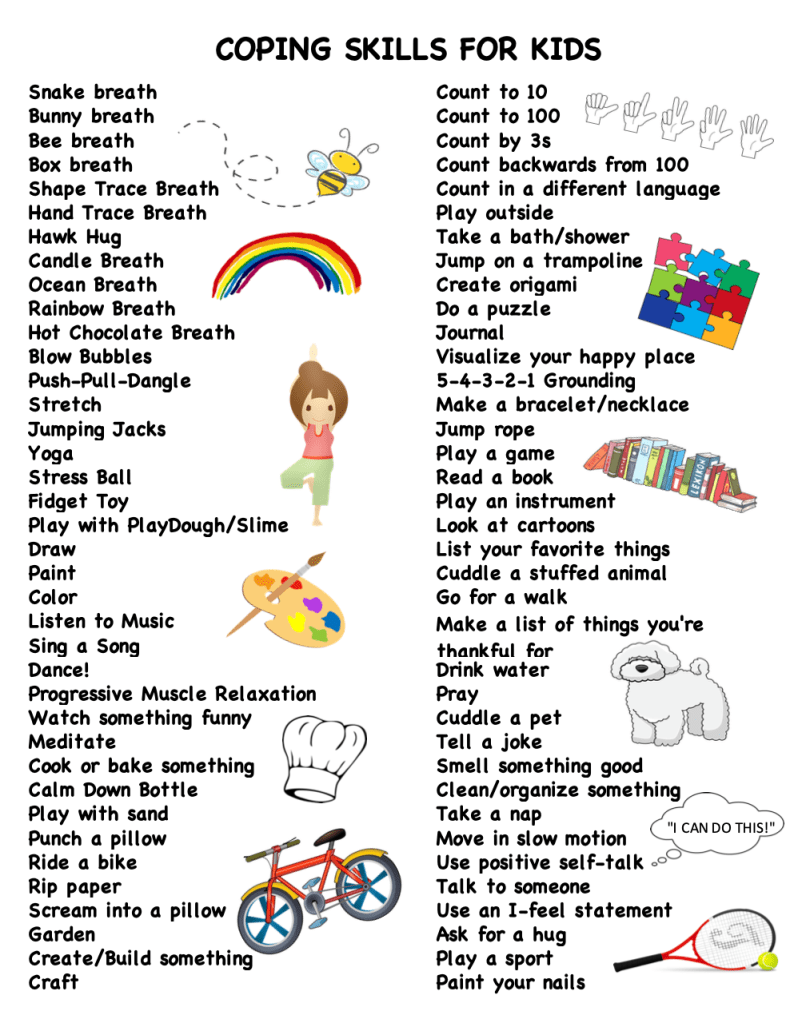
The last post published was Coping Skills Reminder Signs, and towards the end, I realized that I did not have an extensive list published of coping skills… and I cannot believe I’ve gone this long without making one. It’s really hit-or-miss online finding a list of coping skills for kids. Don’t get me wrong, there are some good ones out there, but I’ve had a hard time finding free, printable lists of more than 15-20 coping skills. So if you’re looking… voila, here it is.

You may call these “calming strategies,” “calming skills,” “calming techniques,” “coping strategies,” or something else. What you call them isn’t important… what IS important is that they help your child (or you!) calm down. As a therapist, I always tell clients, both children and adult, that coping skills don’t work the same for everybody. What works for me may not work for you. What works for you may not work for your kiddo. What works for one of your kiddos may not work for your other kiddo. Sometimes it’s a little bit of trial and error to figure out what works.

So here are 75 coping skills for kids to try. Usually, I recommend picking a few to try, then keeping track of what works and what doesn’t.

You can download this (with logo) to print by clicking here.

Not all of these may look familiar to you, so here is a list of them with explanations or links:

  1. Snake breath – take a big, deep breath, then release it while make a “ssssssss” sound, like a snake
  2. Bunny breath – take a breath by taking 3-4 little “sniffs” through your nose, then let the breath out through your nose
  3. Bee breath – plug your ears, take a big, deep breath, then release your breath while making a “mmmm” sound
  4. Box breath – breathe in for four seconds, hold for four seconds, then breathe out for four seconds
  5. Shape Trace Breath – trace a shape (i.e., star, triangle, hexagon) while take deep breaths
  6. Hand Trace Breath – trace your hand/fingers while taking deep breaths; breathe in while traveling up a finger and breathe out while traveling down the length of your finger
  7. Hawk Hug – hug yourself like you love yourself! Hug yourself by placing your right hand on your left shoulder and your left hand on your right shoulder. Take a few deep breaths, then gently and slowly pat your shoulders with your hands, alternating sides.
  8. Candle Breath – hold your hand in front of you like you’re holding a candle, then imagine blowing on the candle slowly and softly, so as not to blow it out
  9. Ocean Breath – hold your hands over your ears, then breathe in and out of your nose (this will create sounds like ocean waves)
  10. Rainbow Breath – hold your arms at your sides, arch them around and up over your head as your breathe in, then move them back down to your sides as you breathe out
  11. Hot Chocolate Breath
  12. Blow Bubbles
  13. Push-Pull-Dangle
  14. Stretch
  15. Jumping Jacks
  16. Yoga
  17. Stress Ball
  18. Fidget Toy
  19. Play with PlayDough/Slime
  20. Draw
  21. Paint
  22. Color
  23. Listen to Music
  24. Sing a Song
  25. Dance!
  26. Progressive Muscle Relaxation – tensing and release muscle groups. I usually recommend Angry Octopus (for young kids) or this YouTube video.
  27. Watch something funny
  28. Meditate (there are many guided meditations for kids on YouTube)
  29. Cook or bake something
  30. Calm Down Bottle
  31. Play with sand
  32. Punch a pillow
  33. Ride a bike
  34. Rip paper
  35. Scream into a pillow
  36. Garden
  37. Create/Build something
  38. Craft
  39. Count to 10
  40. Count to 100
  41. Count by 3s
  42. Count backwards from 100
  43. Count in a different language
  44. Play outside
  45. Take a bath/shower
  46. Jump on a trampoline
  47. Origami
  48. Do a puzzle
  49. Journal
  50. Visualize your happy place – have your child pick a place that makes them happy, then close their eyes and imagine they are there
  51. 5-4-3-2-1 Grounding
  52. Make a bracelet/necklace
  53. Jump rope
  54. Play a game
  55. Read a book
  56. Play an instrument
  57. Look at cartoons
  58. List your favorite things
  59. Cuddle a stuffed animal
  60. Go for a walk
  61. Make a list of things you’re thankful for
  62. Drink water
  63. Pray
  64. Cuddle a pet
  65. Tell a joke
  66. Smell something good
  67. Clean/organize something
  68. Take a nap
  69. Move in slow motion
  70. Use positive self-talk
  71. Talk to someone
  72. Use an I-feel statement
  73. Ask for a hug
  74. Play a sport
  75. Paint your nails

Some tips for getting your child to use coping skills:

  • Practice when they’re happy/in a good mood!
  • Model these for your children – they’re more likely to do something if they see you do it.
  • Praise your child for using coping skills!
  • Prompt your child to use a coping skill when you see them getting upset.
  • Consider making a Coping Skills Reminder Sign.

I hope this is a helpful list! I’d love for you to leave me a comment with the coping skill that works best for your child!

Disclaimer: I am a licensed mental health therapist, but I am not your therapist. The information in this article is for general informational purposes only. This article does not create a therapist-client relationship. If you need specific recommendations based on your individual circumstances, please consult with a mental health practitioner near you.

Coping Skills Reminder Sign

We are taking a break from the social skills series to talk about making a visual reminder to use coping skills (or calming techniques/coping strategies/calming strategies/calm down strategies – whatever you want to call them!).

In my work as a therapist working with children, using signs as visual reminders is SO incredibly helpful. Even if a child knows dozens of ways to calm down and can successfully demonstrate those skills when they are calm, it doesn’t guarantee they’ll use them while upset. It can be amazingly difficult to use a coping skill when we are overwhelmed and emotionally flooded. It is near impossible to just stop feeling for a few seconds and think to yourself, “oh yeah, I need to do something to calm down.” Talking about Body Signals can help (for a review click here) and making a sign can help!

In my opinion, a reminder sign for a child will be more meaningful if they have a part in creating it. If they’ve had some influence into the reminder sign, they’re more likely to be receptive to using it. This also means that they get to pick what coping skills they like best, and that work best for them.

When making the reminder sign, the goal is to add pictures that represent coping skills. As a therapist, when I make reminder signs with kids, we do it on the computer using Excel and I help children safely google fun images that represent coping skills. One of my favorites for “taking deep breaths” is a picture of a whale that says “take a deep breath!” When we find a good image, we insert those images into the excel sheet (anywhere from 4-10 images), then print a copy or two, and I sent it home with the child.

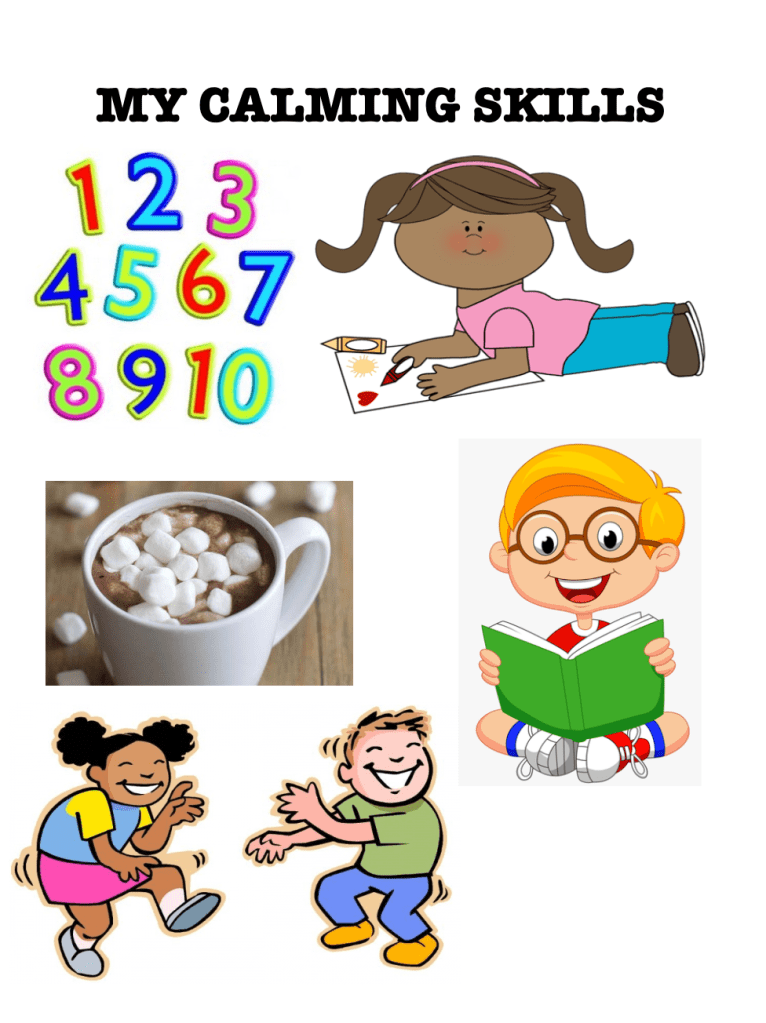
Here’s an example of a calming/coping skills reminder sign. The coping skills represented include counting, drawing, hot cocoa breath, reading, and dancing. I do not own the rights to these images, thus will not offer a download of this sign. Remember – it’s more meaningful if your child helps create it and pick out the coping skills/images for themselves.

If you’d like to print a blank template like the one above, you can here. Then you can print pictures, cut them, and glue them to the paper.

We’re pretty limited on time and resources in a therapy session, but your child could do so much more with this sign. They could find pictures in a magazine to cut and glue on it. They could write “Mary’s Coping Skills” in glitter glue across the top. If your child is artistically gifted, they could draw all the pictures representing coping skills. You could even take pictures of your child doing each coping skills, print them, and glue them onto the sign. There really aren’t any rules other than the pictures represent a coping/calming skill.

If you need some help on what coping/calming skills to include, you can find several lists online. Just google “coping skills for kids.” Looks like my next blog post will be a list of coping skills for children – I’ll add it soon and link it here! One of my favorites is hot chocolate/cocoa breathing – little kids LOVE it.

I’d love to hear the creative ways your kiddo made their own sign – please share in the comments!!

Disclaimer: I am a licensed mental health therapist, but I am not your therapist. The information in this article is for general informational purposes only. This article does not create a therapist-client relationship. If you need specific recommendations based on your individual circumstances, please consult with a mental health practitioner near you.