Positive Consequences vs. Negative Consequences

Did you know that there are BOTH positive consequences AND negative consequences? I’m going to guess that you may not have known this. No shame – I had no idea until my extra training in behavior modification! This is similar to the concept of reinforcement, which can be both positive and negative (if you’re interested, you can read about that here).

Most people hear the word “consequence” and think “punishment.” This CAN be true, but consequence doesn’t always equal a form of punishment. A consequence (more specifically, a negative consequence) can be a punishment, but consequences can also be positive too!

It’s really no wonder that most people think consequences are always bad. How many times have you heard someone say, “there will be consequences” (or something similar) in a menacing way? Or how many times have you made a “Pros and Cons list”? Both of these use of the word “consequence” can depict consequences as being only bad things.

So what is a consequence? A consequence is what happens as a result of something else. Or, according to Dictionary.com, a consequence is the effect, result, or outcome of something occurring earlier. With this definition, consequence can be positive or negative. And to make matters even more complicated, whether it’s positive or negative can be subjective. A consequence of a thunderstorm is that the baseball game is cancelled. To the players, this may be a negative consequence. But to a tired mama who has to sit and watch her son play while also keeping track of his two younger siblings, this may more of a positive consequence.

For my own purposes as a therapist, and for the purposes of parenting, I think of “positive consequences” as praise and rewards, and negative consequences as any sort of “punishment.” This may not be technically correct, but for the purposes of parenting, it works. Again, if you want to get a little more technical, you can read Crash Course on Reinforcement (Positive and Negative).

Examples of negative consequences include loss of privileges, re-do, extra chores, time-out/ignoring/removing attention, or really any activity that your child doesn’t enjoy. Some parents make their children write out sentences about their behavior. Some parents make their children do jumping jacks or pushups. Or do something kind for a sibling. In my house, negative consequences include re-dos and loss of privileges. Different children respond differently to different negative consequences, so sometimes it’s a little trial-and-error to figure out what works best. Click here for tips on how to make negative consequences more effective.

Examples of positive consequences include praise, positive physical touch (high-gives, pats on the back) time-in/giving attention, and any sort of reward – whether it’s a special treat, extra tablet time, a special activity, etc. In my house, positive consequences frequently used include praise, positive physical touch, stickers, and small toys as rewards. Praise is such an under-estimated and under-used positive consequence. Click here for tips on making praise more effective.

To wrap up, remember that consequences can be both positive AND negative. While people tend to lean naturally towards using one or the other (I tend to lean towards using positive consequences more frequently, while my husband tends to lean more towards negative consequences), it’s usually good to have a nice balance of both. However, you’re the expert on your child; you know how they respond and can see for yourself what mix of consequences is motivating for them.

Disclaimer: I am a licensed mental health therapist, but I am not your therapist. The information in this article is for general informational purposes only. This article does not create a therapist-client relationship. If you need specific recommendations based on your individual circumstances, please consult with a mental health practitioner near you.

Crash Course on Reinforcement (Positive and Negative)

I’m taking a break from the Social Skills Series to write about Reinforcement. My post Crash Course on the Four Functions of Behavior is one of my most popular. What this tells me, is that people are actually interested in these terms/theories, and looking for more information. So if you are looking for more information on what Reinforcement is, this post is for you.

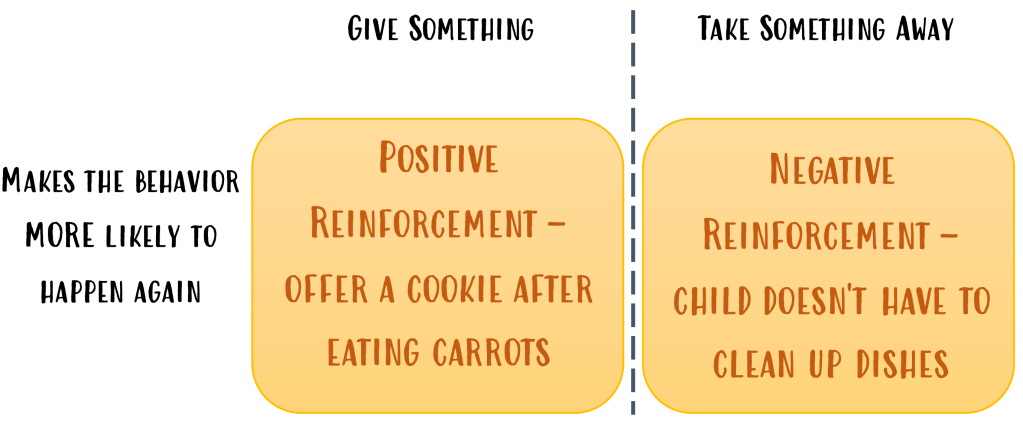
So what is Reinforcement? Reinforcement is anything that makes it MORE likely for a behavior to happen. Or, if you prefer dictionary definitions, Merriam-Webster says that Reinforcement is, “the action of strengthening or encouraging something.” In the behavior modification world, the “thing” you are trying to strengthen or encourage is positive behaviors. Check out the chart below (AND/OR download it here) – in this post we’re focusing on the top two boxes – positive and negative reinforcement. As you can see, you are either taking something (unpleasant) away or giving something pleasant in order to make the behavior more likely to happen.

There are a multitude of actions/things that can be used as Reinforcement. Reinforcement can be negative OR positive, and this is where it gets a little tricky. “Negative” in “negative reinforcement” doesn’t mean that it’s a punishment. Both negative and positive reinforcement are “good” things that make a behavior more likely to occur. They are both reinforcing. Let me say it again:

Both positive reinforcement AND negative reinforcement are “good” – BOTH make a behavior more likely to occur again.

Positive Reinforcement is usually easier to understand because it’s giving something good to make it likely the good behavior will reoccur. Think praise, rewards, and positive attention. My child does something “good” that I want them to do again (like cleaning up her socks off the floor, so I give her an extra cookie. Or she is kind to a friend, so I tell her what a great job she did. Or she says “okay” with no whining when I say it’s time to turn off the tv, so I give her 5 minutes of tablet time. Or she gets ready for bed without a fuss, so I read an extra book with her before bed. All of these are examples of positive reinforcement. You get something good for doing something good, which makes it more likely you’ll keep doing something good.

So what does the “negative” in Negative Reinforcement mean? It means you’re taking away something considered “bad” or unpleasant to make the positive behavior more likely to occur again. The most popular example of this is the alarm for seatbelts. In cars, it’s pretty common for an alarm to ding if you don’t put your seat belt on. That ding is pretty obnoxious. Once you put your seatbelt on, the dinging stops. This is negative reinforcement. You’re taking away something unpleasant (the dinging) to reinforce positive behavior (putting on the seatbelt). You get something unpleasant removed for doing something good, which makes it more likely you’ll keep doing something good.

Here’s an example of how both negative and positive reinforcement may be used to reinforce a good behavior. Let’s say your child doesn’t like carrots and typically whines about them, but today they ate all their carrots without any whining or fussing.

In this scenario, you have the option of giving something good (positive reinforcement) or taking away something “bad” (negative reinforcement) to make it more likely your child will eat their carrots without a fuss next time.

Unfortunately, I think negative reinforcement may be used to reinforce negative/bad/undesired behavior more often than it is to reinforce positive behavior. If you give your child a food they don’t like, then take it away when they whine/scream/complain/yell… that’s negative reinforcement. You are taking away something unpleasant (the yucky food), which reinforces the negative behavior (whining/screaming/complaining/yelling). If you tell your child it’s time to help with a chore, then change your mind when they throw themselves on the floor kicking and screaming… that’s negative reinforcement. You took away the unpleasant chore, which reinforced the “tantrum” behavior.

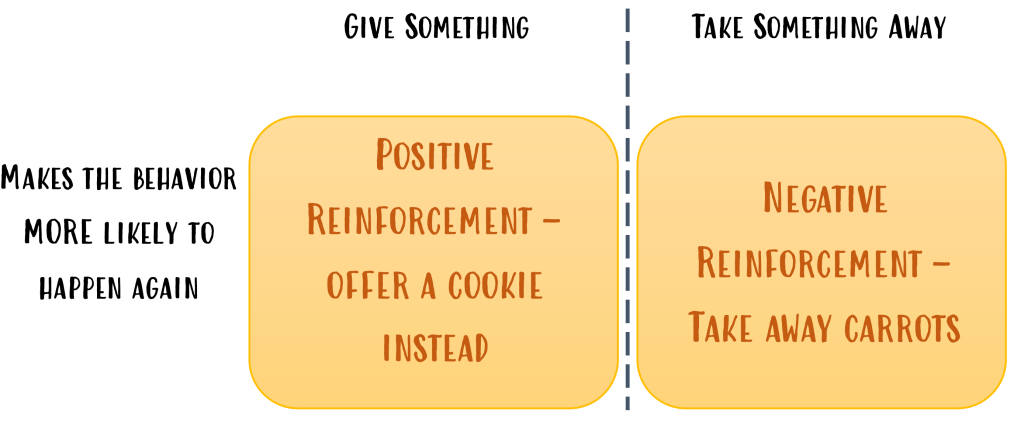
Let’s revisit our carrot scenario to see how positive and negative reinforcement would be used to actually make the negative behavior more likely. This time, let’s say your kiddo sees the carrots on their plate and yells “you know I don’t like carrots, mom! I’m NOT eating these.” Here’s how you might reinforce his yelling with positive and negative reinforcement:

Offer a cookie instead = give something good = positive reinforcement.

Take away carrots = taking away something unpleasant = negative reinforcement.

In this case, both positive reinforcement and negative reinforcement will make it more likely that your child yells at you again – and more likely that they won’t eat their carrots.

The two carrot examples above are also examples of how you can use positive reinforcement AND negative reinforcement at the same time. In the first example, giving a cookie as a reward will be reinforcing. Or letting your child off the hook for cleaning their dishes will be reinforcing. You can use one of these, or you can use both. Using them together will make the behavior even more likely – the reinforcement will be even stronger.

And that’s a wrap on positive and negative reinforcement. The most important thing to remember is this: Both positive reinforcement AND negative reinforcement are “good” – BOTH make a behavior more likely to occur again.

As always, I’d love to read your comments and questions – drop them below!

Disclaimer: I am a licensed mental health therapist, but I am not your therapist. The information in this article is for general informational purposes only. This article does not create a therapist-client relationship. If you need specific recommendations based on your individual circumstances, please consult with a mental health practitioner near you.
Social Skills Series: Saying “Please” and “Thank you”

Good morning/afternoon/evening/night! The next social skill in this Social Skills Series is Saying “Please” and “Thank you.” If you need a reminder on what social skills are and why they’re important, read Social Skills Series: Introduction.

Whether or not you’ve ever said the words “social skill” in relation to saying “please” and “thank you,” most people acknowledge that those words are very important in today’s society. Does that mean everyone uses them consistently? Not at all – even adults are not always great about it. But most people would agree that it’s kind and respectful to say “please” when they want something and “thank you” when they’ve received something.

One rationale for saying “please” is that it makes it more likely that the person will say “yes.” And a rationale for saying “thank you” is that it makes it more likely people will do kind things for you next time. These are pretty solid rationales, in my opinion. Can you think of examples of a time that you were inclined to say “no,” but because the person said “please,” you said “yes” instead? I can! Just a few days ago my daughter asked for “one more time” going down the water slide. I looked at her, considered her “please,” and told her that I was saying “yes” only because she had asked so nicely and said “please.” And how many times have you given something to someone, not gotten a “thank you,” and thought to yourself, “I guess I’m done doing nice things for them” or something similar? Please and Thank You are important!

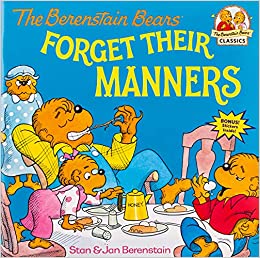
Books can be a great way to introduce skills to kids! There are two books in the Berenstain Bears series that can be read aloud to your child to introduce them to the concept of using “please” and “thank you.” One if The Berenstain Bears Forget Their Manners and the other is The Berenstain Bears Say Please and Thank You. I have not read the second one, but Forget Their Manners was a favorite of mine when I worked in a treatment facility with children.

So how to practice saying “please” and “thank you?” There are so many ways! One of the easiest ways I’ve practiced is to do a coloring activity with your child. You hold on to all of the crayons/markers/colored pencils, and when your child wants one, they must say “please” when asking and “thank you” once they’ve received. You could also practice with a small treat – carry a small baggie of m&ms or chocolate chips around, and in order to get one, your child must say “please” when asking and “thank you” once they’ve gotten one. Another idea is with a sticker book. My daughter still needs help peeling the stickers, so I can practice with her by making her ask “please” when she is ready for another sticker to put on, then saying “thank you” once I’ve given her one. Yet another option is to use building blocks of some kid – put all the blocks in a pile and before taking one, your child must ask “please,” then say “thank you” once you tell them it’s okay to take one.

Remember to praise and reward (optional) your child when they are successful! You want to praise every time they say “please” or “thank you.” Rewards are, again, optional. With each of these practice ideas, there is a positive consequence built in to the practice – they are getting a sticker for their book, getting a block to use, or getting a crayon to use. And obviously if you are having them practice saying “please” and “thank you” for a small treat, the small treat acts as a reward. If you want to, you can use another reward – my recommendation would be to use a reward for a certain number of successes. Such as, ten successful “please” and “thank you”s will earn something. You can even give a sticker for each success, then give a reward when they earn a certain number of stickers. Ten stickers may equal ten extra minutes of tv time (or any other reward you want to use).

Some TIPS for practicing this social skill:

  • Practice when your child is calm/in a good mood. Practice will probably not go well if your child is grumpy or just got in trouble for something.
  • Make sure to praise you child for saying “please” and “thank you.”
  • Kids LOVE IT when they can turn the tables – let them be in charge during the practice and praise YOU for saying “please” and “thank you.”
  • Try to make it fun! If your child becomes uncooperative at any point, just end the practice and revisit it later.

Good luck! Drop a comment with any other fun ideas for practicing this important social skill!

Disclaimer: I am a licensed mental health therapist, but I am not your therapist. The information in this article is for general informational purposes only. This article does not create a therapist-client relationship. If you need specific recommendations based on your individual circumstances, please consult with a mental health practitioner near you.