Extinction Burst (Why Behavior May Get Worse Before It Gets Better)

If you have a kiddo with a “problem” behavior and you implement a new parenting strategy, chances are you hope that the behavior will get better right away. Wouldn’t that be nice? Don’t get me wrong – SOMETIMES that happens. Sometimes, you start doing things a little differently, such as implementing a consequence or ignoring behavior, and you start to see improvement right away.

Unfortunately, more often than not, most people experience what’s called an “extinction burst.” Doesn’t sound so good? It’s not, but knowing that it may come can help caregivers anticipate it and be prepared for when it happens.

So what IS an extinction burst? It’s the way behavior analysists/therapists describe an increase in the severity of behavior once extinction occurs. Basically, once you take away whatever is reinforcing a child’s behavior (like attention, an item, or getting out of doing something), their behavior gets a little worse before it bets better. Clear as mud?

Let’s say I have a boy who throws a tantrum after lunch every day because he wants a brownie. He cries and screams and kicks the walls, and I do my best to hold out, but I eventually cave and give him one. Then one day I decide I’ve had enough and I’m not going to give him a brownie, no matter what. That day his behavior is likely going to be even worse. In addition to crying, screaming, and kicking walls, he might say he hates me, and try to hit me.

The chart below shows how the severity of a behavior (on a scale from 0 to 10) gets worse once extinction (not giving a brownie) begins (this is indicated by the red line). The behavior gets worse, but then starts getting better!
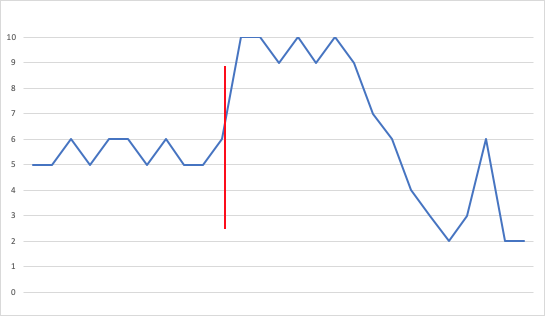
(Severity of outbursts)

Unfortunately, this extinction burst is where some parents might be tempted to give up, or to think that what they’re doing doesn’t work. BUT, an extinction burst is actually a sign that what you are doing is working!

Let’s imagine what is going through the boy’s mind. The little boy wants a brownie, so he cries, screams, and kicks the walls. He’s thinking any minute now, she’ll give up and give me a brownie. But then a few minutes go by and he starts to think well shoot, this isn’t working; she’s usually caved by now. So what does he then think? Oh well, I guess I’ll give up…? Not usually! Probably something more like I better try even harder! What else can I do to convince her to just give it me? Then he starts with the hurtful words and hitting. He has learned that his typical behavior isn’t cutting it, so he amps it up. This is the extinction burst. Just when you thought your kiddo’s behavior was bad enough, you see this burst of something even worse.

Don’t give up! Keep with it, and it WILL get better. You just need to be consistent to get through that extinction burst and see progress. It’s also important to note that, even after the extinction burst, it’s not out of the norm to see some smaller bursts of more severe behavior. You think you’re seeing progress and then BOOM! Your child decides to test the limits again. They’re just testing your resolve to see if you’ll stick it out. Consistently show them you will (that you’re more stubborn than they are), and their negative behavior will fade.

And while you’re going through that extinction burst, remind yourself “this means what I’m doing is working.” Tell yourself whatever you need to in order to get through it. “This will all be worth it in the long run.” “I can do this.” Whatever will work for you to keep your consistency up.

Disclaimer: I am a licensed mental health therapist, but I am not your therapist. The information in this article is for general informational purposes only. This article does not create a therapist-client relationship. If you need specific recommendations based on your individual circumstances, please consult with a mental health practitioner near you.

How To Get Your Child to Stop Acting Out for Attention

Every parent has or will deal with this at some point. Their child is acting out and it’s hard to identify why. Usually your daughter has a meltdown when she asks for M&Ms and doesn’t get them. Or she whines and stomps her feet when told it’s time for bed. That behavior is due to wanting something (M&Ms) and wanting to get out of something (bed). Of the Four Functions of Behavior, attention is one of the hardest two to deal with.

Why? Well, for one, it can be hard to identify that attention is why your child is acting out. If you need help, see these tips for identifying what “function” is fueling your child’s behavior. Remember, negative attention is better than no attention. Another reason it can be difficult to “fix” behavior caused by desire for attention is that, for many parents, it can be hard to provide the solution, which is to give your child attention when they are being good. Why is this hard? For one, life is busy. Caregivers everywhere are working, keeping houses clean, balancing budgets, cooking, and doing all the other daily things that go with being a human and parent.

Imagine a mom who needs to empty the dishwasher. She has been playing with her child for 10 minutes or so, and decides it’s time to go empty it. About 5 minutes in, her child starts acting up. So she yells from the kitchen (thus giving attention) to stop, then goes back to work. One minute later, the child starts yelling and the mother runs in and scolds the child (again, giving attention). In this situation, the mother is reinforcing the child’s behavior by giving them exactly what they want… ATTENTION. But it’s a hard cycle to break because caregivers can’t just ignore all their other responsibility in order to give their child 100% of their attention all the time. That’s unrealistic and, frankly, not healthy for anyone.

So what do you do? The first step is to start making an effort to give more attention when your child is doing something “good.” Obviously you can’t do this ALL the time, but start trying to catch your child being good and let them know you saw and approve (praise!). This is call TIME-IN (as opposed to Time-outs, which remove attention for negative behavior). Time-in is all about giving your child lots of attention and praise when they are doing something well. By giving them more positive attention when they do something “good,” you decrease the likelihood they are going to act out for attention.

A second tactic to try to is to use your attention as a reward. This doesn’t mean withhold your attention unless they earn it; rather this means carving out an extra 10 minutes towards the end of the day for you to do something special with your child and give them your sole attention for that time. They earn it with their positive behavior. If they have been throwing a fit or tantrum, then they earn that extra time by not doing so throughout the day. Whatever they’ve been doing that you don’t like, figure out what the opposite is and make that their goal, then reward them for it. Give them 10 minutes of extra reading time before bed, or 10 minutes playing a board game, or 10 minutes of painting your toe nails… whatever your kid loves to do WITH you, do it with them for 10 minutes.

A third intervention, and likely the hardest, is to limit attention for negative behavior. This doesn’t mean to ignore every “bad” behavior. But it does mean that it is in your best interest to try to cut down on the amount of attention. Some parents like to lecture. When you have a child acting out for attention, lecturing is the jackpot for them. Why? Because you’re giving them attention! So try to cut back on that attention. Limit verbals. Instead of a lecture, say “no thank you” or something else that gets the point across without using a lot of words and attention.

Lastly, you can use consequences to cut down on attention-seeking behavior. Just make sure this consequence isn’t one that means more time with a caregiver. Take away 5 minutes of electronic time. Have them pick a chore from a chore jar. That wouldn’t even necessarily require verbals, you can just walk the chore jar over to them and hold it out for them to pick.

If you can follow these steps, you can make a lot of progress on decreasing your child’s attention-seeking behavior. Start somewhere, try your best, and keep making an effort until you see progress. Remember that it’s always possible (and likely) that the behaviors will get a little worse before they get better (this is called an extinction burst). But stick with it. And if you’re having a hard time, seek help from a therapist to come up with a plan.

Disclaimer: I am a licensed mental health therapist, but I am not your therapist. The information in this article is for general informational purposes only. This article does not create a therapist-client relationship. If you need specific recommendations based on your individual circumstances, please consult with a mental health practitioner near you.