If you haven’t heard of the Four Functions of Behavior, read about it here. Basically, the Four Functions of Behavior are the reasons your child is behaving the way they are. Sometimes it’s really easy to identify the function of their behavior. Sometimes it can be a little tricky.
One thing that might help is to make a timeline of what happened just before, during, and after their behavior. Here’s an example:
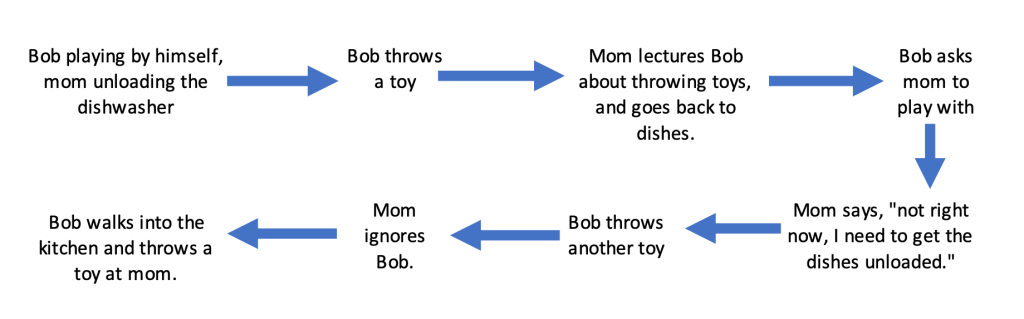
In this situation, the most likely function of Bob’s negative behavior was the desire for attention. How do we know this? Look at what immediately happens prior to Bob’s negative behavior (which was throwing toys)… he was either not getting any attention at all, or had just been told by his mother that she couldn’t give him attention. Whether he would have been able to verbalize the need or not, Bob wanted attention and was willing to do anything to get it.
Another tip to help determine the function of behavior is to think about these questions…
- What happened just prior to the negative behavior?
- What finally got my child to stop?
- Was my child trying to get something?
- Had my child just been told they couldn’t have something?
- Was my child trying to get out of doing something?
- Had my child just been told to do something they likely didn’t like?
- Was my child feeling overwhelmed with negative emotion?
- Immediately after the negative behavior, did they seem calm?
A final tip is to use an ABC chart to track Antecedents, Behaviors, and Consequences. This can be helpful to track patterns of behavior over time. You can just use a piece of paper and draw 4 columns (Day, Antecedent, Behavior, and Consequence), or you can download the one I created here.
If you’re still having a hard time and the behaviors are creating disturbances at home or school, it may be time to talk to a therapist/counselor for help!
Disclaimer: I am a licensed mental health therapist, but I am not your therapist. The information in this article is for general informational purposes only. This article does not create a therapist-client relationship. If you need specific recommendations based on your individual circumstances, please consult with a mental health practitioner near you.
 Krista H Counseling