Using a Token Economy with Kids

Do you know what a token economy is? Never fear, you’re about to find out! The term might sound a little intimidating, but using a token economy with kiddos is a great way to improve behavior. A token economy means that they are getting small objects (tokens) for instances of good behavior – then, once they earn enough “tokens,” they trade them in for a prize.  Just like how I earn money for working, then turn it in for a prize to pay bills after I get paid… that’s a lot less fun, but the concept is the same.

A few examples:

  • I might give my daughter a “token” every time she follows a direction the first time asked. When she has collected 10 total, she gets some electronic time.
  • I might give my kiddo a “token” every time he completes his homework. Once he has 10 tokens, he gets to pick a fun family outing.

A token economy is a great way to use big rewards for many instances of good behavior, while also making sure you’re giving praise and a small reward (the token) immediately… because immediacy is important, remember? If you don’t, read Tips for Making Praise Effective.

So how do you get started? First, pick a positive behavior you want to increase. It could be just about anything that you want your kiddo to do more of.  Second, pick what you will use as a “token.” You want it to be something fun, something easy to keep track of, and something that your kiddo won’t find around the house (and cheat by adding to the pile they’ve been given).

A few ideas (in no particular order):

  • Stickers
  • Marbles
  • Colored or marked Q-tips
  • Rubber bracelets
  • Rubber bands (marked)
  • Colored paper clips
  • Fake coins
  • Laminated pieces of paper

**I feel like I shouldn’t have to say this, but… don’t use any smaller items if your kiddo is young enough that the item could be a choking hazard.**

Next, pick a reward AND decide what the goal is – how many small objects does your child need in order to earn the reward.  You don’t want to make this goal too easy or too hard, but remember: if you do, you can always bump that goal up or down.  As for choosing a reward, you can enlist the help of your child if you need to – just ask them what they’re interested in earning.  Or, you could also do a reward menu, where the kiddo would get to choose from a list of rewards once they meet their goal.  There really are a lot of options!

After you’ve made all of these decisions, explain what’s happening to your child – that they will earn a small object (whatever you’ve chosen) each time they do whatever positive behavior you’ve chosen, then they will be able to turn those small objects in, once they’ve earned a certain amount, for a bigger reward.  The next step?  Catch them being good and be consistent with handing out those small objects.  Not too difficult, right?  Good luck!

Three Steps (Tell-Show-Do) for Encouraging Compliance with Young Children

Little kids, especially those under 3 years of age, can have a VERY difficult time following directions – which is completely age-appropriate!!  For one, their communication skills are developing, so they may not understand a lot of commands that are said to them.  Secondly, their attention spans are extremely short!  Also, they’re testing their independence and may show a defiant streak!

I do not believe it’s appropriate to give a negative consequence to a child for something that they don’t understand or are unable to do, due to age and development.  BUT you still want to have kiddos of all ages follow through on every task you give them.  So how do you get a child under the age of 3 with limited verbal skills to do this?  You follow 3 steps:

  1. TELL your child what you want them to do.  Keep it short – recommended length of a prompt/direction is one word per age of life (which isn’t always possible, but keep it short)!  Also attempt to be specific.  You might tell your 2-year-old to “pick up toys.”  If she doesn’t…
  2. SHOW your child what you want them to do.  If you told your 2-year-old to “pick up toys” and she looks at you, then keeps playing, get her attention again and show her what you want her to do by picking up a toy and putting it in the box.  Then repeat your prompt (“pick up toys”) and give her the opportunity to pick up.  If she doesn’t, then…
  3. DO the task with your child, hand-over-hand.  Take your daughter’s hand, pick up a toy together, and put it in the toy box.  Once you complete one part together, start over with step one by verbally repeating the prompt.

This is more of a teaching and practicing method – your goal is to help your little one understand what prompts mean, but you’re also teaching them that it’s important to follow through with what mom/dad say!

Disclaimer: I am a licensed independent mental health practitioner and certified professional counselor, but I am not your therapist. The information in this article is for general informational purposes only. This article does not create a therapist-client relationship. If you need specific recommendations based on your individual circumstances, please consult with a mental health practitioner near you.

Three Steps (Tell-Show-Do) for Encouraging Compliance with Young Children

Little kids, especially those under 3 years of age, can have a VERY difficult time following directions – which is completely age-appropriate!!  For one, their communication skills are developing, so they may not understand a lot of commands that are said to them.  Secondly, their attention spans are extremely short!  Also, they’re testing their independence and may show a defiant streak!

I do not believe it’s appropriate to give a negative consequence to a child for something that they don’t understand or are unable to do, due to age and development.  BUT you still want to have kiddos of all ages follow through on every task you give them.  So how do you get a child under the age of 3 with limited verbal skills to do this?  You follow 3 steps:

  1. TELL your child what you want them to do.  Keep it short – recommended length of a prompt/direction is one word per age of life (which isn’t always possible, but keep it short)!  Also attempt to be specific.  You might tell your 2-year-old to “pick up toys.”  If she doesn’t…
  2. SHOW your child what you want them to do.  If you told your 2-year-old to “pick up toys” and she looks at you, then keeps playing, get her attention again and show her what you want her to do by picking up a toy and putting it in the box.  Then repeat your prompt (“pick up toys”) and give her the opportunity to pick up.  If she doesn’t, then…
  3. DO the task with your child, hand-over-hand.  Take your daughter’s hand, pick up a toy together, and put it in the toy box.  Once you complete one part together, start over with step one by verbally repeating the prompt.

This is more of a teaching and practicing method – your goal is to help your little one understand what prompts mean, but you’re also teaching them that it’s important to follow through with what mom/dad say!

Inside Out Feelings Cube Activity

Games are such a great way to get children to talk about feelings.  Have you seen the episode of The Office where Michael has to complete some therapy sessions with Toby (whom he dislikes a lot)? In the episode, Michael REFUSES to talk to Toby about anything, but when Toby recommends a board game, Michael agrees, then suddenly starts opening up, then realizes that Toby has “tricked” him and is livid.  Now, I don’t try to “trick” kids into talking to me, but games and activities are certainly excellent tools to facilitate discussion.  It’s a lot more enjoyable!

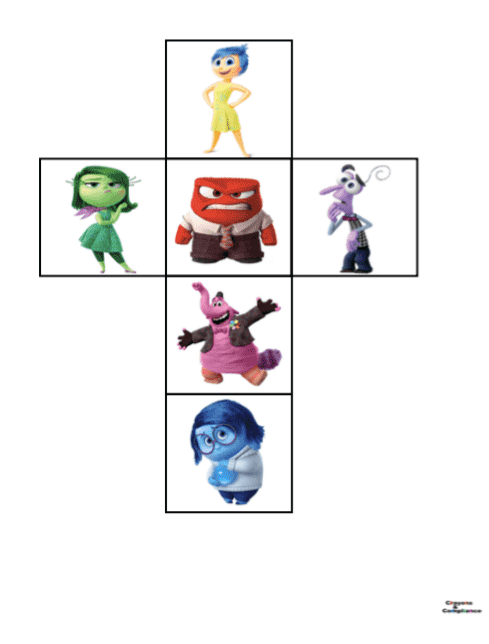
I created two different documents which can be trimmed and folded into cubes, or “dice.”  One has all 6 Inside Out characters on it (Joy, Anger, Sadness, Fear, Disgust, and Bing Bong) and the other has 6 prompts for discussing feelings and calming strategies.  So you would have a kiddo roll both cubes and follow the prompt for whatever Inside Out character (the corresponding feeling) they roll.  You can pick what “feeling” you want to assign Bing Bong – maybe silly, surprised, or embarrassed.

So if I roll both cubes and get “Joy” and “tell me about a time you felt ___,” then I would talk about a time I felt happy.  If I rolled “Sadness” and “Show me something you can do to calm down when you feel _____,” then I would demonstrate a calming strategy that I use when I’m sad.

If you want to use a simplified version of the activity, you could just use the Inside Out character cube and pick one prompt to use for each roll.

The character cube looks like this (printable version here):
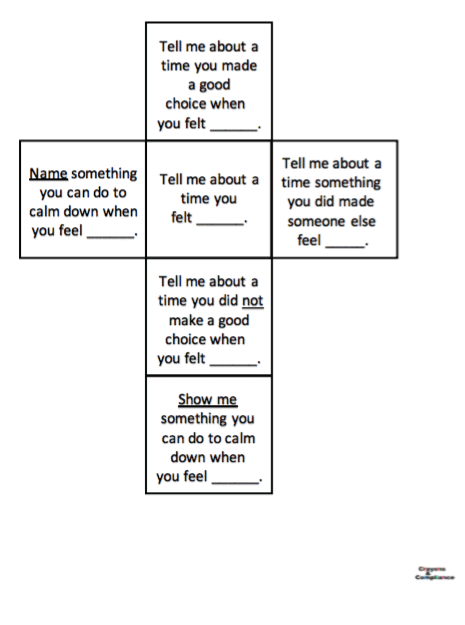
Screen Shot 2018-03-01 at 8.10.16 PMThe prompt cube looks like this (printable version here):

Screen Shot 2018-03-01 at 8.10.29 PM