Using Bracelets as a Reminder to Increase Praise

Old habits can be hard to break and new ones can be hard to keep up with.  I’ve heard numerous parents share that they “just don’t think about praising” on a regular basis, so it can be very hard for some caregivers to increase the frequency of praise they’re using.  But praise is so, so important!  Therefore, it’s important to do whatever it takes to retrain yourself to praise your children more often.

The “gold standard” for ratio of praise to correction is 4:1.  This means that for every behavior I correct, I should be praising my daughter 4 times.  I call this the “gold standard” because it can be extremely hard to meet.  All kinds of things can get in the way… parents are busy doing chores, paying bills, busy with multiple children, or spending time with their spouse.  So you may not meet the 4:1 ratio all the time, but it’s something to strive for.

One way to prompt yourself to praise more often is to use bracelets (or rubber bands).  There’s a few ways you can use them as a reminder:

  • You can have 5 bracelets, 4 of the same color (representing praise) and 1 of a different color (representing correction).  For example, I might use yellow for praise and green for correction.  We’re working on that 4:1 ration with this method!  Start with all the bracelets/bands on one wrist, then move them to the other wrist when you praise or correct.  So when I correct my kiddo, I move the green over to the other wrist.  Then my goal is to get all the 4 yellows moved over (by praising 4 different times) before I correct another behavior.  If you correct again before praising 4 times, just start again with trying to get 4 praise statements again before correcting a behavior (don’t give yourself an impossible task to make up the praise you missed in addition to 4 more!).
    • TIP: Start small by doing this for a small amount of time (maybe an hour?) at first.  If you haven’t been praising much, it will be exhausting to do this all day.
  • You can also set a goal for how often you want to praise in a specific time frame, then put that many bracelets on and move one over to the other arm every time you praise.  With this method, we’re just working on increasing frequency of praise!  So if I decide that I want to praise my kiddo 8 times in 10 minutes, I would start with 8 bracelets/rubber bands on one arm and move one over every time I praise, with my goal being that all 8 of the bracelets will be on the other arm when my 10 minutes is up.

Again, rubber bands are just as easy to use for this.  If you want to work on improving your ration and don’t have two different colored rubber bands, you could also mark 4 of them with “P” and 1 with “C” in permanent marker (“P” for praise and “C” for correction).  The little rubber bracelets are fairly cheap, though.  You can get a pack of 12 on amazon for $3.99.  I’m sure you can find them easily in stores too.

Remember to just do your best!  If you find it impossible to meet the 4:1 ratio, it’s Okay!  Maybe with your specific circumstances, a 3:1 ratio is more realistic.  The point is that most parents can definitely praise their children more than they do.  We’re striving for improvement, not perfection. 🙂


*If you need tips on praising, check out Tips for Making Praise Effective!

Why You Shouldn’t Use Warnings for Negative Behavior

Negative consequences can be difficult for caregivers to use and follow through with.  Few people actually want to discipline their children, and negative consequences can be inconvenient for caregivers.  These, perhaps, may contribute to a parent using warnings with children.  I’m sure these examples will sound familiar, as most adults have probably used warnings with their own kids, heard other parents use warnings, or heard warnings as a child from their parents.

  • “Do you want a timeout?”
  • “I’ll give you to the count of 3 to stop.”
  • “If you do that ONE more time, you’re going to be in trouble.”

Sure, these “warnings” might sometimes work to change behavior, but using warnings with children have some drawbacks.

  1. Your child may not take the warning seriously, which means they won’t be motivated to change the behavior.  If a parent uses warnings without a lot of follow through, the child won’t take the warnings seriously.  The child sees the warning as an empty threat.  The last time I was pulled over for speeding, all I got was a warning.  Trust me, I’m grateful for that, but it didn’t do much to change my driving speed.
  2. Your child may come to expect a warning each time they choose a negative behavior, so behavior won’t change long-term.  If a parent gives a child one warning every day for the same behavior, the kiddo is basically getting a free pass to behave that way once per day with no negative consequence.  If I knew that I would only get a speeding ticket if I was pulled over twice in one month (and only get a warning for the first time each month), I would only be concerned about speeding if I’d already gotten my warning for the month.  But as soon as the 1st of the month came, I’d be back to speeding again because I knew I’d get a warning first.  If you have a parent who counts to 3 (or higher) before issuing the consequence, you’re essentially giving them a few seconds to do whatever they please, because they don’t have to stop right away, just as long as they stop by the time mom or dad gets to 3!

Instead of using warnings, issue the negative consequence as soon as the behavior happens.  This is called immediacy and is one of the important factors in making consequences effective (see Tips for Making Consequences More Effective).  Nobody is perfect, lots of amazing parents use warnings on occasion, but being aware of the drawbacks may help you to reduce the number of warnings you use (and go straight to issuing a negative consequence)

If you’ve been using lots of warnings and suddenly begin issuing consequences without warnings, be prepared for an angry child who thinks it’s “not fair.”  My opinion is that once your child knows a behavior is unacceptable, earning a consequence is their choice (see Behavior is a Choice (and How Parents Can Use This Knowledge)).  They can choose acceptable behavior or they can choose unacceptable behavior and the consequence that comes with it.  Motivating children to choose acceptable behavior will happen a lot faster if you skip the warnings!

Using Stress Balls for Emotional Regulation (and How to Make Your Own)

Stress balls can be a very effective tool for calming down when overwhelmed with emotions.  I think it helps for a few reasons… One reason is that it’s an activity to distract you from triggers and negative thoughts.  Another is that it involves muscle tensing and relaxing (while you squeeze the stress ball).  And a third reason is that it might be a little cathartic… squeezing something with a lot of force.

You can find stress “balls” in all shapes, colors, and sizes.  I even have one shaped and designed like a zebra… though my 1-year-old is currently using that with her Noah’s Ark Little People set.  A quick Amazon search for “stress ball” will bring up stress balls shaped like cats, emoji stress balls, and even one shaped like a breast (I don’t recommend buying that one for your kiddo).

In lieu of buying one online, you can easily make your own – or turn it into a family activity.  All you’ll need is a balloon, either rice or flour, and some sort of funnel to get the rice or flour into the balloon.  Then just follow these easy steps:

  • Stretch out the balloon a bit.
  • Use the funnel to get the rice/flour into the balloon.
  • Squeeze the air out of the balloon.
  • Tie off the balloon.
  • Cut off any excess rubber at the end (if necessary/desired).

This way, your kiddo can choose what color they want and could even possibly draw on the balloon with permanent marker to make it unique!

Keep in mind, as with any calming strategy, that children may need LOTS of reminders and practice to use calming strategies when they get upset.  So practice, practice, practice!  And don’t be afraid to offer a simple reminder like, “I can see you’re upset.  Why don’t you use your stress ball for a few minutes.”

What To Do When Your Child Is Sent Home From School For Negative Behavior

Most parents think their child would never do anything bad enough at school to get sent home, but it happens.  Kids have rough days too.  You may not be overly concerned if it’s a one-time occurrence, but unfortunately, it can snowball fairly quickly.  Why?  Because most kids would rather be at home than at school!  

I don’t want to bash schools – I know their options are fairly limited, but oftentimes sending a child home for negative behavior can turn a small problem into a big one.  Let’s look at what can (not always!) happen when a child is sent home from school for negative behavior.  The child learns that they can go home as long as they do something “bad” enough at school – being sent home is a reward.  So the child will continue acting up so that he/she can be sent home.  Then, once the school starts developing a behavior plan (IEP) in an attempt to try other interventions and prevent the child from being sent home, it’s too late!  Now the child will do whatever it takes to be sent home, even if it means resorting to behaviors more severe than when they first got sent home (this is called extinction burst).

Unfortunately, there aren’t a lot of things that parents can do about school behavior and the school’s response.  Parents can use rewards and negative consequence (click here for tips on how to do so).  Parents can also do their part to reduce the likelihood that being sent home is reinforcing for a child.  So what do you need to do in order to make sure going home isn’t like a reward?

  1. Make sure your child doesn’t get a free pass to have fun the rest of the day.  Don’t let them spend the whole day in their room playing with their favorite toys.  Don’t take them on fun errands or to the park.  Make sure that they’re doing something that they don’t necessarily like during the time they’re supposed to be in school.  Let me be clear… I don’t mean stick your kiddo in a corner for 5 hours.  But consider having your child do some chores or do school work (or print out some academic worksheets).
  2. Make sure you’re not giving your child an excessive amount of attention for what happened (remember that bad attention can still be reinforcing).  Sure, you’re probably going to talk to your child about what happened and what a better choice would’ve been.  Here’s what you don’t want to happen… your child gets attention from you as you discuss the situation the entire way home, then more attention when you call his grandparent and tell them what happened, then even more attention while hearing you talk to your spouse when they get home from work, and then they get even more attention when their other parent comes to talk to them about what happened.  Cut that attention down as much as you can if you have a child who thrives on being the center of attention (give them that attention when they do something well instead!).

Five Different Counting Strategies for Emotion Regulation

One of the more common calming strategies discussed in therapy is counting.  The idea behind many counting strategies is that the brain cannot think about two things at one time.  So if someone is thinking about counting, they cannot be thinking about how angry they are.  It disrupts the thought process, which can make it a lot easier to calm down.

Since the same calming strategies don’t work for everyone, it can be beneficial to try out different strategies to see what works for your child (or you!).  Here are 5 different counting strategies to try:

  1. Regular counting – this is what most people think of when they think of “counting.”  You start with 1 and count up to a specific number.  For younger kiddos, counting to ten might be challenging enough to do the trick, but older kiddos may need to count to a higher number to sufficiently distract themselves and calm down.
  2. Counting backward – start with a specific number and count down to 1 (or 0).  This can require a little more effort and concentration than regular counting.
  3. Counting objects – this combines counting with making lists.  Pick something to list/name as you count.  I’ve had kiddos count and name dinosaur types after each number.  I’ve also had kiddos count Disney princesses, pizza toppings, and types of trains.  This would sound like, “one Cinderella, two Sleeping Beauty, three Snow White, 4 Tiana, etc.).
  4. Counting by a number (3s, 4s, 8s, etc.) – count by multiples of a certain number as high as you can.
  5. Counting in a second language – if your kiddo knows another language, you could have them count in another language.

These are all great counting strategies for kids to know and try.  The more “tools” a child has to calm down, the better!

5 Berenstain Bears Books That Teach Social Skills

Berenstain Bears was one of my favorite book/tv series as a child (you can find out more about the entire series at Home of the Berenstain Bears).  They’re fun reads, but there are also some valuable lessons found in most of the books.  When working with kids, you have to find a way to hold their interest, so if you can find an entertaining book that also teaches social skills?  Jackpot!

Here are 5 Berenstain Bears books that I’ve used (both in individual and group therapy sessions) to discuss social skills:

  • The Berenstain Bears and The Truth – Brother and Sister Bear tell a lie in an attempt to get out of trouble (I’m pretty sure everyone has been there!) and readers get to see how the cubs have to tell more and more lies to cover up their first lie, then deal with the consequences of being dishonest.
  • The Berenstain Bears Forget Their Manners – Mama Bear has to take pretty drastic measures to motivate Papa Bear and the cubs to use some basic manners.
  • The Berenstain Bears Learn About Strangers – Sister Bear is a little too friendly and has to learn about stranger danger.  There’s a neat analogy in the book about how strangers can “look” nice on the outside, but that doesn’t mean they’re always nice people.
  • The Berenstain Bears and the Trouble with Friends – Sister Bear befriends a new neighbor, but they end up fighting and have to learn to take turns and compromise.
  • The Berenstain Bears Learn to Share – the cubs learn that sometimes it’s necessary to share in order to have fun because it can be awful lonely playing by yourself all the time.

These are my top 5 favorite books to use for teaching/discussing social skills, but there are many, many more valuable lessons found in the series!

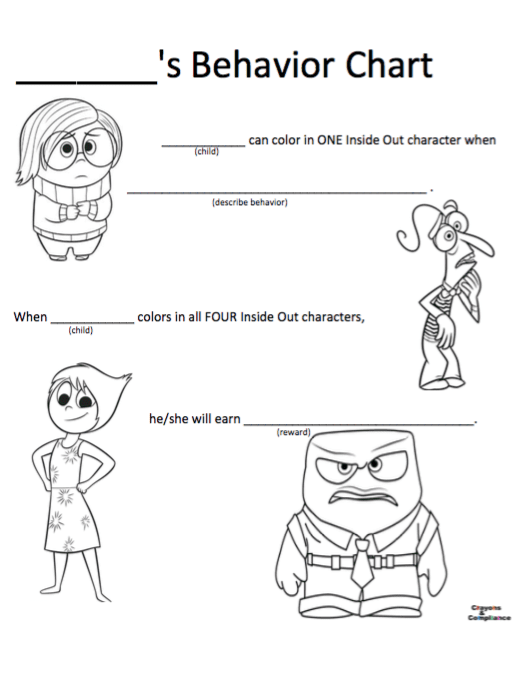
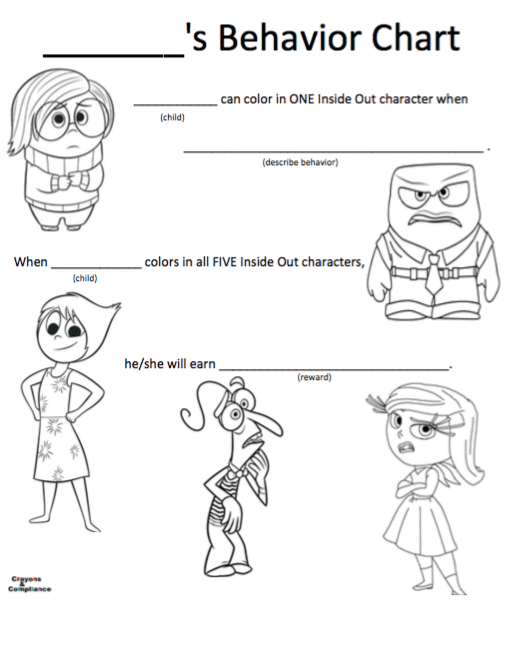
Inside Out Behavior Charts

With all the other Inside Out worksheets and all the other behavior charts I’ve done, I cannot believe I haven’t done an Inside Out behavior chart/contract… so here it is!

Behavior Contracts can be a really useful tool for caregivers to use when trying to increase or decrease a behavior.  Some benefits include:

  • Behavior contracts help caregivers and children keep track of the behavior and the reward.
  • Kids can get involved in filling it out as the day goes by – this is motivating for them!
  • You can modify them as time goes on by changing the reward or making it a little harder to earn the reward.
  • Well-written behavior contracts have very specific expectations, so there’s no question as to whether a child earned the reward or not.

I have created three different Inside Out behavior charts for parents to use.  They are fill-in-the-blank so that you can insert your child’s name, specify what the goal behavior is, and specify a reward.

You also get to specify the length of time to complete the chart – so you may decide that your child has 3 opportunities over the course of a day.  Or you may decide they have one opportunity per day, so you’d use the 5-character chart over the course of a work week.  These can also be used as chore charts – you’d just write chores in instead of a behavior.

Some tips:

  • Try to use proactive language.  Instead of “Krista will not swear,” use “Krista will use nice words all day.”  Or instead of “Krista will not run,” use “Krista will walk” or “Krista will use walking feet.”
  • BE AS SPECIFIC AS POSSIBLE
  • Pre-teach the contract to your child to make sure they understand it.


3-character Inside Out Behavior Chart (click here to print):

Screen Shot 2018-02-08 at 9.25.12 PM

4-character Inside Out Behavior Chart (click here to print):

Screen Shot 2018-02-08 at 9.25.22 PM

5-character Inside Out Behavior Chart (click here to print):

Screen Shot 2018-02-08 at 9.25.35 PM

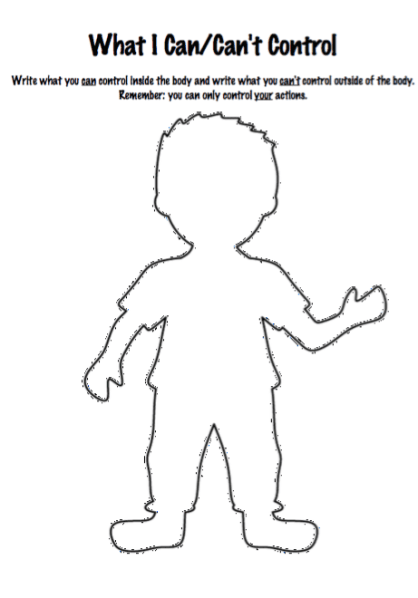
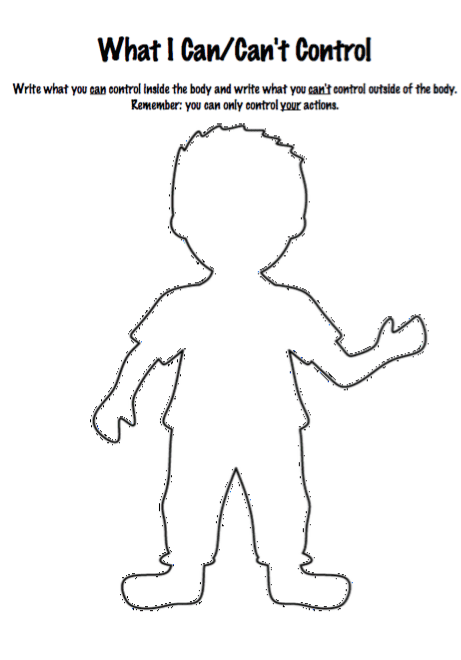
What I Can/Can’t Control Worksheet

It is extremely common to hear children “blame” others for their behavior.  I’ve worked with kiddos who instantly argue with “but he did it first” when they are corrected for misbehavior.  They might be right… maybe a peer did initiate, but that doesn’t mean the child has to do the same (or retaliate).  It can take a lot of discussion to get a kiddo to acknowledge that they only have control of their own bodies and that they can choose to make good choices regardless of what others are doing around them.

The worksheet below is to help kiddos identify things that are within their control and things that are not within their control.  I typed “to help kiddos,” but guess what?  I’ve met my fair share of adults that would benefit from thinking about this as well!

What I Can/Can’t Control Worksheet (click here to print):

Screen Shot 2018-02-08 at 8.15.50 PM

Using a Diagnosis as a Crutch

It is incredibly easy to fall into the habit of making excuses for our children’s behavior (and our own)!  My daughter is only 11 months old and I already find myself doing it. I’ve said, “she’s teething, so she’s a little grumpy,” when she’s whiny at the grocery store.  I’ve said, “she didn’t sleep well last night,” when she has a cry-fest in the church nursery.  When we look at the root of it, I think parents make excuses because they don’t want to be judged for having a not-perfect child.  But guess what?  Nobody is perfect, especially children!

I can’t speak from experience, but I would think that this pressure is increased exponentially if you have a child who has a mental health diagnosis (think Autism Spectrum Disorder, ADHD, Oppositional Defiant Disorder, etc).  These are some of the children who are most likely to “act up,” leaving their parents with ample opportunity to feel judged by others.  So I’m sure it’s easy to throw out “he has Autism” or “she has ADHD” to justify a kiddo’s behavior.  Sometimes, that might be appropriate, so I’m not saying that you shouldn’t ever make excuses for your child.  However, I think it’s a slippery slope and consistently excusing behavior could turn into both parents and their children using a diagnosis as a crutch.


Yes, your child’s diagnosis might (depending on what it is) make it more difficult (and sometimes near impossible) for them to do certain things.  I’m not talking about holding a child with ADHD to the exact same standards as every other child in the classroom.  A child with ADHD will have more difficulty staying focused on a task and controlling impulses.  But that doesn’t mean they can’t meet certain expectations.  When you consistently use their diagnosis as an excuse, a few things can happen over time:

  • You might throw all expectations of reasonable behavior out the window and just let your child get away with everything.  This will likely create havoc in your home, the child’s classroom, and possibly your marriage/relationship.  Here’s the thing: I don’t think anyone just wakes up one morning and says to themselves, “I’m just going to have zero expectations and let my child do what they want.”  It happens slowly over time, but (again) it’s a slippery slope when you start excusing behaviors because of a mental health diagnosis.
  • Your child might pick up on what you’re doing and start using their diagnosis as an excuse to justify their own behavior.  They may start to think that they can get away with everything because they can blame it on their mental health.

I have a sister with a mental health diagnosis (well, actually, it’s more like 3 or 4 diagnoses) and she uses these diagnoses as a crutch.  It is incredibly frustrating because she uses her mental health as an excuse for many terrible behaviors, like being rude and disrespectful to family members.  Don’t get me wrong, I know that her diagnoses make it more difficult for her to regulate her emotions and more difficult for her to control her impulses, but at this point, it seems as if she has stopped trying and just blames everything on her mental health issues.

I have talked to numerous parents who let their child get away with negative behavior because of a diagnosis they have received.  With my own sister, I’ve seen how difficult it can be to determine where to draw the line… what is she capable of doing and what is she not capable of doing?  Even though it’s hard to know what the limit is, the worst thing would be to just stop trying and use her diagnoses as a crutch.  Sometimes it takes a little bit of trial and error to figure out what the expectations should be.  Sometimes you might need help from an unbiased party (teacher, school psychologist, therapist, pediatrician, etc.) to find out where to draw that line.  Sometimes the process of that trial and error can be incredibly frustrating.  But it’s necessary.  And it’s worth it.

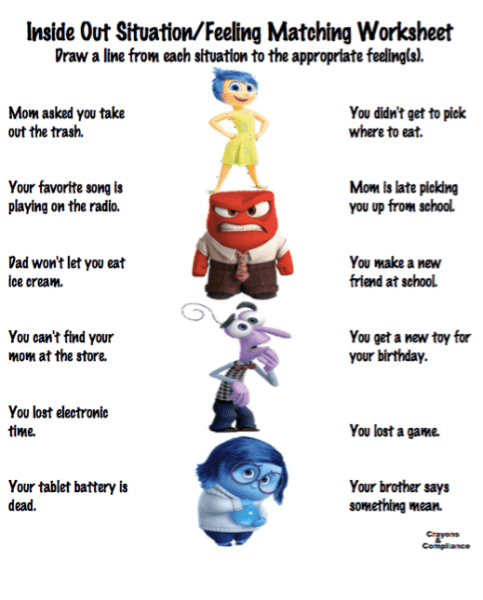
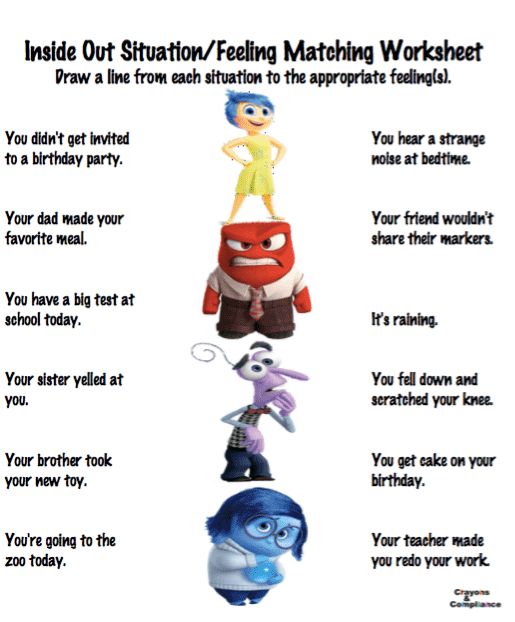
Inside Out Situation/Feeling Matching Worksheets

I know I’ve said it before, but Inside Out is such a great tool for teaching and practicing feelings identification with kiddos.  It’s a great way to get some serious learning done, but the movie characters are fun and make it more bearable for children.  Feelings identification can seem really simple to adults, but lots of children need help in order to be successful identifying how they feel.  Ultimately, the goal is to get them to then be able to regulate those emotions, but we have to start with being able to identify them first.

Below you can find two different worksheets which allow children to match situations to the appropriate feeling(s) that someone would feel in that situation.    Each worksheet has 12 different scenarios.  Some may trigger a few different feelings in children.  For example, there are a few situations which may make a child feel both sad and mad.  Additionally, one child might identify a feeling different from another.  For example, one child might be happy that it’s raining (maybe a kiddo who likes to jump in mud puddles) while another might feel sad that it’s raining.

I encourage any caregivers using these worksheets to be open-minded when going over this with a child.  If a child identifies a feeling that doesn’t seem to make sense to you at first, let them talk about it instead of immediately telling them they’re wrong.  Sometimes I’ve been surprised by a child’s perspective of a situation.  The different situations provide plenty of prompts to talk about feelings.  If a child doesn’t seem to be grasping a situation, it can also be helpful to role-play it and have them try to identify a feeling during the role-play.

Inside Out Matching Worksheet 1 (click link to print):

Screen Shot 2018-02-05 at 8.11.11 PM

Inside Out Matching Worksheet 2 (click link to print):

Screen Shot 2018-02-05 at 8.11.19 PM