Tips for Making Negative Consequences More Effective

Just like praise (see my blog post Tips for Making Praise More Effective), there are some things to consider when deciding on a consequence.  Consequences can be both positive (rewards) and negative (read more on that here).  Some of the tips below are relevant for both positive and negative consequences, but this blog post will focus on tips for making negative consequences more effective.  Components to consider include:

Immediacy: the consequence will be more effective if it immediately follows the behavior.

Limit verbals: this is where a lot of parents go wrong.  It can be easy to fall into the habit of “lecturing” and re-hashing the behavior with your kiddo.  However, this can actually be reinforcing, as you’re giving the child lots of attention and one-on-one time during those fun talks.  Therefore, it is typically recommended that you limit verbal interaction – label the behavior and what you’d like your child to do differently, then let the consequence do the “talking.”

Neutral facial expression/voice: I’ve mentioned before that some children are reinforced by parental reactions… there are some kiddos who think it is hilarious when they can get other people worked up.  Therefore, try to use a neutral facial expression and neutral voice tone when giving a consequence.

Consistency: this one is SO important.  If you decide that a behavior is undesirable, then you have to do something about it every time your child chooses to act that way.  If they think they can get away with it sometimes, then they’re going to keep doing it.  This is why adults speed while driving.

Size: make sure that the size of the consequence fits what the negative behavior is.  Losing electronic privileges for a week might not be appropriate for forgetting one daily chore, but might be appropriate if your kiddo gets in a fight at school.

Follow through: Once you hand out a consequence, you must be able to follow through with it.  If you tell your child that they’ve lost television time, then let them watch television with you that night, that consequence means nothing.  Therefore, before you decide on a consequence, think about if it’s realistic and something you’re able to follow through on.


I have created the following handout for caregivers.  It might be beneficial to print it out and pin it up somewhere as a reminder.  A printable file can be found here.

Screen Shot 2017-12-20 at 12.42.56 PM

Disclaimer: I am a licensed mental health therapist, but I am not your therapist. The information in this article is for general informational purposes only. This article does not create a therapist-client relationship. If you need specific recommendations based on your individual circumstances, please consult with a mental health practitioner near you.

Crash Course on the Four Functions of Behavior

There is a purpose behind all behavior; sometimes the purpose is fairly obvious and other times it can be hard to tell why someone is behaving a certain way.  There are 4 general functions of behavior and they are Tangibles, Escape/Avoidance, Attention, and Sensory.  I have created a (very colorful!) informational handout that summarizes the four functions of behavior.  This can be very helpful for therapists, teachers, and parents.

Screen Shot 2017-12-18 at 4.36.13 PM

You can find the file to print here.

Tangibles is when someone exhibits behavior in order to get something. Escape is when someone exhibits behavior in order to get OUT of something. Attention is when someone exhibits behavior to get attention (NOTE: to many kids, negative attention is better than no attention, so they may act up to get the attention from getting into trouble). Lastly, Sensory is when someone exhibits a behavior because it helps them cope with an uncomfortable feeling.

Sometimes it’s easy to determine the function of behavior. Sometimes it’s not. For tips on how to identify the function of behavior, read the blog post Tips for Identifying what “Function” is Fueling Your Child’s Behavior. Remember that this can be tricky stuff, and seek the help of a professional if you need it!

Disclaimer: I am a licensed mental health therapist, but I am not your therapist. The information in this article is for general informational purposes only. This article does not create a therapist-client relationship. If you need specific recommendations based on your individual circumstances, please consult with a mental health practitioner near you.
Tips for Making Praise Effective

There are some things you can keep in mind to make the most out of when you praise your children.  Praise is great and even a simple “good job” goes a long way, but read on to learn about some useful tips to make praise as effective as possible.

  • Immediacy – praise your child for their behavior as soon as you can!  If you wait until later in the day to praise them for something they did that morning, praise won’t be as effective.  One reason is your child, depending on age, may not even remember what they did that morning!
  • Consistency – to see the quickest and biggest changes, you must try to be consistent in praising your child.  If you’re working on improving your child’s listening, then praising them each time they listen the first time they’re told to do something will be more effective than just praising every once in a while.
  • Specific – label the behavior your kiddo did that made you want to praise them.  Instead of “good job,” say, “great job listening when I told you to _____.”
  • Size – make your praise BIG if your child did well on something they really struggle with.  Your praise probably won’t be so big on a behavior that your child normally does well at.
  • Contrast – make sure your child knows you’re pleased/proud/happy by using a positive voice tone and happy facial expressions.
  • Rationales – using rationales can be effective with older children.  Let them know why it’s so important or meaningful that they did whatever you’re praising them for.  For example, “thank you for listening to me the first time; when you listen right away you can get back to playing faster!”
  • Frequency – you want to be as frequent as possible with your praise, especially if you have a kiddo who is struggling in multiple areas.  The *ideal* ratio is 4:1 – four praise statements for every correction.  However, that can feel like an impossible goal sometimes, so just do the best you can.

I have created a fun handout that can be printed and put up somewhere to help parents, grandparents, teachers, etc. remember the components of praise.  You can find the printable version here.

Screen Shot 2017-12-19 at 10.24.40 AM

How to Make and Use a Chore Jar and Reward Jar

Sometimes it can be difficult to think of rewards and consequences when it’s time to use them. And sometimes using the same consequence or same reward can get really old… for you and your child.

Chore/Reward Jars fix this by letting you think of chores and rewards in advance, then letting/making your child pick one when it’s time. BONUS: they are super easy to make! Just follow these steps:

  1. Get two mason jars and a handful of popsicle sticks
  2. Use a permanent marker to write down your chores and rewards – one per popsicle stick.
  3. Place the chore sticks in one jar and the reward sticks in another.
  4. Wait until your kiddo earns a reward or consequence.
  5. When the time comes, tell your child to either pull out a chore stick (for negative behavior) or reward stick (for positive behavior).
  6. Follow through (or have your child follow through) with whatever is on the stick.

You can make these super fancy if you want… I’ve seen color-coded ones that are different levels of chores/rewards. And I’ve seen some decorated jars from some really creative parents. You can also use something other than jars and popsicle sticks. For example, you could use disposable cups and slips of paper. Or a bowl and pieces of paper.

A few things to keep in mind:

  • Be realistic with the chores – a chore that you have to help your child with might actually be reinforcing because your child gets one-on-one time with you. So include only chores your child can do on their own (or that they can attempt and you can “fix” it afterwards).
  • Ask your kid for input on (reasonable) rewards – you want to make sure they’re excited about picking something from the reward jar. They can even help you “make” the jars!
  • Explain the chore/reward jars to your kiddo so they aren’t confused the first time you use them.
  • Make sure the rewards are something you can follow through on, even if you’re in a hurry or if money is tight that week. The last thing you want is for your child to be excited about a reward then tell him/her that they have to pick a different one.
  • Add new chores/rewards to the jar occasionally so that there’s some variety.

Behavior is a Choice (and How Parents Can Use This Knowledge)

It may not feel like it, but every behavior is a choice. I went into our master bathroom today and, as usual, my husband has neglected to pick up the hangers from his clothes (and for some reason this drives me crazy). Before I sighed and rolled my eyes, I thought to myself… I can either get mad about it, or I can just do it myself and move on with my day. So I picked them up and moved on with my day.

Some behaviors don’t feel like choices. When I pay my mortgage, I don’t feel like I have a choice to do otherwise. But I do! I can choose to pay my mortgage, or I can choose not to and suffer the consequences of late fees, a hit on my credit, and potentially (eventually) foreclosure and homelessness. My husband may not feel like he has a choice about employment, but that’s only because to choose not to work would mean choosing to not be able to pay bills and provide for the family.

As adults, most of us are pretty good at using our well-developed brains to think through what the consequences of each of our behaviors are. I know that if I run a red light, I might get pulled over and get a ticket. I know that if I don’t do laundry, I won’t have clean clothes to wear. I know that if I eat a bunch of junk food I feel sluggish and my face breaks out.

Children’s brains aren’t as developed and they probably have a difficult time thinking about the consequences of their actions without a reminder or repetition. That’s why consistent consequences are so important. If you are consistent with putting your child in a timeout every time they hit their sibling, it won’t take long for them to catch on that hitting = timeout. Once you know that your child is aware of the consequences of a behavior, you know that they are making the choice to misbehave even though they know there will be a consequence. This, to me and many of the parents I’ve worked with, makes discipline a little easier. It makes you, as a parent, feel less like “the bad guy.” Your kiddo knew that they had a choice to make and chose something that would lead to consequences, so they take on that responsibility.

It’s also really helpful to frame it that way to a child by telling them the choice they made, followed by the consequence. Some examples:

  • “You chose not to eat your vegetables at dinner and the consequence is no bedtime snack.”
  • “You chose to argue when told it was time for bed, so now you won’t get a bedtime story.”
  • “You chose not to complete your worksheet at school, so now you won’t have any free time until it’s completed here at home.”
  • “You chose not to clean your room when I told you to, so now you owe me an extra chore after you clean your room.”

Speaking this way let’s your kiddo know that the consequence is a result of a behavior (choice) that they made, not because you’re a “mean” mom or dad. It can also be beneficial to remind your child of their choices and consequence if they are struggling to make the right choice. If you tell your child it’s time for bed and he begins arguing, reminding him that choosing to go to bed right away results in a bedtime story, while choosing to argue results in no bedtime story, you can help him make a better choice. Granted, he may choose to argue anyways, but at least you can be 100% sure that he knew what the consequence was before making his choice.

The ABCs of Parenting (for Stress Management)

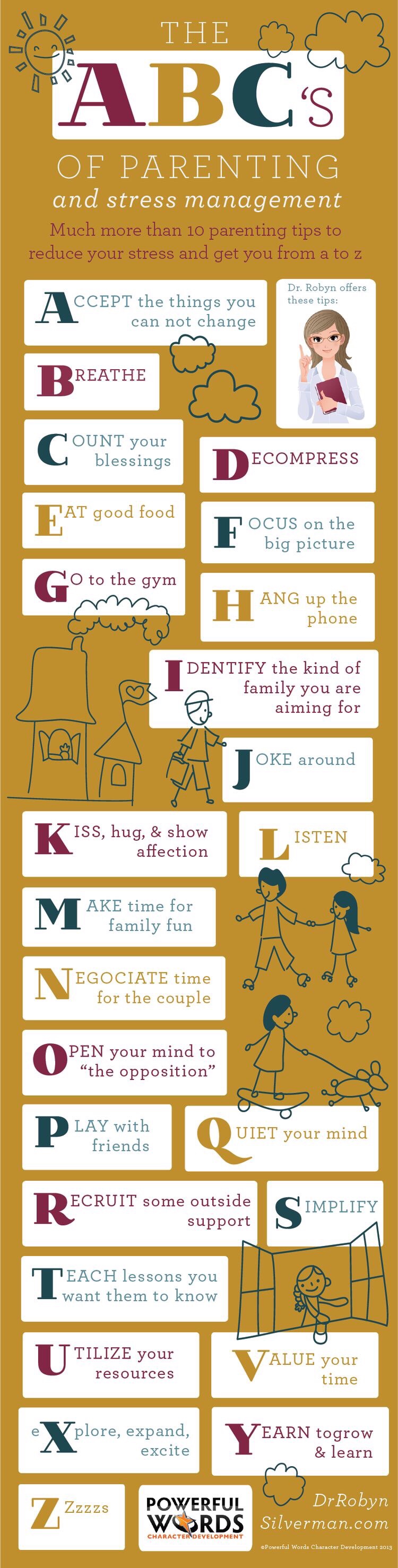
Parenting can be extremely stressful and it can be hard to stay on top of managing that stress! I found this while researching and was so impressed, I thought I’d share. There are a lot of great tips on here! “Accept the things you cannot change” and “Negotiate time for the couple” are ones that are difficult in my home. Pick one that you’d like to do more and go for it!

Get Grounded! A Strategy for Regulating Emotions

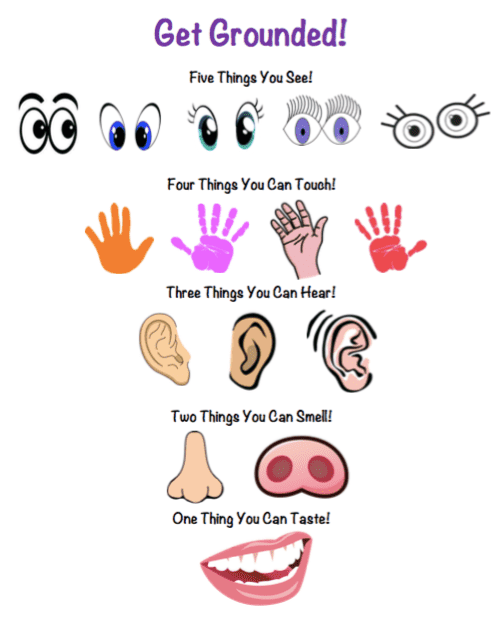
One grounding technique (to assist those dealing with overwhelming emotions) is to list 5 things you can see, 4 things you can feel/touch, 3 things you can hear, two things you can smell, and one thing you can taste.

I use this myself when I am trying to stay in control of my emotions and think it could be a great strategy for children.  To help kiddos remember to use the strategy and how to do it, I created a sign that can be printed (get the pdf here.)

Screen Shot 2017-12-05 at 11.37.22 AM

Super Simple Sticker Charts (They Don’t Have to Be Complicated!)

I’m all for fancy behavior charts and sticker charts, but they’re not absolutely necessary.  Your child might be content with a simple table and some fun stickers.  If you don’t want to mess with finding the perfect one or tweaking one that someone else made, it can be fairly easy to make your own.  I have two examples to share below.

Screen Shot 2017-12-04 at 7.45.16 PM

This first one would be an example of a sticker chart to work on bedtime routine – you have your days of the week running along the top and the tasks of the routine along the side.  The kiddo would get to put a sticker for each task on each day, so potentially a total of 4 stickers per day.


Screen Shot 2017-12-04 at 7.51.47 PM

This second one could be for any behavior and splits the day up into two different time frames.  So, for example, if you’re working on Following Directions, your kiddo would get to put a sticker in the “Before Lunch” on Monday square if they follow directions between waking up and lunchtime.

These are simple to make in Microsoft Word or Excel or by hand (I’d want a ruler because I’m a bit of a perfectionist).  They look boring to start, but most kids LOVE putting stickers on, so it won’t be long before that chart will be filled up with shiny (possibly glittery) stickers.